IndianSanskriti
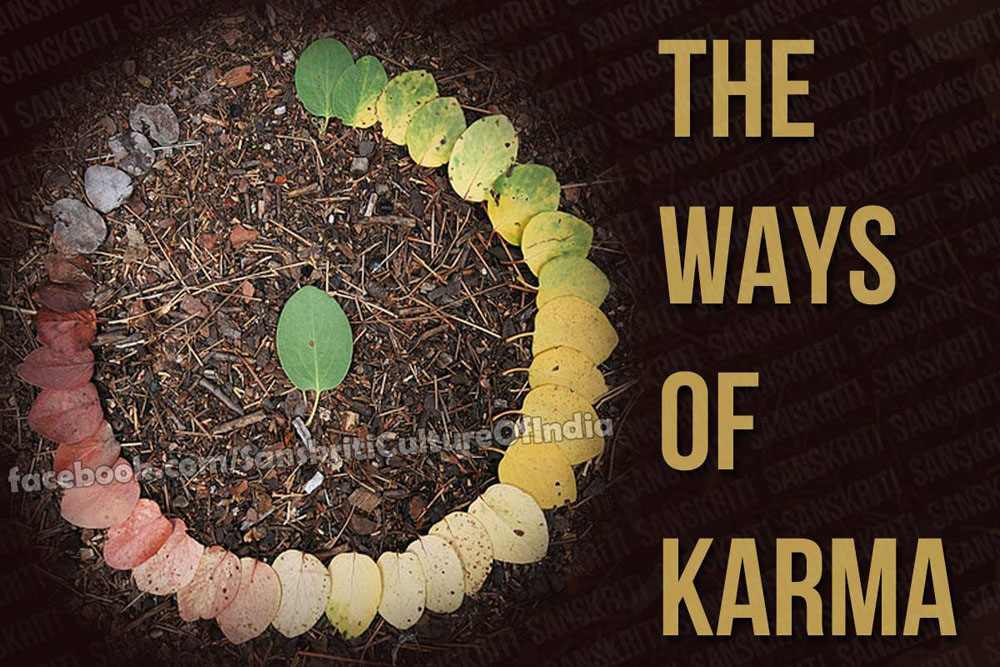
The Ways of Karma

The Ways of Karma

Every object in the universe is endowed with four characteristics: dharma, karma, prema and gyana. Of these, karma is the most talked about; it is also the most misunderstood. The Gita says: “Gahna Karmanyo Gathi” — Unfathomable are the ways of karma. There are three types of karma: praarabdha, sanchita and agami. The first is latent karma, an impression or seed of action. The second is karma as action, and the third is karma as result. praarabdha means ‘begun’; the action that is already manifesting and that is yielding its effect right now.

You cannot avoid it or change it, as it is already happening. Sanchita is accumulated karma. It is latent or manifested in the form of a tendency or impression in the mind. Sanchita karma can be burned off by spiritual practices before it manifests. Agami karma is the future karma of action; that which has not yet come and which will take effect in the future. If you commit a crime, you may not get caught today, but will live with the possibility that one day you may get caught. Karma is also always bound by time, because every action has a limited reaction.

If you do something good to people they will come to thank you and be grateful to you as long as they are experiencing the effect of your action. So, karma has only a limited sphere of its effect, be it good or badIt is often asked, “Why are good people made to suffer while those who commit injustice go unpunished?” Such questions arise when we see an event in its limited framework. No good action will yield a bad result and no bad action will bring a good result. This is the law of karma As you sow, so shall you reap.

If you sow a mango tree, some thorny bushes may come up because of the seeds present in the manure brought from somewhere else. It is not the mango seed that brings up the thorny bush. Your mango seed will bring mango fruit, in due course. Karma is that which propels reincarnation. The stronger the impression, the greater the possibility of the next life being according to that. So, often you reincarnate like the person you hate or love. The mind which is full of different impressions leaves this body but the impressions await suitable situations to come back.

So the last thought is very important. Whatever you do throughout your life, in the last moment your mind should be free and happy. Our perception of suffering, of good and bad, is always relative. God is absolute reality; a witness of all. See God as movie director, rather than as a judge. He has no ill feeling for the villain and no special favour for the hero. Each one is playing her role. An awareness of dharma helps in comprehending the strange ways of karma. Whenever you see bad karma or someone suffering, you need to help.

~ Sri Sri Ravi Shankar

You may also like

Search the website

Like us on Facebook

Get daily updates via Email

Enter your email address:

Recent Posts

Jamai Shashthi 2026 — The Story of Maa Shashthi, the Cat, and the Wife Who Was Forgiven

Jamai Shashthi 2026 — The Story of Maa Shashthi, the Cat, and the Wife Who Was Forgiven

On Saturday, June 20, 2026, Bengali households across Bharata will welcome their married daughters and sons-in-law home for the legendary jamai-aador feast and perform the Shashthi Vrata. But behind the warmth lies a story most Bengalis know by heart and most non-Bengalis have never heard — the wife who stole the hilsa, blamed the cat, lost six sons to Maa Shashthi’s wrath, and was finally forgiven. The Vrat Katha, the vidhi, the mantras, and the deeper teaching.

Vat Purnima 2026 — The Wife Who Argued Yama Into Returning Her Husband’s Life

On Monday, June 29, 2026, women across Maharashtra, Gujarat, and southern Bharata will tie red thread around banyan trees and hear the story of Savitri — the wife who walked behind Yamaraja Himself when He came for her husband, and out-argued the Lord of Dharma into returning Satyavan’s life. The Mahabharata’s Pativrata Mahatmya Parva, the vrat vidhi, and why the banyan witnessed everything.

Nija Jyeshtha 2026 — The Real Jyeshtha Begins, and the Calendar Resumes

Nija Jyeshtha 2026 — The Real Jyeshtha Begins, and the Calendar Resumes

With Adhik Maas now closed on the Somvati Amavasya of June 15, the long-postponed festivals of Jyeshtha return — Vat Purnima (June 29, the Savitri-Yamaraja katha), Jamai Shashthi (June 20, the Bengali festival of Maa Shashthi), Sankashti Chaturthi (June 28), Yogini Ekadashi (July 10), and Devshayani Ekadashi (July 16, opening the four-month Chaturmas of Bhagavan Vishnu’s yoga-nidra). A guide to what the next four weeks hold and what the household that kept Purushottam Maas now carries forward.

The Closing of Purushottam Maas 2026 — Adhik Amavasya and the Sealing of the Month-Long Vrat

On Monday, June 15, 2026 — a rare Somvati Amavasya — the intercalary month that bears Bhagavan Vishnu’s own name comes to its close. The Acharyas teach that a vrat is not measured by its duration but by its closing. Here are the Padma Purana’s instructions for sealing the month-long Purushottam Maas vrat: the morning snan, the closing puja with the Vishnu Sahasranama, the day of dana, the Somvati Amavasya gift, and the final sarva-arpana — the offering of all merit at the feet of the Lord.

Parama Ekadashi 2026 — The Other Rare Ekadashi of Purushottam Maas, and the Poor Brahmin Who Kept It

Two weeks ago, Vaishnavas across Bharata kept Padmini Ekadashi — the rare Shukla Paksha Ekadashi of Adhik Maas. Padmini has a twin. On Thursday, June 11, 2026, the Krishna Paksha Ekadashi of the same intercalary month appears: Parama — the Supreme Ekadashi. The Padma Purana names it the rarer and more secret of the two, and reserves it for those whose poverty or sorrow has refused to lift in spite of every other vrat already kept. The story of Sumedha and Pavitra of Kampilya, the rishi Kaundinya, the prince sent by Bhagavan Brahma — and the vidhi for the day.

css.php