IndianSanskriti
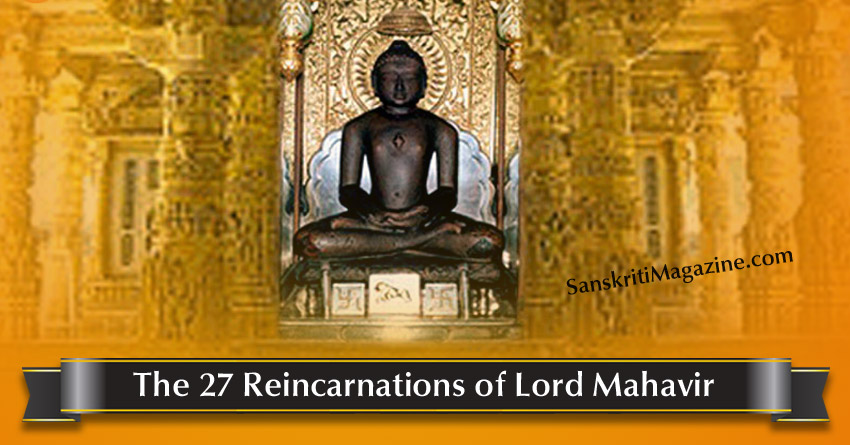
The 27 reincarnations of Lord Mahavir

The 27 reincarnations of Lord Mahavir

Lord Mahavir was the twenty-fourth and the last Tirthankara of the Jain religion.

Born on the thirteenth day of rising moon of Chaitra month, in 599 B.C. in the present state of Bihar, India near the modern city of Patna, Lord Mahavira’s mother’s name was Queen Trishla and his father’s name was King Siddhartha. Both his parents were followers of Lord Parshwanath, the 23rd Tirthankara, who lived during 877-777 BCE.

It is said that a soul attains liberation after countable births after it attains samyak darshana (Right View). Jainism declares the hallmark of a person who has the right vision are, spiritual calmness (Prasanna), desire for liberation from the endless birth-life-death cycles (Samvega),without any attachment or aversion to anything (Nirveda), kindness (Anukampa), and belief in these fundamental principles (Astikya).

After attaining Right View, the soul attains liberation after few births either by becoming a Tirthankar or by becoming ordinary Arihant.

If we glance in Lord Mahavir’s previous births then we would know that the soul of Lord Mahavir attained Right View in his birth as Nayasar. Before being born as Nayasar, the soul had transmigrated through infinite births but after attaining Right View in Nayasar’s birth the soul that became Lord Mahavir attained Liberation after 26 more births. So there were total 27 births along with Nayasar’s birth.

Below is the list describing Lord Mahavir’s 27 births:

  1. Nayasara: A village headman who secured samyaktvaor partial enlightenment in this birth on account of preaching of true dharma by Jain monks
  2. Birth in the 1st Celestial World (Heaven) called Saudharma
  3. Prince Marichi: Grandson of Rsabha, the first Tirthankara and Son of King Bharata
  4. Birth in the 5th Celestial World called Brahmloka
  5. Kaushika: A Brahmin
  6. Pushyamitra: A Brahmin
  7. Birth in the 1st Celestial World called Saudharma
  8. Agnidyota: A Brahmin
  9. Birth in the 2nd Celestial World called Ishaan
  10. Agnibhuti: A Brahmin
  11. Birth in the 3rd Celestial World called Sanatkumar
  12. Bharadwaja: A Brahmin
  13. Birth in the 4th Celestial World called Mahendra
  14. Sthavira: A Brahmin
  15. Birth in the 5th Celestial World called Brahmloka
  16. Prince Vishvabhuti
  17. Birth in the 7th Celestial World called Mahashukra
  18. Triprishtha Vasudeva – First Vasudeva of this half-time-cycle
  19. Birth in the 7th Hell called Mahatamaha Prabha (pitch dark hued)
  20. A lion
  21. Birth in the 4th Hell called Panka Prabha (Mud Hued)
  22. A human being (Name unknown)
  23. Priyamitra: A Chakvartin (The universal ruler of seven continents)
  24. Birth in the 7th Celestial World called Mahashukra
  25. Prince Nandana: Accepted the vow of self control and gained Tirthankara nama karma
  26. Birth in the 10th Celestial World called Pranat
  27. Birth as Tirthankar Lord Mahavir, the final birth

Between births 5th as Kaushika Brahmin and 6th as Pushyamitra Brahmin, the soul transmigrated through countless births as insects, animals, plants, birds etc. Those births are not counted in Lord Mahavir’s 27 births.

Again after the 21st birth as a hellish being in the fourth hell the soul had taken countless births as insects, animals, plants, birds etc and those births are not counted.

~ Rahul Zota

You may also like

Search the website

Like us on Facebook

Get daily updates via Email

Enter your email address:

Recent Posts

Yogini Ekadashi 2026 — The Yaksha Who Missed the Morning Flowers, and the Ekadashi That Undid His Curse

On Friday, July 10, 2026, the rare Krishna Paksha Ekadashi of Nija Ashadha arrives. The Padma Purana tells the story of Hemamali — the Yaksha gardener of Bhagavan Kubera in Alaka, whose single morning of distraction with his wife Vishalakshi cost him his form, his wife, and his celestial city. Cursed to wander the earth of Bharata as a leper for a long time, he was at last shown the way back by Sage Markandeya — a single sincere keeping of Yogini Ekadashi.

Jamai Shashthi 2026 — The Story of Maa Shashthi, the Cat, and the Wife Who Was Forgiven

Jamai Shashthi 2026 — The Story of Maa Shashthi, the Cat, and the Wife Who Was Forgiven

On Saturday, June 20, 2026, Bengali households across Bharata will welcome their married daughters and sons-in-law home for the legendary jamai-aador feast and perform the Shashthi Vrata. But behind the warmth lies a story most Bengalis know by heart and most non-Bengalis have never heard — the wife who stole the hilsa, blamed the cat, lost six sons to Maa Shashthi’s wrath, and was finally forgiven. The Vrat Katha, the vidhi, the mantras, and the deeper teaching.

Vat Purnima 2026 — The Wife Who Argued Yama Into Returning Her Husband’s Life

On Monday, June 29, 2026, women across Maharashtra, Gujarat, and southern Bharata will tie red thread around banyan trees and hear the story of Savitri — the wife who walked behind Yamaraja Himself when He came for her husband, and out-argued the Lord of Dharma into returning Satyavan’s life. The Mahabharata’s Pativrata Mahatmya Parva, the vrat vidhi, and why the banyan witnessed everything.

Nija Jyeshtha 2026 — The Real Jyeshtha Begins, and the Calendar Resumes

Nija Jyeshtha 2026 — The Real Jyeshtha Begins, and the Calendar Resumes

With Adhik Maas now closed on the Somvati Amavasya of June 15, the long-postponed festivals of Jyeshtha return — Vat Purnima (June 29, the Savitri-Yamaraja katha), Jamai Shashthi (June 20, the Bengali festival of Maa Shashthi), Sankashti Chaturthi (June 28), Yogini Ekadashi (July 10), and Devshayani Ekadashi (July 16, opening the four-month Chaturmas of Bhagavan Vishnu’s yoga-nidra). A guide to what the next four weeks hold and what the household that kept Purushottam Maas now carries forward.

The Closing of Purushottam Maas 2026 — Adhik Amavasya and the Sealing of the Month-Long Vrat

On Monday, June 15, 2026 — a rare Somvati Amavasya — the intercalary month that bears Bhagavan Vishnu’s own name comes to its close. The Acharyas teach that a vrat is not measured by its duration but by its closing. Here are the Padma Purana’s instructions for sealing the month-long Purushottam Maas vrat: the morning snan, the closing puja with the Vishnu Sahasranama, the day of dana, the Somvati Amavasya gift, and the final sarva-arpana — the offering of all merit at the feet of the Lord.

css.php