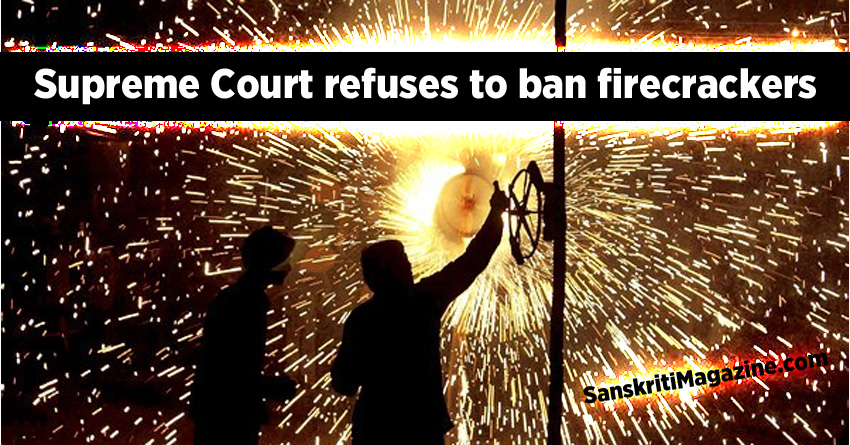
The Supreme Court on Wednesday refused to expand the eight-hour night-time ban period on bursting of crackers and voiced unhappiness over government’s failure to run a campaign to create public awareness during Diwali time on the ill-effects of fireworks.
Refusing to modify its direction in 2001 banning bursting of crackers between 2200 hours and 0600 hours, a Bench comprising Chief Justice H.L. Dattu and Justice Arun Mishra asked the Centre to “give wide publicity both in print and electronic media to the ill-effects of fireworks” almost on daily basis from October 31 to November 12.
“If anyone wants to burst crackers outside his house, then we cannot say no. It will be dangerous to do so and people will say it is their right,” the Bench said.
Declining to pass an interim order at the initial stage, the Bench said, “We cannot say so unless we have a regular hearing … at this moment, we cannot say that all persons should go to a ‘maidan’ for bursting crackers.”
Senior Advocate A.M. Singhvi, appearing for the minor boys who have approached the court against exploding of loud fire crackers, however, sought tweaking of the 2001 direction and said that there must be a restriction window limiting the cracker bursting time between 7 pm and 9 pm and regulation of licences to check hazardous fireworks.
“It is already there in the (2001) judgment,” the Bench said. The apex court had banned bursting of crackers between 2200 and 0600 hours.
Singhvi, however, was arguing that the 2001 direction related to noise pollution only and can be modified to bring down air pollution.
During the hearing, the Bench expressed unhappiness over the non-publication of government advertisements on creating anti-cracker awareness among the people.
“You should have done it on October 16 itself. It should be published continuously. This is not done,” the Bench said during the hearing on the issue
.
Solicitor General Ranjit Kumar assured the court that advertisements will be given in print and electronic media from October 31 to November 12 in pursuance of the direction.
The Bench asked the Delhi government and Central Pollution Control Board (CPCB) to file their response and said the matter will be heard for final disposal.
Earlier, the court had directed the Centre and state governments to educate people about the ill-effects of crackers and advise them not to use fireworks.
The Union Government has told the court that it has already taken effective steps to give wide publicity to the ill-effects of fireworks.
The court was hearing a petition, filed by the fathers on behalf of three infants aged between six and 14 months, who had stressed on their right to be brought up in a pollution-free environment and pleaded that government agencies be restrained from issuing license for sale of crackers in the National Capital.
The plea had said the widespread use of firecrackers in Delhi during the festive season exposed vulnerable infants to severe diseases such as asthma and worsens lung condition.
“They are foremost prone to lung disease, asthma, coughing, bronchitis, retarded nervous system development and cognitive impairment,” the infant petitioners had submitted.
Besides the Centre and Delhi government, the Bench had also issued notices to CPCB and Delhi Pollution Control Board (DPCB).
The plea has cited a study in Bangalore that showed how a widespread awareness campaign and enforcement mechanisms led to a sharp 32 per cent decrease in pollution levels there during Diwali time in 2013 compared to a year ago.
The petition said that a 2005 top court ruling restricting the use of fireworks beyond 10 pm had brought some respite to Delhiites but studies thereafter revealed that cases of wheezing, respiratory diseases, exacerbation of bronchial asthma and bronchitis increase by 40 per cent during Diwali.