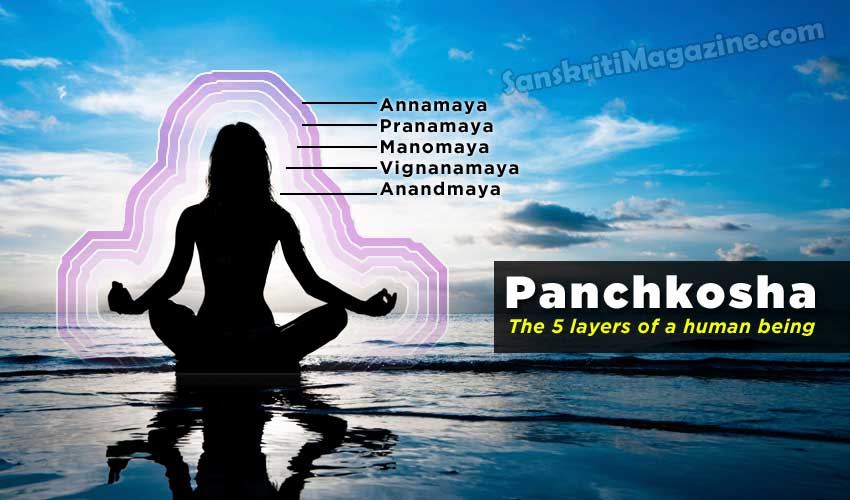
A human being is part consciousness (Atma – soul) wrapped in 5 layers known as Panchkosha in Vedanta.
The layers are Physical Body (Annmaya Kosha), Energy Body (Pranamaya Kosha), Mind Body (Manomaya Kosha), Intuition Body (Vigyanmaya Kosha), and Joy Body (Anandmaya Kosha).
Anandmaya Kosha is part consciousness (Atma) carrying the core desire with a purpose to manifest and experience joy. This innermost core body of one’s being has a pure part of Universal Consciousness (Parma Atma) experienced as eternal joy or bliss. Other functions of this Kosha (body) are co-creation like the Creator himself, peak experiences of super consciousness and sexual ecstasy (beyond normal sexual pleasures).
Vigyanmaya Kosha is the second innermost layer which is responsible for all the new knowledge and intuitive functioning of human beings. The other functions of Vigyanamaya Kosha are ordinary awareness for day to day intuitive working, which facilitates you in deciding what to do next and how to do it. Only from this Kosha do you get intuitive solutions in intense situations when the logical mind is not able to answer your questions. The natural function of healing inside the human body is also governed by this Kosha.
Manomaya Kosha is the domain of functions of the human mind. This is the central layer among the 5 Kosha. The function of this Kosha is primarily to receive information through 5 senses and process that information for manifestation of core purpose. Manomaya Kosha has 3 layers as recognized by contemporary psychology. They are conscious mind, sub-conscious and super conscious state of mind. In Medical Science these states are studied in brain wave theory and known as Beta, Alpha, Theta and Delta states of brain activity. Through Yogic or Tantric meditations, awareness is expanded to Alpha, Theta and Delta brain wave patterns, where an ordinary human being falls asleep, that’s when Alpha waves are activated in the brain.
In an experiment EEG tests (Electro Encephalogram – an instrument used to record brain waves) were done while meditators were in meditative state. These EEG actually showed Alpha to Delta brain wave patterns even while those meditators were in fully aware state.
The conscious state of mind is responsible for perception through the 5 sense organs and then taking action via the physical body to perform day to day functions.
The sub-conscious mind receives information from the conscious mind and stores the complete information. In acute cases of emergency or through regular meditative practices the sub-conscious mind receives knowledge from Vigayanamaya Kosha which is called sixth sense or intuition. The deeper sub-conscious or super conscious state of mind is when a person is aware at Theta and Delta brain waves. In this state of mind person gives instant healing or give some innovative outputs.
The Pranamaya Kosha is energy body depicted by Kundalini, sun and moon channels and 7 Chakras along the spinal column. Each one of the 7 Chakras is responsible for controlling different organs in the human body at conscious and sub-conscious levels of mind. When awareness is extended to the super conscious state then these Chakras open up to perceive the new realities of universe and start illuminating by healing all the body functions. In Yogic literature the level of illumination and opening of these Chakras is the basis for measuring the evolution of an individual’s mind and soul.
Annmaya Kosha is the outer most and physical form of a human being- that is the human body. The Annmaya Kosha is made up of 5 elements (Air, Fire, Earth, Space and Water). It is nurtured and sustained by food (Ann), that’s why this is called Annmaya Kosha. In Ayurveda disease is recognised as imbalance of tridosha – Vata (Air + Space), Pitta (Fire) and Kapha (Water + Earth)]. Through physical body the part consciousness (Atma) manifests the core desire to experience the absolute joy. But due to the conditioning of social and academic environments a person gets programmed at the different levels of different Koshas. Thus making him experience pain and miseries. To manifest one’s purpose on this planet, human beings create the structures in the form of buildings to perform certain functions. And these structures become the living or working environment for human beings.
In the Hindu Alchemy of Space, pain, misery and blockages of mind are due to the deviation from the core desire of one’s Anadamaya Kosha or soul. The living environments are either supportive to Manomaya Kosha and Pranmaya Kosha or the living environment also becomes responsible for negative conditioning and programming and thus, cause problems in one’s life. The points of blockages are recognized at the different layers of existence thus creating a way for human consciousness to manifest its core purpose.