The MSRVVP, according to its website, was established in January 1987 for the preservation, conservation and development of Vedic Studies by establishing and supporting Ved Pathshalas.
An affiliate of the Rashtriya Swayamsevak Sangh (RSS) wants the union government to designate Maharshi Sandipani Rashtriya Ved Vidya Pratishthan (MSRVVP), an autonomous body under the Union ministry of human resource development (HRD), as the nodal agency that can work out the way to offer equivalence for those wanting to join the formal education stream from the gurukul system, which is an informal, unrecognised arrangement.
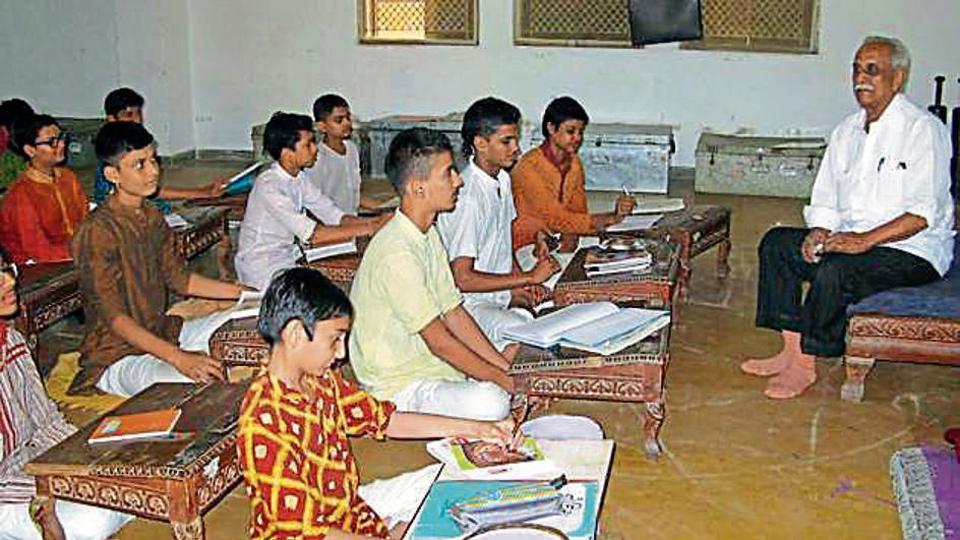
The Bharatiya Shikshan Mandal (BSM), an RSS offshoot that works in the education sector said that while there should be no government interference in the gurukul system, there is a need to streamline the registration of the over 5,000 gurukuls in the country. Mukul Kanitkar, the national joint organising secretary of the BSM, which is bringing together gurukuls from India and abroad at conference in Ujjain later this month to share best practices in the informal teaching system, said the Pratishathan in Ujjain can evaluate the gurukuls.
“There is need to have a system for equivalence, which allows students from gurukul to migrate to formal schooling if they want to,” he said.
The MSRVVP, according to its website, was established in January 1987 for the preservation, conservation and development of Vedic Studies by establishing and supporting Ved Pathshalas.
The objectives of the Pratishthan include fostering the oral tradition of intonation and recitation of Vedas, providing research facilities to students with a background in Vedic knowledge and to establish, takeover, manage or supervise Vedic Pathashalas and research centres.
Currently, gurukuls in the country are not regulated by any board or government body.
Kanitkar said this is how it should be, because trying to impose any standardisation or uniformity in curriculum would rob gurukuls of their individual pedagogy. “Each gurukul has its own way of imparting knowledge. There is need to draw up a list of gurukuls that operate across the country so that people can make an informed choice. As per our assessment, there are nearly 5,000 gurukuls, some of which are operated from private residences …” he said.
At the upcoming conference, being organised with support from MSRVVP and the government of Madhya Pradesh from April 28-30 in Ujjain, representatives from over a 1,000 Gurukuls in India, 250 from Nepal and a few from Bhutan, Trinidad and Tobago, Mauritius, Malaysia and Sri Lanka will be present.
According to Kanitkar, BSM has already organised similar conferences in Nepal and Bhutan. RSS chief Mohan Bhagwat will inaugurate the conference, and HRD minister Prakash Javadekar is also expected to speak.
Shriram Adhikari, who heads a Gurukul in Nepal and is attending the conference said, Gurukuls in the country have included “sciences and other modern subjects” to the curriculum that includes traditional forms of learning including Yoga and astrology.