IndianSanskriti
Rare 1000-year-old Hindu Vishnu temple excavated in Dinajpur with Unique 'Nava-Ratha' architecture

Rare 1000-year-old Hindu Vishnu temple excavated in Dinajpur with Unique ‘Nava-Ratha’ architecture

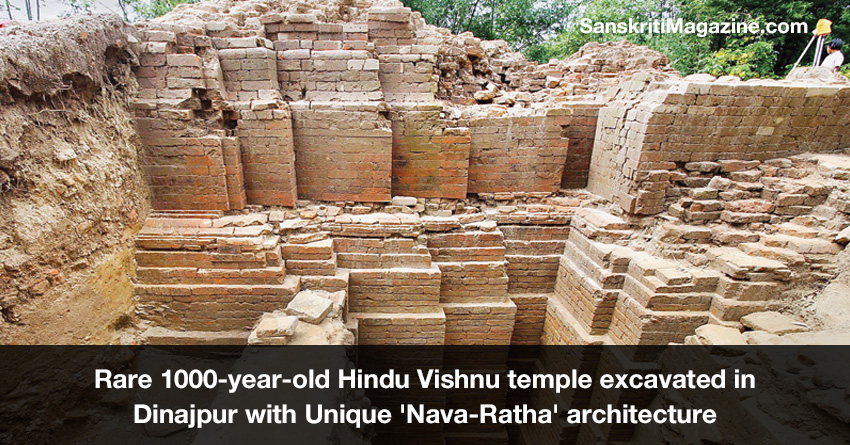
A group of archaeologists has recently unearthed a rare Vishnu temple with a unique ‘nava-ratha’ architecture at Madhabgaon village in Kaharol upazila of the northern district of Dinajpur.

Archaeologists from Jahangirnagar University’s department of archaeology in Savar, Dhaka, including its director Prof. Swadhin Sen, Prof. Syed Mohammed Kamrul Ahsan, Prof. Seema Hoque and Sabekunnaher Sithi started an excavation at the site in April this year. They received financial assistance from the cultural affairs ministry and the Higher Education Quality Enhancement Project (HEQEP) of the University Grants Commission (UGC). They also received the support of the department of archaeology.

The 52-member excavation team included four teachers, 13 students and 13 experienced workers from Mahasthan.

They found a seven-metre-high brick-built structure and a 144-sq-metre solidly built platform, with a 4.48-metre square cell at the centre. The cell represents the ‘garbhagriha’ (sanctum) where the idol was worshipped. The external surface of the platform has ‘ratha’ or vertical offset projections at the west, north and south. There are nine ‘rathas’. That is why the temple is known as a ‘nava-ratha’ temple, according to ‘Early Temple Architecture’.

“The temple is about 1,000 years old. It was constructed in the 10th to 11th centuries. No temple of the ‘nava-ratha’ type has been discovered in Bangladesh till now,” said Prof. Swadhin Sen.

He also said radiocarbon dating of the collected samples would shed light on the precise date of the temple.

“The superstructure of the sanctum is characterised by a ‘shikhara’ or ‘rekha deul’ (curvilinear tower). Among the very few existing brick-built standing temples with ‘shikhara’ in undivided Bengal, the Siddheshwar Temple at Bahulara of Bankura in West Bengal has the closest resemblance,” said Prof. Dipak Ranjan Das, a former professor of the University of Calcutta and an expert on early eastern Indian temple architecture.

The same team had discovered a Hindu temple with ‘pancha-ratha’ variety in Nawabganj upazila of Dinajpur in 2007. The four-pillared ‘mandapa’ was possibly capped with a ‘shikhara’ and is known as a ‘pida deul’ (tiered roof) variety.

The team found more artefacts, including a decorated stone image, a good number of broken fragments of stone sculptures, along with pottery, decorated bricks and stone pieces during the ongoing archaeological excavations at the site. The sculptural fragments represent various iconographic attributes of Vishnu, the Hindu deity.

Prof. Syed Mohammad Kamrul Ahsan said this temple was a very good addition to their research in the northern part of Bangladesh over the past 15 years. He added that their team has already excavated nine sites in this region and documented more than 1,000 archaeological sites in the Dinajpur-Joypurhat region. More than 800 among them could be dated to the early medieval period.

The history of river systems and landscapes was crucial for the development of settlements, which had religious edifices at the core. The excavation accompanied by archaeological studies will continue for the next couple of months.
You may also like

Search the website

Like us on Facebook

Get daily updates via Email

Enter your email address:

Recent Posts

Yogini Ekadashi 2026 — The Yaksha Who Missed the Morning Flowers, and the Ekadashi That Undid His Curse

On Friday, July 10, 2026, the rare Krishna Paksha Ekadashi of Nija Ashadha arrives. The Padma Purana tells the story of Hemamali — the Yaksha gardener of Bhagavan Kubera in Alaka, whose single morning of distraction with his wife Vishalakshi cost him his form, his wife, and his celestial city. Cursed to wander the earth of Bharata as a leper for a long time, he was at last shown the way back by Sage Markandeya — a single sincere keeping of Yogini Ekadashi.

Jamai Shashthi 2026 — The Story of Maa Shashthi, the Cat, and the Wife Who Was Forgiven

Jamai Shashthi 2026 — The Story of Maa Shashthi, the Cat, and the Wife Who Was Forgiven

On Saturday, June 20, 2026, Bengali households across Bharata will welcome their married daughters and sons-in-law home for the legendary jamai-aador feast and perform the Shashthi Vrata. But behind the warmth lies a story most Bengalis know by heart and most non-Bengalis have never heard — the wife who stole the hilsa, blamed the cat, lost six sons to Maa Shashthi’s wrath, and was finally forgiven. The Vrat Katha, the vidhi, the mantras, and the deeper teaching.

Vat Purnima 2026 — The Wife Who Argued Yama Into Returning Her Husband’s Life

On Monday, June 29, 2026, women across Maharashtra, Gujarat, and southern Bharata will tie red thread around banyan trees and hear the story of Savitri — the wife who walked behind Yamaraja Himself when He came for her husband, and out-argued the Lord of Dharma into returning Satyavan’s life. The Mahabharata’s Pativrata Mahatmya Parva, the vrat vidhi, and why the banyan witnessed everything.

Nija Jyeshtha 2026 — The Real Jyeshtha Begins, and the Calendar Resumes

Nija Jyeshtha 2026 — The Real Jyeshtha Begins, and the Calendar Resumes

With Adhik Maas now closed on the Somvati Amavasya of June 15, the long-postponed festivals of Jyeshtha return — Vat Purnima (June 29, the Savitri-Yamaraja katha), Jamai Shashthi (June 20, the Bengali festival of Maa Shashthi), Sankashti Chaturthi (June 28), Yogini Ekadashi (July 10), and Devshayani Ekadashi (July 16, opening the four-month Chaturmas of Bhagavan Vishnu’s yoga-nidra). A guide to what the next four weeks hold and what the household that kept Purushottam Maas now carries forward.

The Closing of Purushottam Maas 2026 — Adhik Amavasya and the Sealing of the Month-Long Vrat

On Monday, June 15, 2026 — a rare Somvati Amavasya — the intercalary month that bears Bhagavan Vishnu’s own name comes to its close. The Acharyas teach that a vrat is not measured by its duration but by its closing. Here are the Padma Purana’s instructions for sealing the month-long Purushottam Maas vrat: the morning snan, the closing puja with the Vishnu Sahasranama, the day of dana, the Somvati Amavasya gift, and the final sarva-arpana — the offering of all merit at the feet of the Lord.

css.php