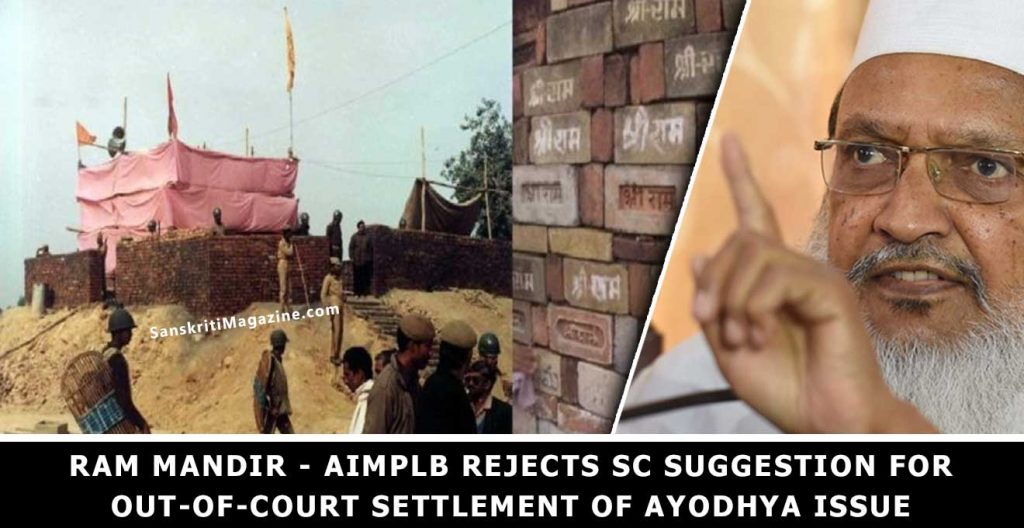
Lucknow: The All India Muslim Personal Law Board (AIMPLB) on Sunday rejected the Supreme Court’s suggestion for an out-of-court settlement of the Ram Janmabhoomi-Babri Masjid dispute and said that only a verdict by the apex court will be acceptable to it.
“No out-of-court settlement is acceptable to us,” AIMPLB General Secretary Maulana Wali Rehmani told reporters after a two-day meeting of the board executive.
A resolution passed by the board executive also said that “on the Babri Masjid issue, the board would only accept a decision by the Supreme Court”, making it clear that the AIMPLB is not willing to accept the Supreme Court’s suggestion.
On March 21, the apex court had suggested an out-of-court settlement of the dispute at Ayodhya, observing that issues of “religion and sentiments” can be best resolved through talks.
Chief Justice J S Khehar had even offered to mediate as a bench headed by him suggested that the parties to the dispute adopt a “give a bit and take a bit” approach for meaningful and sincere negotiations to resolve the issue.
The board also dug its heels on the contentious issue of triple talaq asserting that Muslims have the “constitutional” right to follow their personal law.
Rehmani said that the board has decided to issue a code of conduct and that those who give talaq (divorce) without ‘Sharia’ (Islamic law) reasons will face social boycott.
“A code of conduct for talaq is being issued. With its help, the real picture of Sharia directives will be brought out on the talaq issue. If talaq is given without Sharia reasons, those involved will be socially boycotted,” he said.
The board will issue appeals to maulanas and imams of mosques to read out the code of conduct during Friday ‘namaz’ and emphasise on its implementation, he said.
The board has made it clear that it will not tolerate interference in the Shariat laws, Rehmani said, claiming that a majority of the Muslims in the country do not want any change in their personal law.
He had earlier said that in a recent signature campaign initiated by the AIMPLB across the country, men as well as women had said that the Constitution of India guarantees them the right to practice their religion.
He urged that no “roadblocks” should be put in the implementation of the muslim personal laws.
The Union government had on October 7 last year opposed in the Supreme Court the triple talaq mode of divorce, ‘nikah halala’ and the practice of polygamy among Muslims and favoured a relook on grounds like gender equality and secularism.
The Ministry of Law and Justice, in its affidavit, had referred to constitutional principles like gender equality, secularism as well as international covenants, religious practices and marital laws prevalent in Islamic countries to suggest that the practice of triple talaq and polygamy needed to be adjudicated upon afresh by the apex court.
Rehmani also said the board will help women against whom talaq was misused and injustice was meted to them.
The board’s women wing head, Asma Jahra said that the issue of talaq of Muslim women was not religious but social.
“In India, women’s issues are the same and in such a scenario only Muslim law should not be targeted,” she said.
Jahra said that a 15,500 matters were heard on a helpline started for talaq related cases. This helpline is being run in seven languages including Hindi, Urdu and Bengali, she said.
Referring to the signature campaign conducted by the board, she said that 5.81 crore people including 2.71 crore women had voted against any change in Shariat laws adding that there were “misunderstandings on the issue”.
In another key recommendation, the board said that instead of giving dowry, Muslims should give share to their daughters in their property.
The board decided to use social media effectively for removing wrong conceptions about Islam and Sharia.