A thread of cotton, tied around a wrist, carrying the weight of some of the oldest promises of protection in Sanatana Dharma.
It is the simplest object in the whole calendar of Hindu festivals. Not a fire, not a flood-lit idol, not a fast kept for three days without water. Just a thread — sometimes plain cotton dyed in turmeric, sometimes silk worked with gold, sometimes, in a village, a single strand pulled from the hem of a sari. And yet on the full-moon morning of the month of Shravana, that thread does something no grander object in the tradition quite does. It binds two people in a promise that the shastras themselves recognise as sacred: you are under my protection, and I under yours.
In 2026, that morning falls on Friday, August 28 — and, as with so much of this year’s late-running calendar, the date itself comes with a story. This year, Raksha Bandhan is not on the day most calendars first mark the Purnima. It is a day later. To understand why, we have to meet an old and much-feared figure of the Hindu almanac: Bhadra.
Why Raksha Bandhan Is on August 28, Not August 27
The rule is ancient and unambiguous, and every careful family checks it before tying a single rakhi: the raksha-sutra must never be tied during Bhadra.
Bhadra — also called Vishti Karana — is one of the eleven karanas, the half-tithi divisions of the Hindu day. In the Puranas she is described as a daughter of Surya and a sister of Shani, fierce of temperament, and any auspicious act begun in her shadow is said to be undone. The shastras single out two acts above all to keep away from Bhadra: the coronation of a king, and the tying of the rakhi. Tradition remembers that Ravana had the raksha tied during Bhadra — and that his destruction followed.
In 2026, the Shravana Purnima tithi begins on the morning of August 27, but Bhadra runs across almost the whole of that day and into the night. The Purnima then continues into the morning of August 28, free of Bhadra. And so, by the plain application of the rule, the festival moves to the 28th, when the sisters of Bharata can tie the thread in clear, auspicious time.
All timings as per standard Drik Panchang reckoning (IST) for New Delhi. Verify with your local panchang for regional and city variation.
| Purnima Tithi Begins | approx. 09:08 AM, Thursday, August 27, 2026 |
|---|---|
| Purnima Tithi Ends | approx. 09:47 AM, Friday, August 28, 2026 |
| Bhadra | Active through August 27 (rakhi to be avoided this day) |
| Raksha Bandhan Observed | Friday, August 28, 2026 |
| Rakhi Tying Muhurat | approx. 06:22 AM to 09:47 AM (until Purnima ends) |
A note on the window: because the Purnima concludes late in the morning of the 28th, there is no separate aparahna (afternoon) muhurat this year in the way some years offer. The clear and correct window is the morning of the 28th, up to the end of the tithi. Tie the rakhi early.
What the Thread Actually Is
We call it, in ordinary speech, the “rakhi.” The shastric name is raksha-sutra — the thread of protection — and it is worth pausing on the word, because it is older and wider than the brother-sister festival most of us grew up with.
A raksha-sutra is any thread consecrated with mantra and tied to invoke protection. The kalava or mauli the priest ties to your wrist at the start of any puja is a raksha-sutra. The thread a guru ties for a disciple is a raksha-sutra. Long before Raksha Bandhan became a celebration of siblings, it was a rite of protection between any two people bound by dharma — teacher and student, priest and patron, king and subject. The festival we keep today is one beautiful, human narrowing of a much older idea: that a thread, charged with a sincere promise, is a real thing in the moral universe.
This is why the tradition preserves not one origin story for the day but several — and none of them, tellingly, is originally about a sister and a brother by birth.
Indra, Sachi, and the First Raksha
The oldest of the stories comes from the Bhavishya Purana, and it is told to Yudhishthira by Bhagavan Krishna Himself when the eldest Pandava asks about the thread’s power.
There was once a war, Krishna says, between the devas and the asuras that the devas were losing. Indra, king of the devas, was driven back and back until he took refuge with Brihaspati, the guru of the gods. Indra’s wife, Sachi — also called Indrani — heard of the coming battle. She took a thread, and for a full day she sat and consecrated it with the mantras of protection and the force of her own steadfast will. On the full moon of Shravana, she tied it to her husband’s wrist.
Indra returned to the battle wearing the thread his wife had charged with her devotion. And the tide of the war turned. The devas prevailed.
Note who ties and who is tied. It is a wife who ties the thread, and a husband who wears it into danger. The raksha-sutra, in its oldest recorded telling, is a woman’s spiritual power made portable — protection she has generated by tapas and love, sent out into the world on a strand of cotton.
Yama, Yamuna, and the Promise of Immortality
A second and gentler story is the one that comes closest to the brother-sister meaning we keep today.
Yamuna, the river-goddess, and Yama, the Lord of Dharma and of death, are the twin children of Surya. The two were devoted to one another, but Yama’s duties kept him from his sister for a very long time. When at last he came to visit her, Yamuna received him with such joy — feeding him, honouring him, and tying a thread of protection about his wrist — that Yama, the one being no mortal can bargain with, was moved.
He offered her a boon. She asked that he visit her again. He granted it — and, the tradition adds, granted more: that any brother who receives the raksha from his sister’s hand, and any sister who ties it, shall be freed from fear. It is from this meeting, the story says, that the custom flows: the sister tying the thread, the brother pledging his protection, and Death himself standing witness that the bond outlasts the ordinary run of things.
Krishna, Draupadi, and the Debt Repaid
And then there is the story everyone knows — or half-knows — and which deserves telling in full, because it is the one that turned the raksha-sutra, once and for all, into a promise between a woman and the one who guards her.
It happened at the great Rajasuya Yajna of Yudhishthira, in the assembly at Indraprastha. Shishupala, king of Chedi, rose and heaped insult after insult upon Bhagavan Krishna before the entire gathering. Krishna had promised Shishupala’s mother that He would forgive a hundred offences. He counted them, one by one, in silence. At the hundred-and-first, He raised his hand, and the Sudarshana Chakra flew from His finger and took Shishupala’s head.
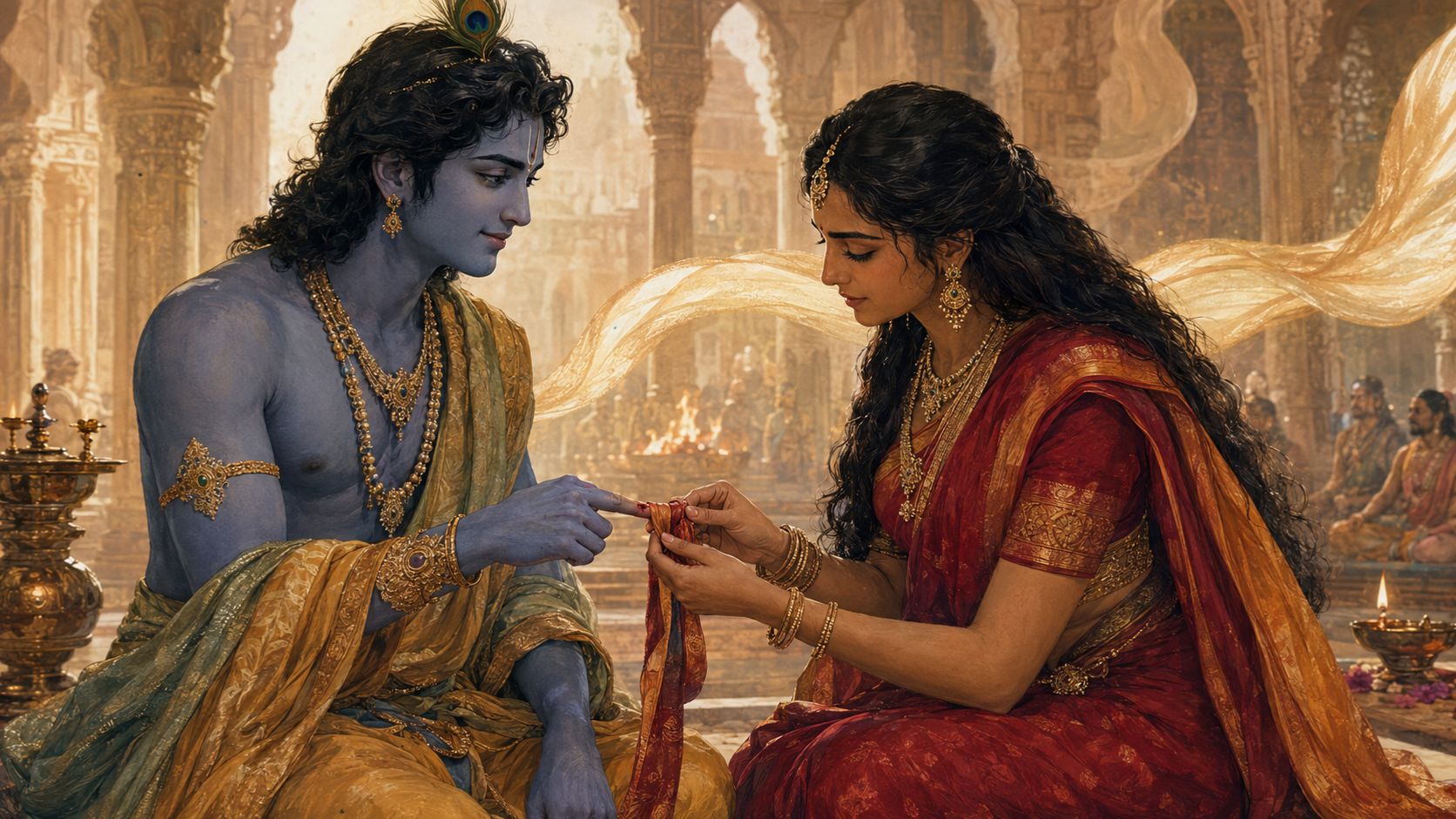
In the doing of it, the razor edge of the chakra grazed Krishna’s own finger, and it began to bleed.
The whole hall stirred. Servants were sent running for cloth and bandages. But before any of them returned, one person had already moved. Draupadi, without a moment’s hesitation, tore a strip from the border of her own silk sari and bound it tight around the bleeding finger of the Lord.
Krishna looked at the thread of her sari around His hand. And He made her a promise.
“For every thread of this sari, sister, I shall repay you. I am now in your debt, and I do not forget my debts.”
The repayment came in the darkest hour of the Mahabharata. In the gambling hall at Hastinapura, when Yudhishthira had lost everything — kingdom, brothers, himself, and finally Draupadi — and when Dushasana seized her by the hair and began, before the silent assembly of elders, to pull the sari from her body, Draupadi’s own strength failed her. She cried out, at last, not to any of the mighty men seated around her, but to Dwarka, to Govinda, to the friend whose finger she had once bound.
And the sari did not end. Dushasana pulled and pulled until he sank exhausted to the floor amid a mountain of cloth, and still Draupadi stood clothed — because the friend who does not forget His debts had made her garment endless. The strip of cloth she had given for His wound came back to her as an ocean of cloth for her honour.
This is the deepest teaching the day carries: the raksha is a bond that runs both ways. The one who ties the thread is not only asking for protection. She is offering it — and she may find, in her own hour of need, that the small kindness she once gave has become the very thing that saves her.
How the Day Is Kept
- The morning begins with a bath and, in many homes, a puja at the household altar before the rakhi is tied.
- The sister prepares a thali: the rakhi itself, roli (or kumkum) and rice for the tilak, a diya, and something sweet.
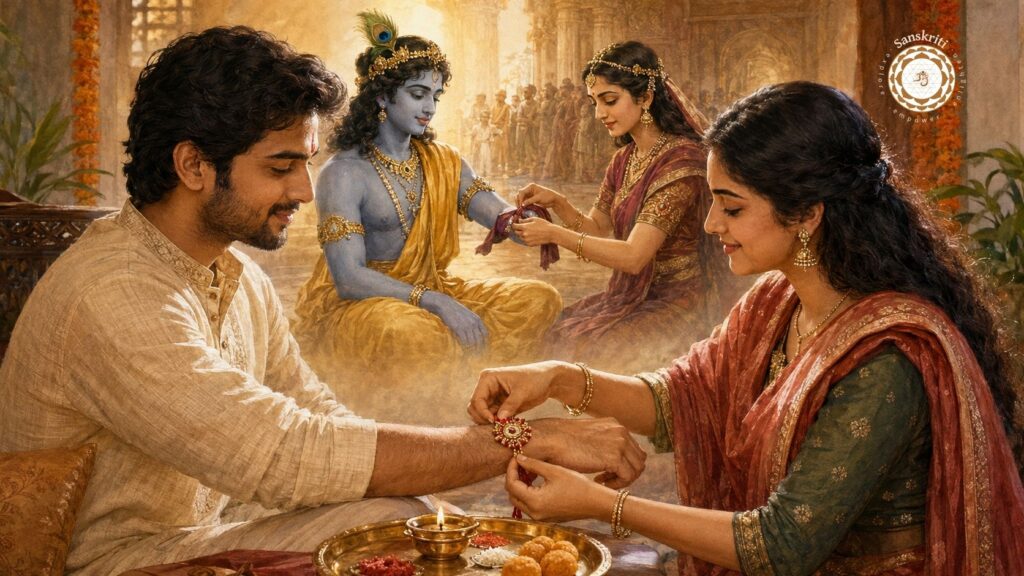
- She applies the tilak to her brother’s forehead, ties the raksha-sutra to his right wrist, performs aarti, and feeds him the first sweet.
- The brother, in turn, gives a gift and — the part that matters most — renews his pledge of protection and care.
- Where a brother and sister are far apart, the rakhi is posted ahead of time and tied to the wrist in spirit, or sent to be tied on the day. The bond does not depend on the distance.
And it need not be a brother by birth at all. A rakhi tied to a cousin, a friend, a soldier at the border, a neighbour, a chosen brother — each is a true raksha-sutra, because what consecrates the thread is not blood but the sincerity of the promise.
The Deeper Meaning of the Thread
It is easy, in a season of gift-wrap and greeting cards, to let Raksha Bandhan shrink to a formality. But look again at the three stories the tradition keeps. In every one, the thread is tied by a woman, and in every one it turns the course of events — a war won, Death disarmed, a queen’s honour saved in a hall full of silent men.
The shastras are making a quiet and radical point. The protective force in the universe is not only the sword arm of the strong. It is also the consecrated will of the one who loves — carried, of all things, on a strand of cotton. When a sister ties the rakhi, she is doing what Sachi did, what Yamuna did, what Draupadi did: she is putting a real spiritual charge into a small material thing, and trusting that dharma will honour it.
And when a brother wears it, he is accepting a truth the mighty men of the gambling hall forgot to their eternal shame — that to be entrusted with someone’s protection is the highest honour a person can be given, and the one debt that must never go unpaid.
A thread of cotton. A promise that Death himself agreed to keep. This is Raksha Bandhan.
“With the very thread that bound Bali, the mighty king of the daityas, I bind you. O Raksha, do not waver, do not waver.” — the traditional mantra spoken while tying the rakhi