The Pre Spanish history of Philippines was shrouded in mystery. Now the mist around the Philippines is clearing thanks to recent discoveries. The Spaniards, wherever they went, destroyed the local culture, plundered their gold and massacred the people. They spared those people who converted to Christianity.
The Philippines is a country of 7000 islands. Nobody asked or wondered what those places were called before they named it “ Philippines” just 400 years ago. They had their own names, their own culture, but they were ignored as primitive and uncivilized. Fortunately one inscription and one golden statue escaped the wrath of the religious fanatics.
One important Tamil inscription of Rajendra Chola was not properly explained. Half of the place names mentioned in the inscription is not properly identified. The East Indies were known to Kalidasa of 1st century BC. Parasurama was linked with Aparanta. Kalidasa used to mention Indonesia and the islands beyond as Dwipantara. Rajendra Cholas inscription mentioned Parasurama.
Hindu music instrument Kadjabi is still played in the Philippines. Hundreds of Sanskrit words are used in the islands even today.
Golden Statue
A five and a half inch tall golden statue recovered from Mindanao in 1917 is kept in the Field Museum of Natural History in Chicago. Vishnu’s vehicle Garuda was found in Palawan. The gold statue is that of a Buddhist goddess known as Tara. It weighs 4 pounds (approximately 2 Kilos). It is dated 1200 to 1300 AD. It was found in Wawa River after heavy rains. Lot of gold was taken back to Spain and melted. Only a few escaped from the invaders.
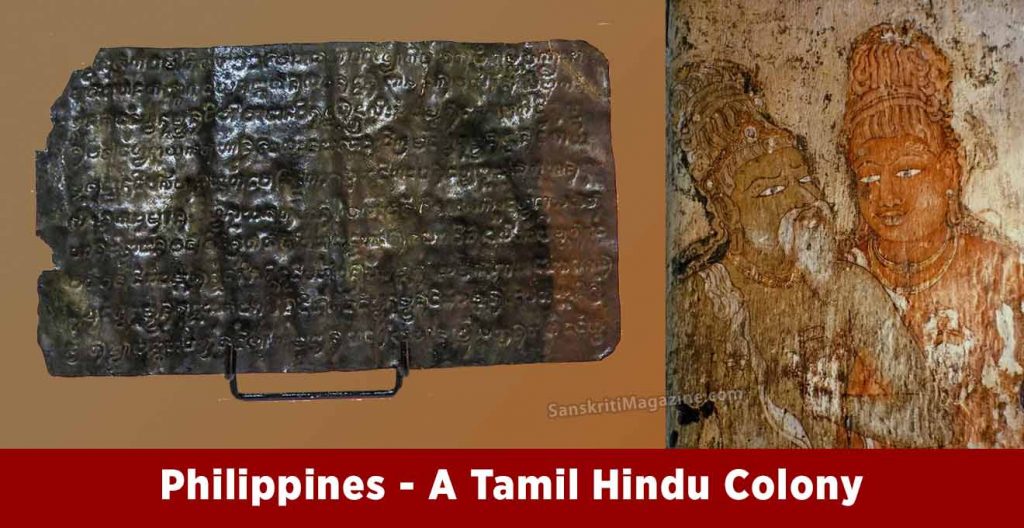
Luzon in the Philippines was ruled by Lakans (local chieftains) from 900 AD until 1571. An inscription found there known as Laguna copperplate inscription dated 900 AD contains Sanskrit words and place names. The inscription which was found in 1989 contains information about debts cleared by the ruler of Tondo. Namwaran along with his children Lady Angkatana and Buka were cleared of debts. It was written in Kawi script. Lord Minister Jayadewa issued the order. The inscription is kept in the National Museum of the Philippines in Manila. A lot of Sanskrit words such as Swasti, Visaka,Chathurthi, Suwarna, Krishnapaksha, Somawara, Dewata, Jyotisa are in the text. Full text and translation is available in Wikipedia.
Language
Wikipedia article says 25 percent of words in Philippines native language are from Sanskrit and Tamil. Look at the list given by Wikipedia:
From Tagalog:
- Budhi “conscience” from the Sanskrit bodhi
- Dukha “one who suffers” from the Sanskrit dukkha
- Guro “teacher” from the Sanskrit guru
- Sampalataya “faith” from the Sanskrit sampratyaya
- Mukha “face” from the Sanskrit mukha
- Laho “eclipse” from the Sanskrit rahu
- Maharlika “noble” from Sanskrit mahardikka
From Kapampangan:
- Kalma “fate” from the Sanskrit karma
- Damla “divine law” from the Sanskrit dharma
- Mantala -“magic formulas” from the Sanskrit mantra
- Upaya “power” from the Sanskrit upaya
- Lupa “face” from the Sanskrit rupa
- Sabla “every” from the Sanskrit sarva
- Lawu “eclipse” from the Sanskrit rahu
- Galura “giant eagle (a surname)” from the Sanskrit garuda
- Laksina -“south (a surname)” from the Sanskrit dakshin
- Laksamana/Lacsamana “admiral (a surname)” from the Sanskrit lakshmana
From Tausug:
- Suarga “heaven”; compare “sorga” in modern Indonesian [1]
- Neraka “hell”
- Agama “religion”
Sanskrit and Sanskrit-derived words common to most Philippine languages:
- Sutla “silk” from the Sanskrit sutra
- Kapas “cotton” from the Sanskrit kerpas
- Naga “dragon or serpent” from the Sanskrit naga
Ramayana in the islands
Ramayana and Mahabharata are popular in all the South East Asian countries. Philippines also have its own version of Ramayana. The Maranao version is Maharadia lawana ( Maharaja Ravana). Lam- Ang is the version of the Llocanos. Many verses of Hud Hud are from Ramyana and Mahabharata.
Musical Instruments
Several musical instruments of the Philippines are similar to Indian musical instruments and Kutiyapi is a corrupted word of Kadjabi, a Sanskrit word.
Rajendra Chola Inscription
Rajendra Chola, son of the Raja Raja won many countries in South East Asia. The inscription named all the countries and islands he won around 1025 AD. K.A.Nilakanta Sastri, the greatest authority on South Indian History has written about his conquests. But when he wrote about the Cholas 75 years ago Laguna inscription was not discovere. Only Rajendra’s Tamil inscription was known. Now we know Philippine islands were under Hindu rulers even before Rajendra invaded S.E. Asian countries.
Scholars identify the following places in the inscription:
Sri Vijaya= Palembang, Pannai= North Sumatra, Malaiyur= Jambi, Mayirudingam= Thai-Malay peninsula, Ilangasokam= Langkasuka, Mappalam= Pegu, Mavimbangam= Isthumus of Ligor or Thai-Malay peninsula, Valaipanduru= Vietnam?, Talaitakkolam= Takoba, Madamalingam= Tambralinga, Ilamuridesam= Lamri in Aceh, Manakkavaram= Nicobar islands, Kadaram= Kedah.
.
Kaundinya from South India established the Hindu empire in the First century AD in Funan. Chinese writers have written about the rulers and their relationship with China. Agastya cult was deep rooted in Java, Sumatra and Bali islands.