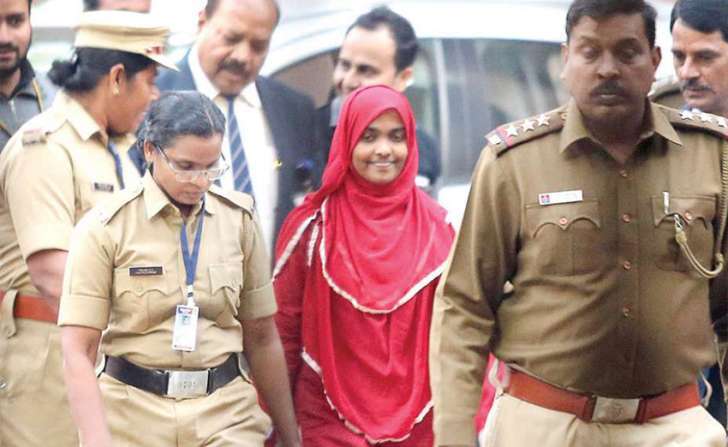
The court also said the National Investigation Agency (NIA) can go ahead with its probe into a so-called “larger conspiracy” behind the alleged forced religious conversion of Hadiya and others in Kerala.
THE SUPREME Court Thursday set aside the Kerala High Court order annulling the marriage of Hadiya, a 25-year-old Hindu woman who converted to Islam two years ago, to a Muslim man and said she was free to “pursue her future endeavours in accordance with the law”.
“Considering the arguments advanced on both sides, in the facts of the present case, we hold that the High Court should not have annulled the marriage between appellant No.1 Shafin Jahan and respondent No.9, Hadiya alias Akhila Asokan, in a Habeas Corpus petition under Article 226 of the Constitution of India,” said the order issued by a three-judge bench headed by Chief Justice of India Dipak Misra.
“She (Hadiya) appeared before this Court on November 27, 2017, and admitted her marriage with appellant No.1. In view of the aforesaid, the appeal stands allowed. The judgment and order passed by the High Court is set aside. Respondent No.9, Hadiya alias Akhila Asokan, is at liberty to pursue her future endeavours according to law,” stated the bench.
The court also said the National Investigation Agency (NIA) can go ahead with its probe into a so-called “larger conspiracy” behind the alleged forced religious conversion of Hadiya and others in Kerala.
“We clarify that the investigations by the NIA in respect of any matter of criminality may continue in accordance with law,” said the bench, also comprising Justices A M Khanwilkar and D Y Chandrachud.
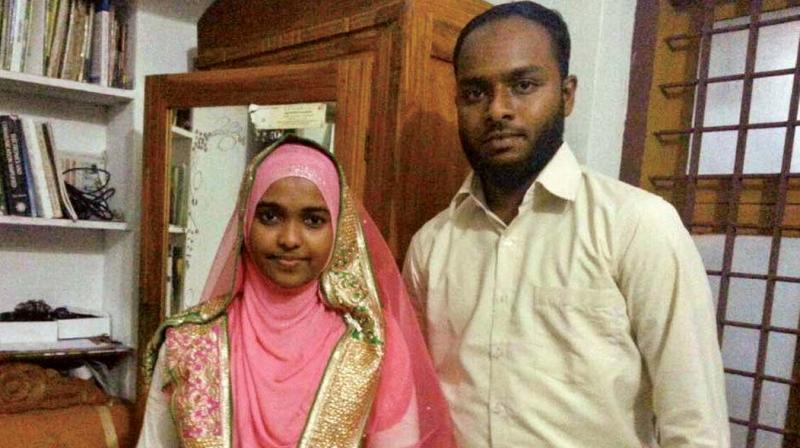
Months after converting to Islam in January 2016, Hadiya married Jahan, triggering allegations of forced conversion. Claiming that her daughter had been “brainwashed”, Hadiya’s father K M Asokan moved the Kerala High Court which annulled the marriage and sent Hadiya to her parents’ custody last May. On an appeal by Jahan, the Supreme Court summoned Hadiya, interacted with her in open court and sent her to continue her studies in a Salem college.
The NIA’s probe, on a direction from the Supreme Court, began in August last year. The agency filed a status report of its probe in the court and claimed that there was a “well oiled machinery” behind the conversion of Hadiya and other girls.
On Thursday, Senior Advocate Shyam Divan, appearing for Asokan, said the High Court was within its powers to annul the marriage. “There is an inherent jurisdiction in a court of law to annul a marriage in an appropriate case,” he said, arguing that the expanding concept of law takes into account the question of “marriage frauds”.
Justice Chandrachud said that while courts could annul marriages, the power should be exercised only in exceptional circumstances. “For instance, there may be the case of a 16-year-old married off to a 75-year-old. There, she may be incapable of asserting her free will because of her poverty, etc. Such cases border on trafficking and we may invoke our powers… But where there are two consenting adults, can we go into the justness of the marriage?” he said.
Divan contended that while no third party could ordinarily get involved in a marriage between two consenting adults, the facts of this case justified the High Court order. He said that public law has evolved to account for situations where a marriage may be intended to defeat a state interest or even a private interest.
Justice Chandrachud, however, said that “the moment we step into the realm of public law, we are stepping into a dangerous domain”. ”There may be several state interests. Marriage and personal relations are the core of plurality of Indian culture. We must do everything to protect it…We can’t allow the test of reasonableness to the legality of marriage,” he said.
At this point, CJI Misra said: “How can we get into the question whether consent is free or not, specially when the parties are mentally sound?”
Additional Solicitor General Maninder Singh, appearing for the NIA, claimed that “marriage” in this case “was a disguise to further an offence”. ”This marriage was a ploy to get her out of court proceedings,” Singh said, and implored the Bench to take a look at NIA’s status report.
The Bench said the government was free to take action if it found that the parties were involved in any criminal act.
Senior Advocate Kapil Sibal, who appeared for Jahan, requested the court to not take any of the NIA’s arguments at face value.