Kolkata: Climate change was probably not the sole cause for the collapse of the Harappan civilisation in the Indus-Ghaggar-Hakra river valleys, say Indian scientists in a breakthrough study, highlighting that the the Harappans “did not give up” despite the decline in the monsoon.
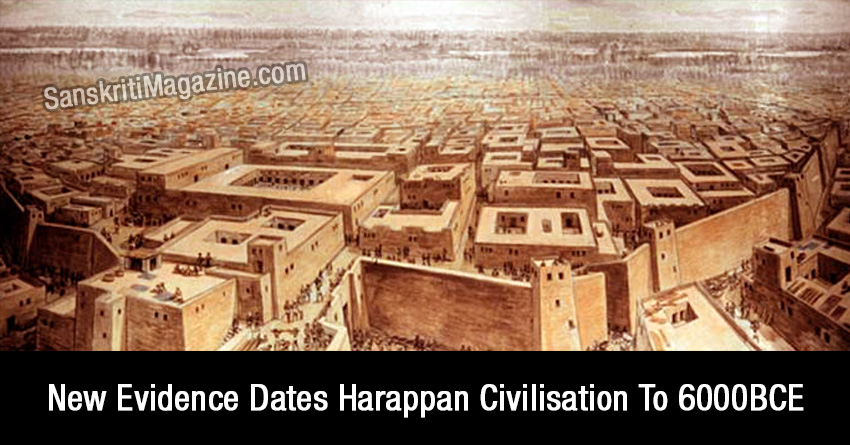
The recent research by a team of researchers from IIT Kharagpur, Institute of Archaeology, Deccan College Pune, Physical Research Laboratory and Archaeological survey of India (ASI) also shows that the civilization itself was much older than thought — it is at least 8,000 years old.
“Our study suggests that the climate was probably not the sole cause of Harappan decline. Despite the monsoon decline, they did not disappear. They changed their farming practices.
“They switched from water-intensive crops when monsoon was stronger to drought-resistant crops when it was weaker. Our work shows they did not give up despite the change in climate conditions,” Anindya Sarkar of the Department of Geology and Geophysics, IIT Kharagpur and the lead investigator, told IANS.
“Our study suggests that other causes, like change in subsistence strategy, by shifting crop patterns rather than climate change was responsible for the Harappan collapse,” Sarkar said.
The findings have been published in the journal ‘Nature Scientific Report’ on May 25.
In the Indian subcontinent, the major centres of this civilisation include Harappa and Mohenjo-Daro in Pakistan and Lothal, Dholavira and Kalibangan in India.
“These people shifted their crop patterns from the large-grained cereals like wheat and barley during the early part of intensified monsoon to drought-resistant species of small millets and rice in the later part of declining monsoon, and thereby changed their subsistence strategy,” explained Sarkar.
The findings come from a major excavated site of Bhirrana in Haryana, that shows preservation of all cultural levels of this ancient civilisation from pre-Harappan Hakra phase through Early Mature Harappan to Mature Harappan time.
Bhirrana was part of a high concentration of settlements along the now dried up mythical Vedic river ‘Saraswati’, an extension of Ghaggar river in the Thar desert.
To find out how old the civilization is, the researchers dated potteries of Early Mature Harappan time – by a technique called optically stimulated luminescence (OSL) – and found them to be nearly 6,000 years old, the oldest known pottery so far. The levels of Pre-Harappan Hakra phase have been dated to be as old as 8,000 years.
“That the Bhirrana and probably several of the Indian Indus Valley sites are much older than 5,700 years has been guessed by many archaeologists for quite some time. Our study pushes back the antiquity to as old as 8th millennium before present and will have major implications to the evolution of human settlements in the Indian sub-continent,” said Sarkar.
The study also reveals that the monsoon became progressively weaker from 7,000 years onwards, but surprisingly the civilisation did not disappear, rather it continued to evolve even in the face of declining monsoon condition.
“It is very interesting to investigate how these ancient people coped with the then climate change and can be a lesson for today’s impending disaster of climate change,” said Navin Juyal of Physical Research Laboratory, Ahmedabad, who dated the potteries and is a co-author of the paper.