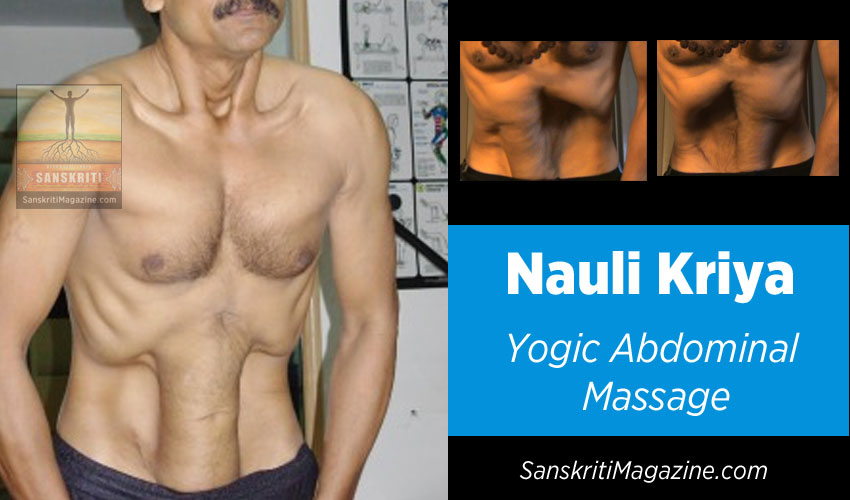
Lean forward, protrude the abdomen and (the muscles) from right to left with speed, this is called nauli by the siddhas.
(“Hatha Yoga Pradipika”, 2:33)
The Sanskrit word nauli comes from the root word ‘nala’ or ‘nali’, which means a tubular vessel, vein or nerve of the body; a reed or hollow stalk. The word ‘nala’ is also the Sanskrit for the rectus abdomini, (in the Monier Williams Sanskrit dictionary it is literally defined as the ‘navel string’). It is also interesting to note that the Sanskrit word ‘nau’ means ‘ship’, for when nauli is perfected then the abdominal muscles seems to flow like the rolling waves of the ocean. The muscles create the same wavelike motion produced by a ship. Nauli is the practice of contracting and isolating the rectus abdominii muscles. In the “Gherand Samhita” it is known as ‘laulika’. Laulika comes from the word ‘lola’ which means ‘to roll or ‘agitate’. When the rectus abdominii muscles are rotated from left to right (anticlockwise), it is called ‘dakshina nauli.’ When they are rotated from right to left (clockwise), it is ‘vama nauli’. When the muscles are pulled together and the middle group of muscles protrude, it is ‘madhyama nauli’. Before attempting nauli you must be able to perform uddiyana bandha properly.
The rectus abdominii are the two long vertical muscles situated in front of the abdomen, which run under the centre of the ribcage near the diaphragm to the pubic bone. Though these are the muscles you are manipulating in nauli, the external oblique and traverse abdominii are also utilised. At first nauli is practised with the hands just above the knees and the body bent forward. Once this is perfected you can practise in a more erect position, with the hands placed on the upper thighs.
Technique 1
Stage 1
Stand with the feet 1½ to 2 feet apart – bend the knees and rest the palms of the hands just above the knees, thumbs on the insides of the thighs and finders touching the outsides, or as shown in diagram – keep the head up and the eyes open – breathe in deeply through the nose and exhale quickly through the mouth, slightly pursing the lips – perform jalandhara bandha while maintaining bahiranga, (external) kumbhaka – suck the abdomen and stomach in by performing uddiyana bandha – lift the right hand slightly off the knee, keeping all the pressure on the left hand and knee, but do not lean to the left side – this will automatically isolate the rectus abdominii muscles on the left – release uddiyana bandha – raise the head slowly – stand up and inhale slowly – this is vama nauli – practise in the same way on the right side – keep the right hand resting above the knee and slightly lift the left hand to isolate the rectus abdominii muscles on the right – this is dakshina nauli – in between each round of nauli, release uddiyana first, then jalandhara – raise the head – stand erect and breathe in very slowly through the nose – take a few normal breathes before practising the nest round.
Stage 2
Practise vama or dakshina nauli as in stage 1 – start to roll the muscles to the other side, but before they reach the opposite side, hold them in the middle – in order to roll the muscles, slowly bring the weight back onto the hand which was lifted from the knees – this is madhyama nauli.
Stage 3
Practise in the same way as for stages 1 and 2 but learn, to control the contraction of the muscles and to isolate the muscle groups without lifting the hands from the legs – first try by just releasing the pressure off the hand without moving it from the leg – gradually begin to control the practice so that the hands remain fixed on the legs – practise with the hands on the thighs.
Technique 2
Stand in the same position as in technique 1 – keep the hands on the legs above the knees throughout the whole practice – practise vama nauli and then roll the muscles to the right and back to the left – continue rotating the muscles in a clockwise direction – this is known as ‘churning’ – start by practising 3 times consecutively -then release – practise dakshina nauli in the same way, rotating the muscles anticlockwise – when this churning is perfected, practise it 3 times with vama nauli, then 3 times with dakshina nauli and release – when this is perfected you can increase to 10 and 90 rounds.
Technique 3
Practise techniques 1 and 2 in siddhasana or siddha yoni asana, with the buttocks raised slightly by a cushion – initially it will be difficult to control the muscles in the sitting position, so it is better to first perfect the practice of nauli in the standing position.
Nauli should only be practised when the stomach is empty, i.e., at least 5 to 6 hours after meals. The best time to practise is early in the morning before break fast. If you feel any pain in the abdomen during nauli you should immediately stop the practice. Try the following day or when the pain subsides, but if it persists you should consult your teacher or doctor. Nauli should not be performed by those suffering from heart disease, hypertension, high blood pressure, gallstones, hernia or peptic or duodenal ulcer. Pregnant women should not practise. However, after childbirth it is highly recommended in order to strengthen the abdominal and pelvic muscles and readjust the position of the inner organs.
Benefits of nauli
According to Yogi Swatmarama “Nauli is foremost of the hatha yoga practices. It kindles the digestive fire, removing indigestion, sluggish digestion and all disorders of the doshas, and brings about happiness”. Nauli quickly tones the abdominal muscles, nerves, intestines, reproductive, excretory and urinary organs. Every part of the internal system is stimulated by this practice. It balances the endocrine system and helps control the production of sex hormones. Nauli, is especially useful for alleviating constipation, indigestion, nervous diarrhoea, acidity, flatulence, depression, hormonal imbalances, sexual and urinary disorders, laziness, dullness, lack of energy and emotional disturbances. Through its practice one can control sensual desires and strengthen one’s willpower.
Why is it instructed in nauli and many other pranayama practices to first breathe in deeply and then exhale ‘slightly pursing the lips’?
Swami Niranjan: The manner of breathing and control of the breath are important in the pranayama practices, along with the ability to create a proper vacuum in the system by expelling the total breath. It is the general tendency of the lungs to retain some air in little bags called alveoli, and these air sacks are not always emptied in the process of normal breathing. By forcing the abdomen in, even after having exhaled completely, it is possible to expel some more air.
It has been the experience of yogis that, when we breathe in deeply through the nostrils and then try to expel the total amount of air through them, the lungs will not become empty. Opening the mouth completely and expelling through the open mouth, will still result in some air being trapped in the lungs, but if we slightly purse the lips and maintain a constant flow of exhalation by creating proper contraction of the abdominal and thoracic muscles, it will be possible to empty out the lungs by at least ninety-five percent. Slightly pursing the lips and relaxing tends to create proper pressure in the different parts of the lungs, which helps to remove the trapped air from the alveoli.
At what age exactly should the other shatkarmas like nauli be commenced, and when can children start performing them?
Swami Niranjan: As a standard rule, children are taught the limited practices of yoga from the age of” eight, in the form of pranayama, surya namaskara and mantra japa, and as they gradually progress in age, (keeping in view their physical, hormonal and glandular growth), other practices of yoga are included. Of course, in certain cases, some other practices of yoga are taught to children at a different ago. Children, for example, who breathe from the mouth, can begin to practise neti after the age of eight, but normally they have to be exposed gradually to the practices of hatha yoga or the shatkarmas, so they generally begin their training after the age of fourteen. Practices such as the different forms of neti, nauli, trataka and kapalbhati pranayama can be taught then. However, the advanced techniques of dhauti and basti are generally taught after the age of twenty.
~ Swami Niranjan