IndianSanskriti
Murud-Janjira-Fort

Murud – Janjira Fort

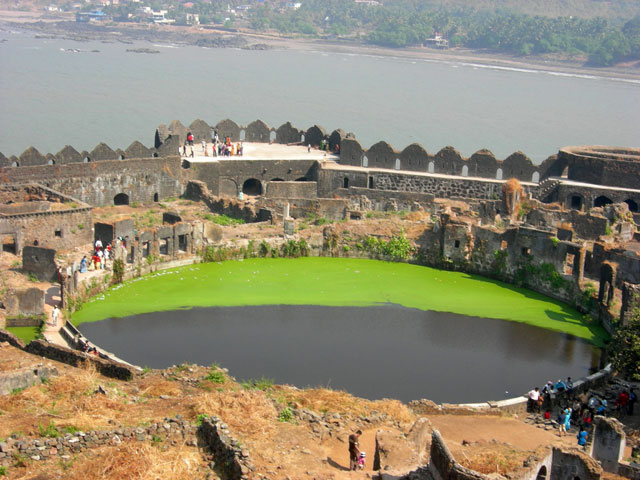
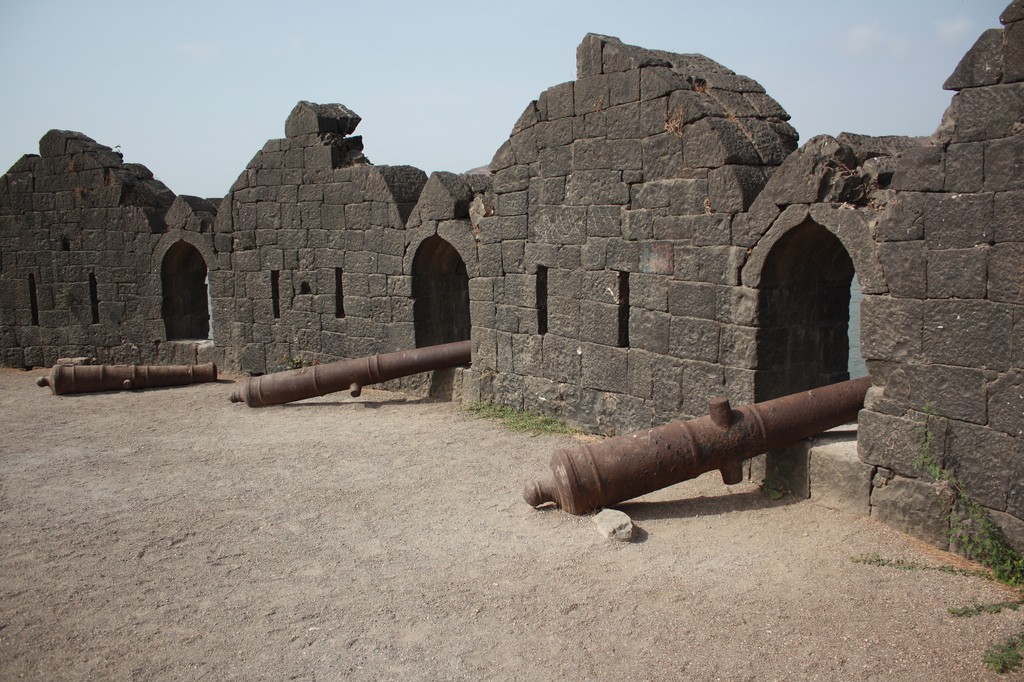
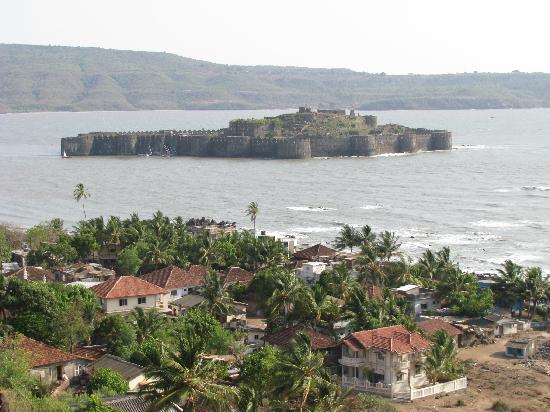
Situated on a rock of oval shape near the port town of Murud, 165kms south of Mumbai, Janjira is one of the strongest marine forts of India (the word ‘Janjira’ is a corruption of the Arabic word Jazira for island). The forts is approached by sailboats from Rajapuri jetty. The main gate of the fort faces Rajapuri on the shore and can be seen only when one is quite close to it. It has a small postern gate towards the open sea for escape. The fort has 19 rounded bastions, still intact. There are many canons of native and European make rusting on the bastions. Now in ruins, the fort in its heyday had all necessary facilities, e.g., palaces, quarters for officers, mosque, a big fresh water tank, etc. On the outer wall flanking the main gate, there is a sculpture depicting a tiger-like beast clasping elephants in its claws. This sculpture, its meaning difficult to interpret, appears on many fort-gates of Maharashtra.

Originally the fort was small wooden structure built by a Koli chief in the late 15th century. It was captured by Pir Khan, a general of Nizamshah of Ahmednagar. Later the fort was strengthened by Malik Ambar, the Abyssinian Siddi regent of Ahmednagar kings. From then onward Siddis became independent, owing allegiance to Adilshah and the Mughals as dictated by the times. Despite their repeated attempts, the Portuguese, the British and the Marathas failed to subdue the Siddi power. Shivaji’s all attempts to capture Janjira fort failed due to one reason or the other. When Sambhaji also failed, he built another island fort, known as Kansa or Padmadurg, just 9kms north of Janjira. The Janjira state came to an end after 1947. The palace of the Nawabs of Janjira at Murud is still in good shape.

murud-janjira-fort

janjira-fort-in-midst

Murud-Janjira

4662237007_29bc5775c6_b

You may also like

Search the website

Like us on Facebook

Get daily updates via Email

Enter your email address:

Recent Posts

Varada Chaturthi 2026 — The Rare Ganesha Day of Purushottam Maas

Varada Chaturthi 2026 — The Rare Ganesha Day of Purushottam Maas

Once every 2.5–3 years — when the rare 13th month of Adhika Maas opens — a thirteenth Vinayaka Chaturthi appears. The Mudgala Purana calls it Varada Chaturthi, the “boon-giving” Chaturthi, and holds it as the most fruit-bearing Ganesha day of the entire calendar. Today, Wednesday May 20, 2026, is that day.

Padmini Ekadashi 2026 — The Rare Ekadashi That Comes Only in Purushottam Maas

Padmini Ekadashi 2026 — The Rare Ekadashi That Comes Only in Purushottam Maas

Padmini Ekadashi 2026 falls on Wednesday, May 27 — the Shukla Paksha Ekadashi of Adhika Maas, the rarest Ekadashi in the entire Hindu calendar (it appears only every 2.5–3 years). The Padma Purana conversation between Bhagavan Krishna and Yudhishthira, the Vrat Katha of Queen Padmini, complete vrat vidhi with jagrana, mantras, and the lotus symbolism that gives the Ekadashi its name.

Ganga Dussehra 2026 — The Day Maa Ganga Came Down to Bhagiratha

Ganga Dussehra falls on Monday, May 25, 2026 — commemorating the day Maa Ganga descended from Vaikuntha to the earth through the millennia-long tapasya of King Bhagiratha. The full account from the Valmiki Ramayana, snan vidhi, dana traditions, mantras, and the teaching of sustained sincerity.

Adhik Jyeshtha Maas 2026 — The Hidden Month That Belongs to Lord Vishnu

Once every 2.5–3 years, the Hindu calendar opens a quiet thirteenth chamber — the intercalary month Lord Vishnu took for His own. A Puranic look at Adhik Jyeshtha Maas 2026 (May 2–31), the Padma Purana account of how it became Purushottam Maas, and a complete householder’s guide for its closing days.

css.php