IndianSanskriti
Buddha statue with mummy inside

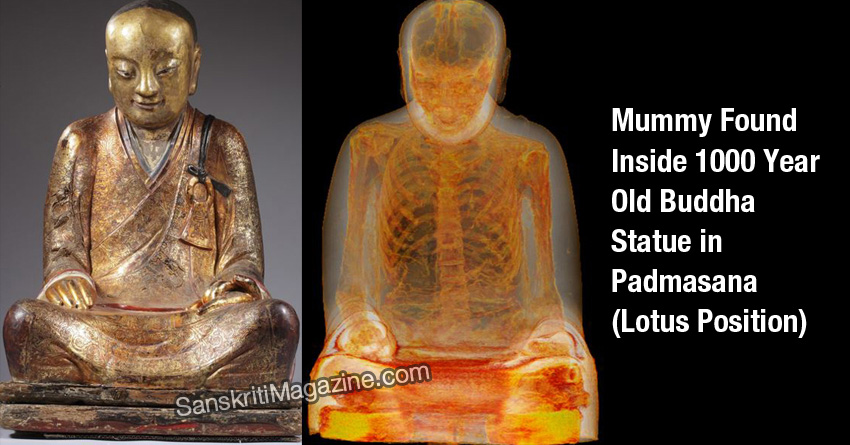
Mummy Found Inside 1000 Year Old Buddha Statue in Padmasana (Lotus Position)

Scientists made a bizarre discovery when they took a CT scan of an ancient Buddha statue from China. Inside was a mummy sitting in the same lotus position. Further investigation revealed that the organs had been removed and replaced by scraps of paper with Chinese writing on them.
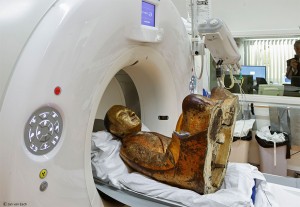
scan-01The Buddha statue, dating back to 1100 CE, belongs to the Drents Museum in the Netherlands and is currently on loan to a museum in Budapest.

“On the outside, it looks like a large statue of Buddha,” the museum said in a release quoted by Discovery News. “Scan research has shown that on the inside, it is the mummy of a Buddhist monk who lived around the year 1100.”

Experts believe that the mummy inside the statue is of Buddhist master Liu Quan, a member of the Chinese Meditation School.

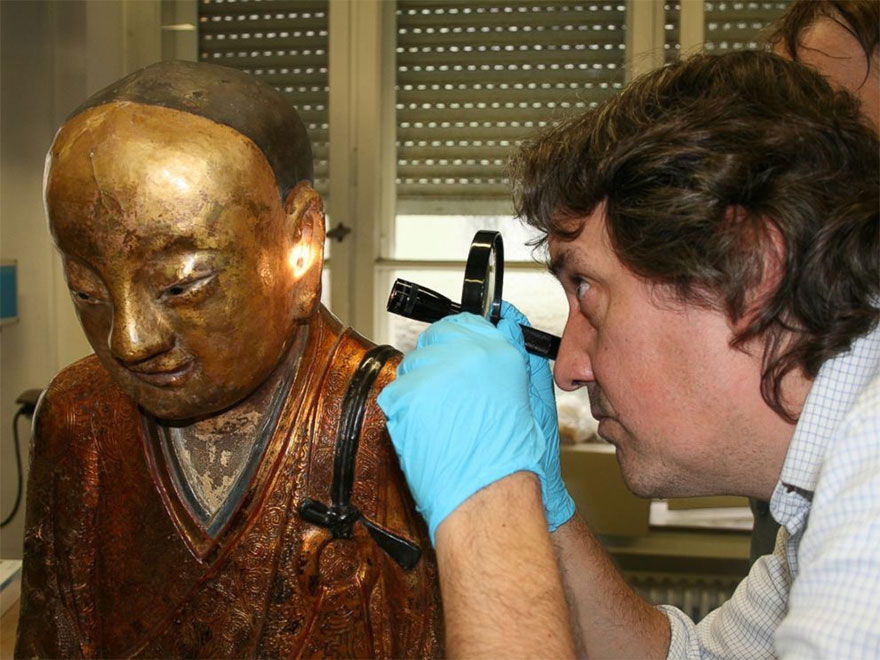
After the initial scan showed the skeleton inside the statue, researchers took it to the Meander Medical Center in Amersfoort and carried out an endoscopy and additional CT scans. That is when they found the missing organs and, among a lot of unidentified material, scraps of paper with Chinese script on it. Further research is in progress.

The Museum is of the view that probably the Buddhist master ‘self-mummified’ himself. This is a long painful process involving starving oneself progressively for several years.

Self-mummification used to be a mainly Japanese practice. Discovery News describes this tortuous process in the following way. For 1000 days the monk would eat only nuts and seeds, reducing body fat to a minimum. Then, for another 1000 days a diet of roots and barks would be consumed. In the last stages, the monk would drink a poisonous tea made from the sap of the Japanese varnish tree to induce vomiting and elimination of body fluids. The toxic nature of the infusion probably helped kill off bacteria too.

Then, the skeletal monk was put in a stone tomb just fitting around the body. An air tube and a bell were provided. Every day the monk would ring the bell indicating that he was alive. When the bell stopped ringing, it was known that he had died. His mummified body would then be removed after another 1000 days and preserved. Only a handful of monks achieved this stage after the long and grueling process.

It is unclear when and how the organs were removed from this mummy. Further research is going on.
scan-02

You may also like

Search the website

Like us on Facebook

Get daily updates via Email

Enter your email address:

Recent Posts

Jamai Shashthi 2026 — The Story of Maa Shashthi, the Cat, and the Wife Who Was Forgiven

Jamai Shashthi 2026 — The Story of Maa Shashthi, the Cat, and the Wife Who Was Forgiven

On Saturday, June 20, 2026, Bengali households across Bharata will welcome their married daughters and sons-in-law home for the legendary jamai-aador feast and perform the Shashthi Vrata. But behind the warmth lies a story most Bengalis know by heart and most non-Bengalis have never heard — the wife who stole the hilsa, blamed the cat, lost six sons to Maa Shashthi’s wrath, and was finally forgiven. The Vrat Katha, the vidhi, the mantras, and the deeper teaching.

Vat Purnima 2026 — The Wife Who Argued Yama Into Returning Her Husband’s Life

On Monday, June 29, 2026, women across Maharashtra, Gujarat, and southern Bharata will tie red thread around banyan trees and hear the story of Savitri — the wife who walked behind Yamaraja Himself when He came for her husband, and out-argued the Lord of Dharma into returning Satyavan’s life. The Mahabharata’s Pativrata Mahatmya Parva, the vrat vidhi, and why the banyan witnessed everything.

Purushottam Maas — The Month No Deity Would Claim, and the Lord Who Made It Supreme

Every month of the Hindu calendar has a lord — except the rare thirteenth, the Adhika Maas, born an orphan and shunned as the “impure month.” The Puranas tell how this rejected month went in grief to Bhagavan Vishnu, who claimed it, gave it His own name — Purushottam — and made it the most fruitful month of all. The origin story, the teaching, and what it means for Purushottam Maas 2026 (May 17 – June 14).

Padmini Ekadashi 2026 — The Ekadashi Even the Devas Descend to Keep

Padmini Ekadashi 2026 — The Ekadashi Even the Devas Descend to Keep

The rarest Ekadashi of the entire Hindu calendar is three days away. The Padma Purana preserves a conversation between Bhagavan Krishna and Yudhishthira about a single Ekadashi the great Rishis spend lifetimes waiting for — Padmini. The Vrat Katha of Queen Padmini of Mahishmati, the lotus teaching, and why May 27, 2026 is the morning Vaishnavas across Bharata are preparing for.

Varada Chaturthi 2026 — The Rare Ganesha Day of Purushottam Maas

Varada Chaturthi 2026 — The Rare Ganesha Day of Purushottam Maas

Once every 2.5–3 years — when the rare 13th month of Adhika Maas opens — a thirteenth Vinayaka Chaturthi appears. The Mudgala Purana calls it Varada Chaturthi, the “boon-giving” Chaturthi, and holds it as the most fruit-bearing Ganesha day of the entire calendar. Today, Wednesday May 20, 2026, is that day.

css.php