#Mosquemetoo was actually started by Egyptian-American feminist and journalist Mona Eltawy, who first shared her experiences on social media.
New Delhi: For Muslims across the globe, Haj is the fifth and final pillar of Islam. It is something that every sane adult Muslim must undertake at least once in their lives if they can afford it and are physically able.
Every year, thousands of Muslims men and women visit the holy land of Mecca – one of the most sacred pilgrimage centres of Islam situated in western Saudi Arabia.
Haj – the pilgrimage to the birthplace of the Prophet Muhammad – gives an opportunity to millions of devotees to seek divine blessings and atone for their sins.
In 2013, I was 1st person to talk about being sexually assaulted at Haj on Arabic-language #Egyptian primetime TV show. In 2015, I wrote about it in my book. I’m talking about it now & will keep talking about it until Muslim women are safe from sexual harassment & assault at Haj https://t.co/uDsZFDolgX
— Mona Eltahawy (@monaeltahawy) February 8, 2018
I have shared my experience of being sexually assaulted during Haj in 1982 when I was 15 in the hope that it will help fellow Muslim women break silence and taboo around their experience of sexual harassment/abuse during Haj/Umra or in sacred spaces. Let’s use #MosqueMeToo https://t.co/uDsZFDolgX
— Mona Eltahawy (@monaeltahawy) February 6, 2018
Thank you again to fellow Muslim women who have shared their own experience at Haj. Love and solidarity. #MosqueMeToo https://t.co/uDsZFDolgX
— Mona Eltahawy (@monaeltahawy) February 6, 2018
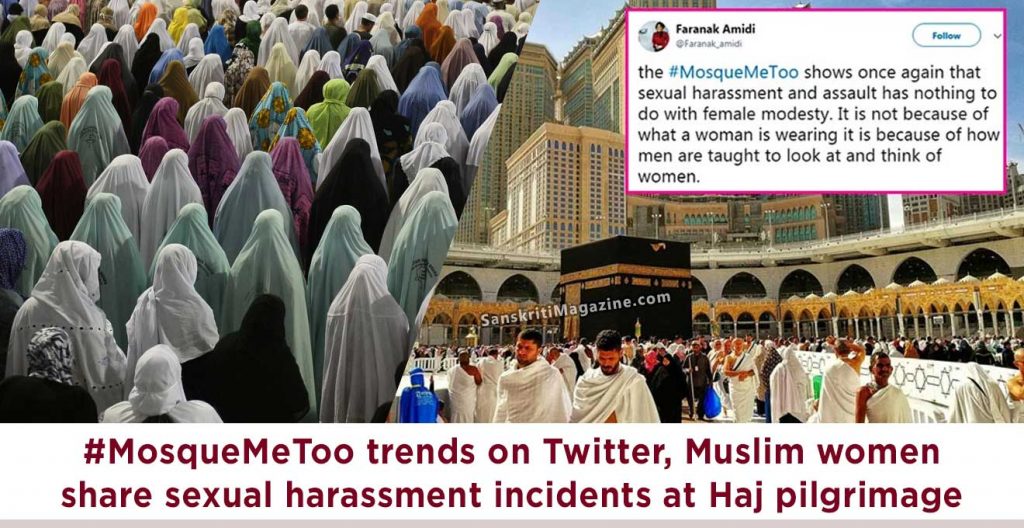
However, many females devotees have had some unpleasant experiences during the Haj pilgrimage and they are now rallying behind the hashtag Mosquemetoo to share their experiences of sexual harassment during their visit to Mecca and other religious centres.
#Mosquemetoo was actually started by Egyptian-American feminist and journalist Mona Eltawy, who first shared her experiences on social media.
She first spoke out about being sexually assaulted during the Hajj pilgrimage at the age of 15.
Mona Eltawy’s posts caught the attention of thousands of Muslim men and women across the globe who started sharing their experiences using the hashtag #Mosquemetoo, which even become one of the top ten trends on Farsi Twitter.
Using the hashtag, several users shared with others how they were groped or inappropriately touched by someone in the crowd during Haj.
Many of them also challenged the idea that wearing the hijab keeps women safe from assault and harassment.
In Islam, women are encouraged to cover their hair and body in public in order to preserve decency and keep themselves safe from male attention and from harassment and assault.
Importantly, a large number of Iranian women had recently removed their hijabs in protest against the country’s mandatory Islamic dress code in capital Tehran.