By DAVID FRAWLEY @davidfrawleyved
They have rejected scholarly views that opposed
their historical theories primarily on political grounds.
Some years ago, I began studying the Vedas in Sanskrit as part of an examination of Sri Aurobindo’s teachings. It soon became clear to me that historical interpretations of ancient India based upon the Aryan invasion theory, with the idea that the Vedic people came from Central Asia, were incorrect.
I noted over a hundred references to the ocean in the oldest Rig Veda alone, including ships upon the sea and the image of the cosmic ocean. I concluded that Vedic culture, whenever it existed, must have been located by the sea. Naturally, this refuted the idea in history books that the Vedic people were invading nomads from the northwest. This led further research in the field, and caused me a to write number of books on the subject.
Strangely, though my political views were considered to be of the progressive kind in the US, where I resided, I found myself being called a fascist by leftist groups in India merely for opposing the Aryan invasion theory. How following great yogis like Sri Aurobindo made me a “fascist” opened my eyes as to how Indian Marxists deal with dissent. I soon discovered that historical studies in India were dominated by the far left, which had its own investment in power. I learned that other scholars who challenged Marxist historians in India were subject to the same type of personal attacks.
Marxist politics of history
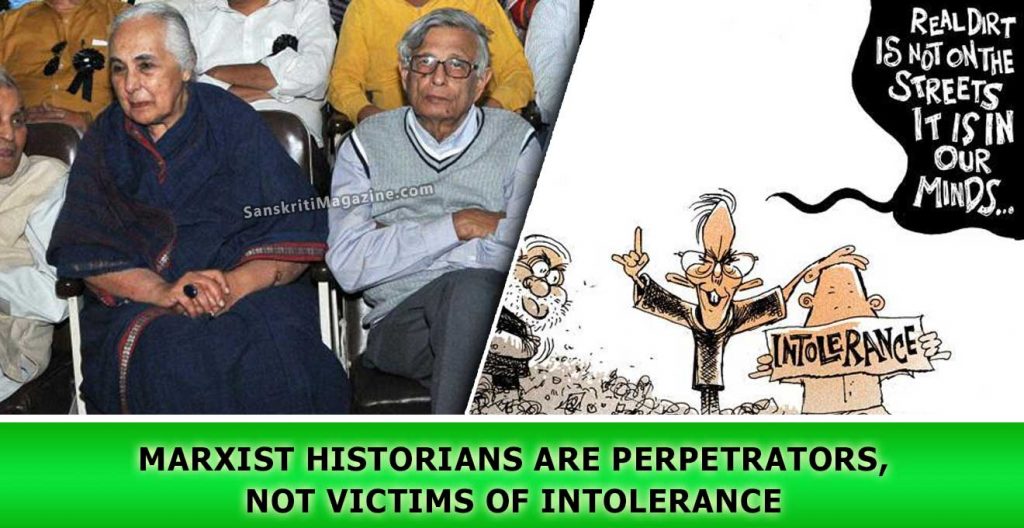
Marxist scholars in India like Romila Thapar and Irfan Habib have, until recently, controlled the interpretation of ancient India at an institutional level. Being Marxists, there is naturally little of yoga or dharma in their views, and not much regard for any indigenous tradition of India. Chinese communists similarly rejected the Dalai Lama and Chinese Buddhism as fascist.
Marxists dictated historical studies in communist and socialist countries like the Soviet Union and China, using history for propaganda to promote class warfare, which became caste warfare in India. Today Marxist historians have been removed from power in Russia, which has gone back to honouring its Tsars, and the Chinese are taking up Confucius and Buddhism. It is time for India’s Marxist historians to go the way of history as well.
These same Marxist intellectuals have ignored solid archaeological evidence, like the work of Prof BB Lal, former director of the Archaeological Survey of India (ASI), who similarly found a Vedic connection with ancient India. They have tried to ignore and discredit the work of the Geological Survey of India (GSI) and its extensive data on ancient river systems according to which the Vedic Saraswati river dates from before 2000 BCE and was the main centre of civilisation in the country.
Marxists have rejected such scholarly views that opposed their historical theories primarily on political grounds, not owing to their own research in archaeology or geology. Almost every scholar, in the East or West, who has questioned the Marxist view of ancient India has been subject to political, if not personal defamation by the same leftist scholars who today portray themselves as the victims of intolerance. They have not been the victims but rather the perpetrators of intolerance for decades.
Marxism is not an approach based upon reason or cultural sensitivity but puts political ideology above the pursuit of knowledge. It lacks the deeper insight necessary to understand India’s great civilisation and its dharmic traditions.
Behind the charge of intolerance
So when Indian Marxists speak of intolerance, particularly relating to historical issues, we must take a good look at their own biases and their efforts to suppress evidence and inhibit any scholarship that does not agree with them.
A few years ago, I was part of a conference explaining the Vedic view of ancient India at the Jawaharlal Nehru University (JNU), the hotbed of Marxist thought in India. At the end of the session, one of the students stated that our conference had presented a convincing case as to why ancient India was Vedic, but emphasised that such information “should be suppressed, even if it is true, because it is advantageous to Hindu political groups”.
We see the same mentality today. It is not a question of truth but loss of power and patronage that motivates the charge of intolerance from eminent Marxist historians.