IndianSanskriti

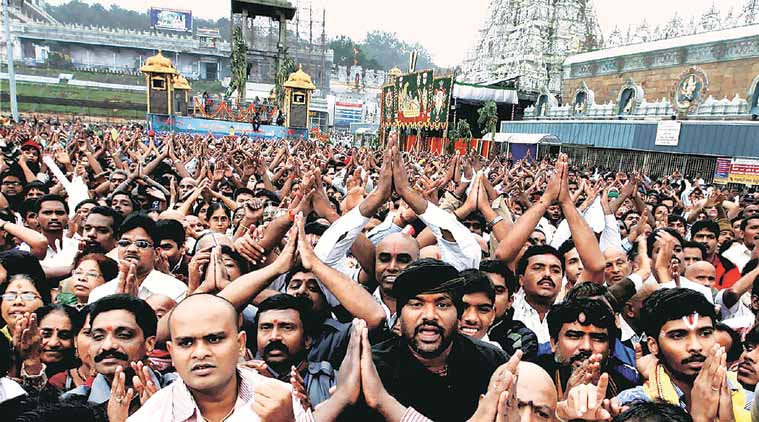
Madras High Court stays temple dress code order

The HC had prescribed dhoti and shirt or pyjama “with upper cloth” for men and saree or half-saree or churidar “with upper cloth” for women.

The Madurai bench of the Madras high court on Monday granted an interim stay on its order to impose a dress code for visitors to temples run by the Hindu Religious and Charitable Endowments Department of Tamil Nadu.

The dress code was imposed on November 26, with Justice S Vaidyanathan hearing a petition seeking the court’s permission to hold a cultural programme at a temple in Trichy district, observing that a dress code was necessary to restrict devotees from wearing improper clothing. The state government subsequently responded that it was not possible to follow a uniform dress code. Monday’s order granting an interim stay until January 18 also followed petitions from women’s organisations challenging the single-judge bench’s order passed in November 2015.

Justice Vaidyanathan’s order came into effect on January 1. “According to Christianity, a general lesson from the New Testament is that we should dress for public worship in a way that is generally considered appropriate,” the controversial judgment had stated.

“Standards of dress are different from church to church and change over time, but we should avoid any style of dress that is offensive or sends a message opposing the church community’s values.”

The court observed that Islamic norms also insist on a dress code. For women, the court said, sleeves should reach the wrists and the head should be covered by a scarf. “Pants or skirts that are too revealing, clingy, or tight should not be worn and the dress permissible to men for worship is that they should wear long pants and plain shirts without messages or slogans when visiting mosques,” it said. “Short-sleeved shirts are acceptable as long as the sleeves are not shorter than average.”

Days after his judgment, Justice Vaidyanathan and two fellow judges — Justices N Kirubakaran and S Ilavazhagan, Registrar (Administration) of the Madras High Court — had visited three temples in Dindigul district in traditional clothes prescribed in the dress code.

You may also like

Search the website

Like us on Facebook

Get daily updates via Email

Enter your email address:

Recent Posts

Purushottam Maas — The Month No Deity Would Claim, and the Lord Who Made It Supreme

Every month of the Hindu calendar has a lord — except the rare thirteenth, the Adhika Maas, born an orphan and shunned as the “impure month.” The Puranas tell how this rejected month went in grief to Bhagavan Vishnu, who claimed it, gave it His own name — Purushottam — and made it the most fruitful month of all. The origin story, the teaching, and what it means for Purushottam Maas 2026 (May 17 – June 14).

Padmini Ekadashi 2026 — The Ekadashi Even the Devas Descend to Keep

Padmini Ekadashi 2026 — The Ekadashi Even the Devas Descend to Keep

The rarest Ekadashi of the entire Hindu calendar is three days away. The Padma Purana preserves a conversation between Bhagavan Krishna and Yudhishthira about a single Ekadashi the great Rishis spend lifetimes waiting for — Padmini. The Vrat Katha of Queen Padmini of Mahishmati, the lotus teaching, and why May 27, 2026 is the morning Vaishnavas across Bharata are preparing for.

Varada Chaturthi 2026 — The Rare Ganesha Day of Purushottam Maas

Varada Chaturthi 2026 — The Rare Ganesha Day of Purushottam Maas

Once every 2.5–3 years — when the rare 13th month of Adhika Maas opens — a thirteenth Vinayaka Chaturthi appears. The Mudgala Purana calls it Varada Chaturthi, the “boon-giving” Chaturthi, and holds it as the most fruit-bearing Ganesha day of the entire calendar. Today, Wednesday May 20, 2026, is that day.

Padmini Ekadashi 2026 — The Rare Ekadashi That Comes Only in Purushottam Maas

Padmini Ekadashi 2026 — The Rare Ekadashi That Comes Only in Purushottam Maas

Padmini Ekadashi 2026 falls on Wednesday, May 27 — the Shukla Paksha Ekadashi of Adhika Maas, the rarest Ekadashi in the entire Hindu calendar (it appears only every 2.5–3 years). The Padma Purana conversation between Bhagavan Krishna and Yudhishthira, the Vrat Katha of Queen Padmini, complete vrat vidhi with jagrana, mantras, and the lotus symbolism that gives the Ekadashi its name.

Ganga Dussehra 2026 — The Day Maa Ganga Came Down to Bhagiratha

Ganga Dussehra falls on Monday, May 25, 2026 — commemorating the day Maa Ganga descended from Vaikuntha to the earth through the millennia-long tapasya of King Bhagiratha. The full account from the Valmiki Ramayana, snan vidhi, dana traditions, mantras, and the teaching of sustained sincerity.

css.php