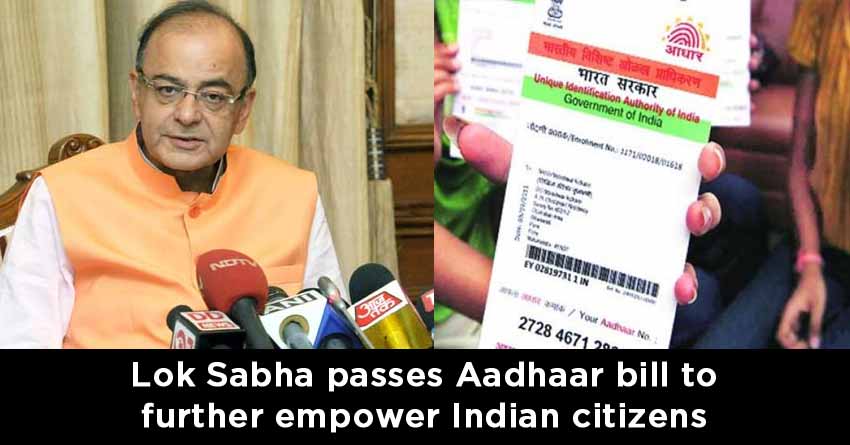
The Lok Sabha on Friday passed the Aadhaar bill to give legal teeth to the government in ensuring its subsidies and services reach the intended beneficiaries directly, thereby going beyond the scheme’s current mandate of merely assigning a unique identity to residents.
The Aadhaar (Targeted Delivery of Financial and Other Subsidies, Benefits and Services) Bill, 2016, was passed by the Lok Sabha with voice vote after a brief debate, during which Finance Minister Arun Jaitley assured the house that details provided for the card will not be misused in any manner.
When enacted, the bill will empower the government in providing targeted services to the intended beneficiaries by assigning them unique identity numbers, called Aadhaar. It will be given to every person who has stayed in India for 182 days in the year preceding the date of application.
During the debate, Jaitley said there is an “element of urgency” in passing the bill and urged the Congress party not to oppose or “even delay” its passage. All amendments to the bill moved by members of opposition parties were either defeated or withdrawn.
“Learning from the experience, we have improved upon the idea,” Jaitley said and also maintained that the bill should also not be delayed by sending it to any parliamentary panel. “We have gone through it for seven years,” he said.
Jaitley also said the bill tabled by the previous government in 2010 did not conceive the purpose of such a unique identification. This, he added, evoked public debate — and even in courts — on the intended legislation trespassing on the rights of citizens.
Biju Janata Dal member Tatagatha Sathpathy, who represents Dhenkanal constituency in Odisha, said he and his party were opposing it. But Jaitley rejected his apprehensions that Aadhaar card can be misused for “ethnic cleansing”.
The finance minister also defended the move to turn it into a money bill, even as the opposition Congress objected to the move. The party’s floor leader Mallikarjun Kharge said the previous one piloted by his party-led regime in 2010 did not term it as one.
Kharge also alleged the government intented to call it a money bill, motivated by an apprehension that the draft legislation may face hurdles in the Rajya Sabha, where the ruling coalition does not enjoy a majority.
But Jaitley said the new bill is “unlike” the previous one moved by the Manmohan Singh government in 2010. The finance minister said its core focus was on the money the government will spend for beneficiaries and not a mere identification document.
“This bill deals with one primary focus and that is: Whoever gets benefit from the Consolidated Fund of India, either state government or the Centre and other institutions — the person is entitled to have an Aadhaar card.”
Regarding the coverage, Jaitley said 97 percdnt of adult Indians now have an Aadhaar card, while 67 percent children also have been enrolled for it. He added that 5-7 lakh people are being added to the system each day.
Among the other features of the bill, it calls for the government to ask a person to apply for one if he does not have an Aadhaar number, while providing alternative means of identification in the interim.
The card can be used as proof of identity, but not as a proof of citizenship or domicile.
Jaitley said the Aadhaar number will not be misused since the overseeing authority can respond to an authentication query only with a positive, negative or other appropriate response. He said it is not permitted to share the biometric attributes. These include finger prints and iris scans.
The details can be shared only under two circumstances: National security and court order.
The bill also calls for an imprisonment of up to three years and the minimum fine of Rs.10 lakh on a person for extending unauthorised access to the centralised data-base — or for revealing any information stored in it.
Jaitley also made a strong case for streamling the country’s subsidy regime. “Subsidies should be targeted,” he said, “Those who are undeserving should be phased out.” He said the system, under which earlier he himself got subsidies for kerosene, needed to be corrected.