IndianSanskriti
India’s national emblem

India’s National Emblem

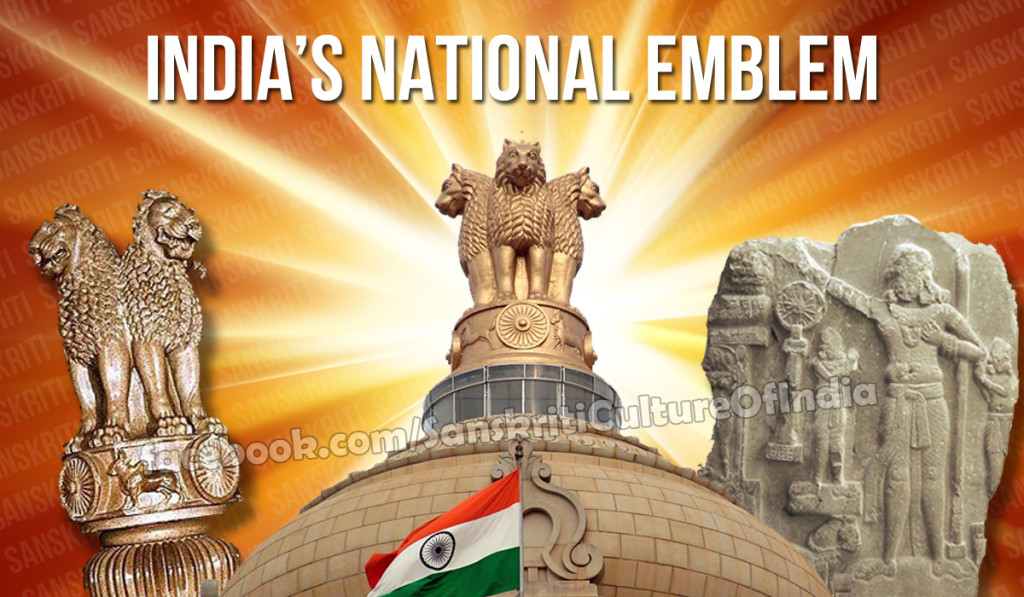
The lion capital of the Ashoka pillar at Sarnath in Uttar Pradesh is probably the most ubiquitous symbol in India. Being India’s national emblem, it adorns the nation’s currency notes and coins, government documents and even the cover of the Indian passport. But do you know what it means? Read on to know more about the history and symbolic meaning of the lion capital.King Ashoka, the renowned conqueror-king of India who later became a Buddhist, erected several pillars during his reign (3rd century BC) to propagate the teachings of the Buddha. The most famous of these pillars is the fifty-foot tall Sarnath pillar that marks the site of the Buddha’s first sermon. The national emblem of India is an adaptation of the lion capital that once sat atop this pillar.

The original lion capital has four lions (the fourth is hidden from view) perched on a circular platform engraved with four small animal figures – an elephant, a bull, a horse and a lion. The animals are separated by wheels known as Dharma Chakras or wheels of righteousness. In the adapted emblem, there is only one wheel in the centre. The platform rests on an inverted lotus flower – this does not figure in the national emblem.

So, what does the lion capital symbolize?

The lions are considered to be symbols of power, courage and victory. While the four animals were originally supposed to represent the four stages in the life of the Buddha, a more secular interpretation is that it stands for the four directions. The Dharma chakra, which epitomizes the triumph of righteousness, has twenty-four spokes representing the hours in a day.

The Indian national emblem has the words “satyameva jayate” inscribed in Devanagari script beneath the lion capital. This phrase from the Mundaka Upanishad literally means “truth alone triumphs”. Thus the emblem is a depiction of the eternal and universal power of righteousness and truth.
You may also like

Search the website

Like us on Facebook

Get daily updates via Email

Enter your email address:

Recent Posts

Sanskriti Calendar 2026

We are delighted to present the 2026 Sanskriti Calendar – a thoughtfully curated blend of timekeeping and

Why Swami Vivekananda’s Chicago Speech Still Resonates Today

On 11 September 1893, Swami Vivekananda’s “Sisters and Brothers of America” reset the world’s conversation on faith and fellowship. More than a century later, his call for universal brotherhood, respect for diversity, and service over ritual feels newly urgent. In a polarised, hyper-connected age, Vivekananda offers a practical ethic: expand, don’t contract—build character, seek truth, and serve the weakest first.

css.php