IndianSanskriti
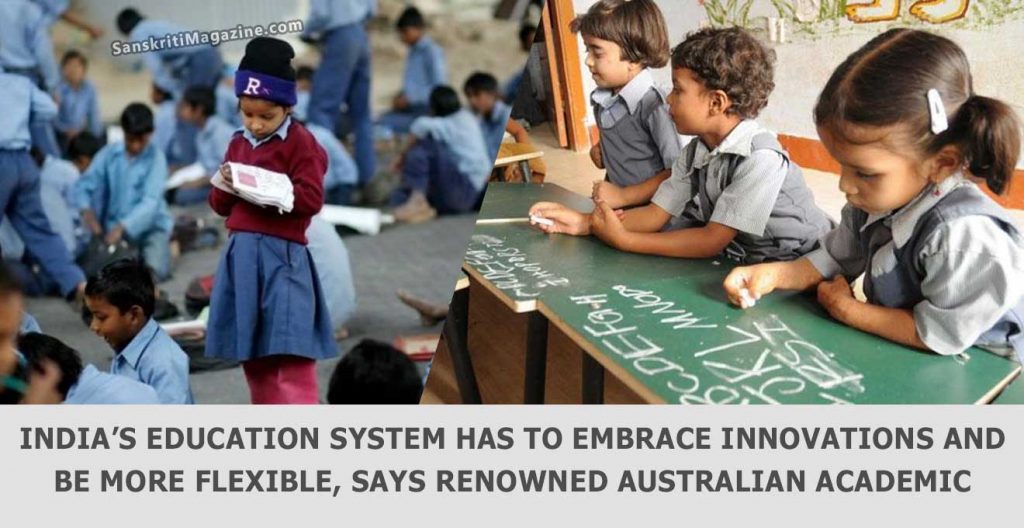
India’s education system has to embrace innovations and be more flexible, says renowned Australian academic

India’s education system has to embrace innovations and be more flexible, says renowned Australian academic

An Australian academic has said that the education sector in India must embrace innovations, disruptions in technology, and in a sense, reinvent itself to be relevant and attractive globally.

Taking part in the recently held INBUSH 2018- International Research Conference, Professor Martin George Bean, Vice Chancellor, RMIT University, Australia, stressed that tertiary education in almost all countries is trapped in yesterday’s model.

“The education sector needs to embrace innovations and disruptions in technology, thereby re-inventing itself. The education sector in any country needs to be in sync with society’s demands, industry’s demands and demands of the students. It needs to be a lot more flexible, “he said.

Professor Bean strongly advocated democratisation of tertiary education and opening it up through digital education. He said doing otherwise would be a massive disservice to a generation of human beings.

He remarked that young leaders of today are looking for skills and not just degrees and diplomas.

He warned that ten years from now, robots will change the way work is done in India, especially in law firms, Artificial Intelligence, marketing companies and advertisement companies.

He said, “50% of the jobs are at the risk of replacement in next 20 years. He implored that there is a need for universities to prepare students for life and work, just like RMIT University where skills for an exponential economy such as critical thinking, entrepreneurship, and adaptability are nurtured in students.”

Bimal Sikdar, Director, Ministry of Skill Development and Entrepreneurship stressed that the information flow and knowledge component has increased amongst today’s youth, but no matter how much knowledge or information one may have, what matters is how well that knowledge or information can be applied.

He opined that very soon a time would come when skill, information, and education will integrate, increasing the employability factor of the youth of the country.

(With inputs from ANI)

You may also like

Search the website

Like us on Facebook

Get daily updates via Email

Enter your email address:

Recent Posts

Yogini Ekadashi 2026 — The Yaksha Who Missed the Morning Flowers, and the Ekadashi That Undid His Curse

On Friday, July 10, 2026, the rare Krishna Paksha Ekadashi of Nija Ashadha arrives. The Padma Purana tells the story of Hemamali — the Yaksha gardener of Bhagavan Kubera in Alaka, whose single morning of distraction with his wife Vishalakshi cost him his form, his wife, and his celestial city. Cursed to wander the earth of Bharata as a leper for a long time, he was at last shown the way back by Sage Markandeya — a single sincere keeping of Yogini Ekadashi.

Jamai Shashthi 2026 — The Story of Maa Shashthi, the Cat, and the Wife Who Was Forgiven

Jamai Shashthi 2026 — The Story of Maa Shashthi, the Cat, and the Wife Who Was Forgiven

On Saturday, June 20, 2026, Bengali households across Bharata will welcome their married daughters and sons-in-law home for the legendary jamai-aador feast and perform the Shashthi Vrata. But behind the warmth lies a story most Bengalis know by heart and most non-Bengalis have never heard — the wife who stole the hilsa, blamed the cat, lost six sons to Maa Shashthi’s wrath, and was finally forgiven. The Vrat Katha, the vidhi, the mantras, and the deeper teaching.

Vat Purnima 2026 — The Wife Who Argued Yama Into Returning Her Husband’s Life

On Monday, June 29, 2026, women across Maharashtra, Gujarat, and southern Bharata will tie red thread around banyan trees and hear the story of Savitri — the wife who walked behind Yamaraja Himself when He came for her husband, and out-argued the Lord of Dharma into returning Satyavan’s life. The Mahabharata’s Pativrata Mahatmya Parva, the vrat vidhi, and why the banyan witnessed everything.

css.php