The third class will include religious and spiritual leaders, often engaged by candidates to mobilise their followers.
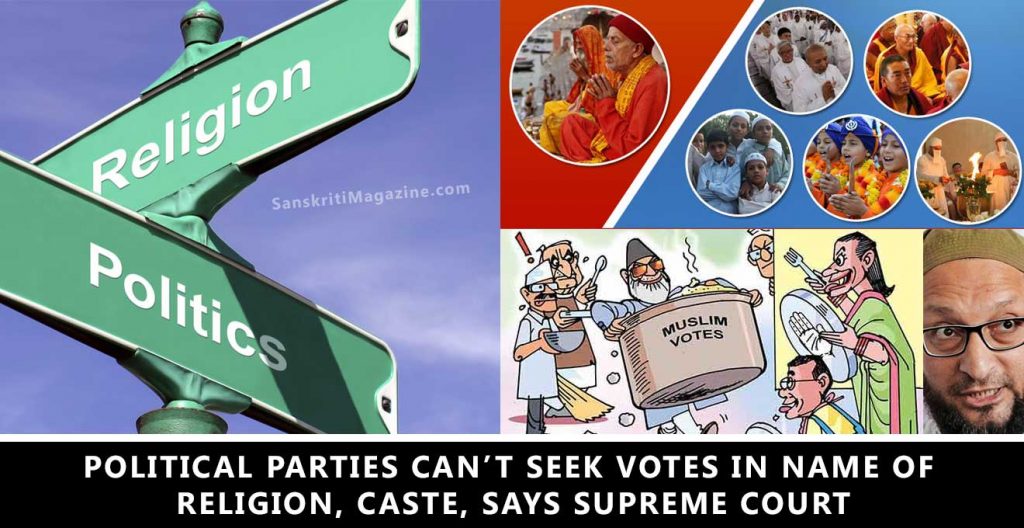
As parties brace for assembly elections in seven states including Uttar Pradesh, Punjab and Gujarat in 2017, the Supreme Court Monday ruled that “religion, race, caste, community or language would not be allowed to play any role in the electoral process” and that election of a candidate would be declared null and void if an appeal is made to seek votes on these considerations. By a 4-3 majority ruling, a seven-judge Constitution Bench held that an election will be annulled not only if votes are sought in the name of the religion of the candidate but also when such an appeal hinges on religion of voters or candidate’s election agents or by anybody else with the consent of the candidate.
The third class will include religious and spiritual leaders, often engaged by candidates to mobilise their followers. The majority view interpreted Section 123(3) of the Representation of the People Act to mean that this provision was laid down with an intent “to clearly proscribe appeals based on sectarian, linguistic or caste considerations; to infuse a modicum of oneness, transcending such barriers and to borrow Tagore’s phrase transcend the fragmented ‘narrow domestic walls’ and send out the message that regardless of these distinctions, voters were free to choose the candidate best suited to represent them.”
Section 123(3) of the Act defines as “corrupt practice” appeals made by a candidate or his agents to vote or refrain from voting for any person on the ground of “his” religion, race, caste, community or language. What came up for interpretation before the Constitution Bench was the meaning of the term “his” since that would define whose religion it has to be when an appeal is made. Previous judgments handed out conflicting views and hence the question came up before the seven judges.
In their majority view, Chief Justice of India T S Thakur, Justices Madan B Lokur, S A Bobde and L Nageswara Rao ruled in favour of a purposive interpretation, stating that “his” would mean religion of candidate, his agents, voters as well as any other person who, with the candidate’s consent, brings up religion in an appeal for the furtherance of the prospects of the election. “An appeal in the name of religion, race, caste, community or language is impermissible under the Representation of the People Act, 1951 and would constitute a corrupt practice sufficient to annul the election in which such an appeal was made regardless whether the appeal was in the name of the candidate’s religion or the religion of the election agent or that of the opponent or that of the voter’s,” the majority judges ruled.
The bench, however, refrained from revisiting its 1995 judgment on whether the words “Hindutva” and “Hinduism” connote the “way of life” of the Indian people and not just Hindu religious practices. According to this three-judge bench judgment of 1995, an appeal in the name of ‘Hindutva’ to seek votes was not a corrupt practice warranting disqualification of a candidate as it was ‘a way of life’ and not a religion. Since this judgment also formed the clutch of matters being examined by the seven judges, the issue regarding revisiting the meaning of “Hindutva” and “Hinduism” also came up but the Constitution Bench judgment Monday remained silent on it. Meanwhile, Justices Adarsh K Goel, Uday U Lalit and D Y Chandrachud dissented with the majority view, holding that the expression “his” used in conjunction with religion, race, caste, community or language is in reference to the candidate, in whose favour the appeal to cast a vote is made, or that of a rival candidate when an appeal is made to refrain from voting for another.
“To hold that a person who seeks to contest an election is prohibited from speaking of the legitimate concerns of citizens that the injustices faced by them on the basis of traits having an origin in religion, race, caste, community or language would be remedied is to reduce democracy to an abstraction,” the minority judgment said. “Electoral politics in a democratic polity is about mobilisation. Social mobilisation is an integral element of the search for authority and legitimacy. Hence, it would be far-fetched to assume that in legislating to adopt Section 123(3), Parliament intended to obliterate or outlaw references to religion, caste, race, community or language in the hurly burly of the great festival of democracy,” it said, and added that “his” in Section 123(3) cannot validly refer to the religion, race, caste, community or language of the voter.
But the majority view overruled this, pointing out that electoral processes are secular activities of the State and that religion can have no place in it. “The State being secular in character will not identify itself with any one of the religions or religious denominations. This necessarily implies that religion will not play any role in the governance of the country which must at all times be secular in nature. The elections to the State legislature or to the Parliament or for that matter or any other body in the State is a secular exercise just as the functions of the elected representatives must be secular in both outlook and practice,” the CJI held.
Justice Thakur noted that the Constitutional ethos forbids mixing of religions or religious considerations with the secular functions of the State and that religion remains a matter personal to the individual with which neither the State nor any other individual has anything to do. “An interpretation that will have the effect of removing the religion or religious considerations from the secular character of the State or state activity ought to be preferred over an interpretation which may allow such considerations to enter, effect or influence such activities,” Justice Thakur said.
Justices Lokur and Rao underlined that concerns under Section 123(3) of the Act have increased with the tremendous reach already available to a candidate through the print and electronic media, and now with access to millions through the Internet and social media as well as mobile phone technology, none of which were seriously contemplated till about fifteen years ago.
“Therefore now, more than ever, it is necessary to ensure that the provisions of sub-section (3) of Section 123 of the Act are not exploited by a candidate or anyone on his or her behalf by making an appeal on the ground of religion with a possibility of disturbing the even tempo of life,” they maintained.
Justice Bobde, in a separately authored judgment, said that the provision intended to serve the broad purpose of checking appeals to religion, race, caste, community or language by any candidate. “That to maintain the sanctity of the democratic process and to avoid the vitiating of secular atmosphere of democratic life an appeal to any of the factors should avoid the election of the candidate making such an appeal,” the judge said, adding that Section 123(3) has to be interpreted in a manner that leaves no scope for any sectarian caste or language-based appeal.