



Bhadrapada begins today in North India, opening a lunar month that moves from the midnight

The 12 Jyotirlingas of Lord Shiva — where each stands, its sacred story, and how to make the Dwadasha Jyotirlinga pilgrimage in person or in spirit this Shravan.

The Rudrabhishek is the abhishekam said to please Lord Shiva fastest. What it is, the meaning of each sacred substance, the Sri Rudram, and how it is performed at home this Shravan.

Shravan runs July 30–Aug 27 in 2026, with four Sawan Somwars (Aug 3, 10, 17, 24). Why the whole month belongs to Mahadeva — the churning of the ocean, the poison He drank, and how to keep the Sawan vrat.

Thiruvonam 2026 falls on Wednesday, August 26 — the crown of Kerala’s ten-day festival. The Bhagavata story of King Mahabali and the Vamana avatar, and why Onam is a homecoming, not a defeat.




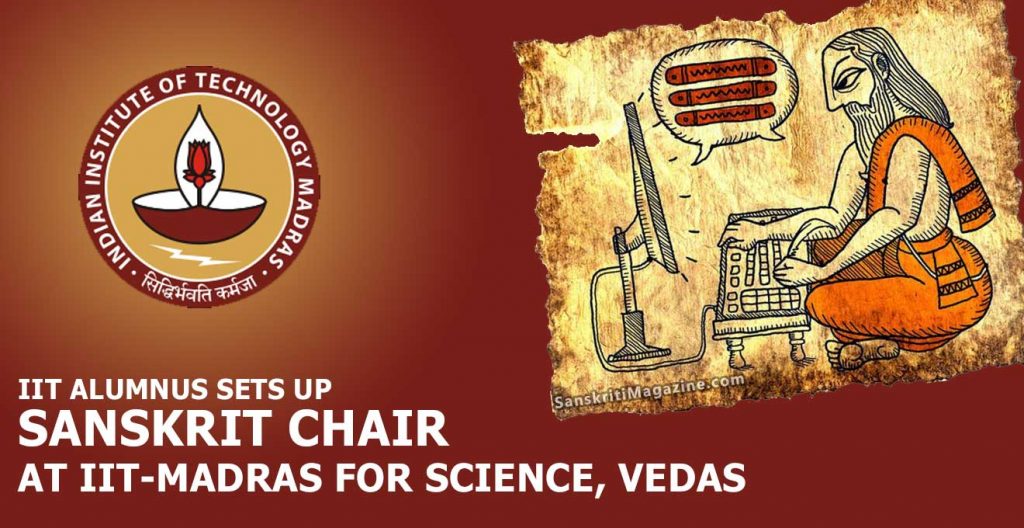
The Indian Institute of Technology-Madras (IIT-M) will soon get a ‘Sanskrit Chair’, attached to the Department of Humanities and Social Sciences, to study “India’s legacy of science and technology in the Vedas, with special focus on Sanskrit language”.
The Chair has been funded by Sant Rajinder Singh Ji Maharaj, “spiritual head” of the Science of Spirituality and Sawan Kirpal Ruhani Mission, who is also an IIT-M alumnus.
A senior IIT-M administrator said Maharaj has contributed Rs 90 lakh for the endowment and scholarship programme. “Using this fund, we will set up the Chair to explore science and technology in the Vedas,” said the official.
The funding includes a one-time contribution of Rs 75 lakh, and a named endowment for student scholarship — Rs 15 lakh annually, for four years.
The Chair will be headed by Sampadananda Mishra, a Sanskrit expert and director of Sri Aurobindo Foundation for Indian Culture (SAFIC).
“I have a yogic approach to science and culture. Sanskrit is a scientific language, it is a language that expresses India’s soul. I hope I will be able to make this language familiar for the youth in IIT-M,” said Mishra, who has written books like The Wonder That Is Sanskrit and Hasyamanjari-A Book Of Humorous Stories In Sanskrit.
“I hope to take charge within a month. I want to show them the great scientific contributions of rishis and saints in ancient India. I have developed a course for students on the achievements of ancient Indian scientists through Sanskrit,” he said. “The freedom within the Chair allows me to introduce credit courses on Sanskrit and India’s ancient science and technology. Students can enrol for PhD programmes on these topics,” he said.
Mishra, who has also brought out audio CDs on the subject, said it was one of his listeners, a faculty member of IIT-M’s chemical engineering department, who first proposed the idea of a Chair named after Maharaj.
“People don’t understand Sanskrit,” he said, adding that the language is always interpreted as being linked to religion or Hinduism. “It is a language which facilitated the progressive evolution of humanity. It is a language that helps scientists, because Sanskrit and Science could go hand in hand. For instance, there are 27 different words for water in Sanskrit, when it is a mere object for scientists. Imagine if we could teach our young scientists about 27 dharmas of water beyond their usual understanding of it as as an object,” said Mishra, who did his doctorate from Utkal University on “Sanskrit and the evolution of human speech”.
IIT-M director Bhaskar Ramamurthy said he was not aware of the academic objectives of the new Chair, but confirmed that Maharaj had contributed funds for the purpose. “Usually, we appoint experts with a PhD in such Chairs. Those who fund the Chairs can make suggestions on the subject or persons to be appointed, and the final decision is taken by the concerned academics here. I do not know the exact details of this Chair,” he said.
Maharaj, the spiritual head of Science of Spirituality based in Delhi, completed his B.Tech degree in Electrical Engineering from IIT-M in 1967. In a blog post on IIT-M’s official site, he has explained how scientific method can be applied in spirituality too. “As in a science lab, we start with a hypothesis and test it… The same approach could be used to test the spiritual hypothesis of whether there is a higher power… The difference is that instead of testing in a physical laboratory, the spiritual hypothesis could be tested within the laboratory of the human body,” he has said.
His profile says that he “had a successful 20-year career in engineering, communications and technology”, before he became “spiritual master of meditation on the inner light and sound”.