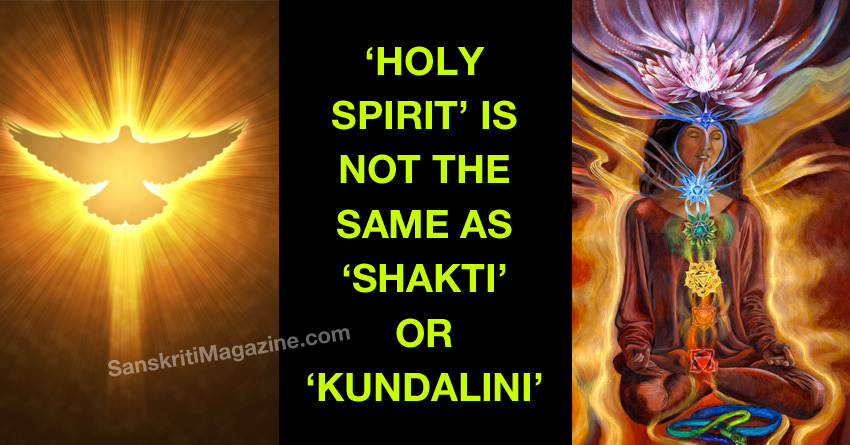
In the fashionable search for sameness in all religions, Holy Spirit in Christianity is often equated with Shakti or kundalini in Hinduism. However, these terms represent different, even incompatible cosmologies.
Early Vedic literature describes a supreme being whose creative power (Shakti) manifests the universe. Shakti is subsequently systematized as the Universal Goddess with sophisticated theology and worship. She is the matrix and primordial material substance of the universe, its consciousness and power, and the agency differentiating all forms.
In Christianity, though the Holy Spirit is also “within” the human, there is a strong emphasis on the descent from above or outside. Furthermore, unlike Shakti, the Holy Spirit is not seen as the essence of human selfhood (“soul”) or the essence of the cosmos.
Christianity assumes an inherent dualism between God and creation. This necessitates historical revelations along with prophets, priests and institutions to bring us the truth. But Shakti, being all-pervading, obviates dependence on these; its experience can be discovered by going within through yoga. Since the universe is nothing but Shakti’s immanence, nearly every Hindu village worships its own form of the Goddess as the deity. Eco-feminism is built into the cosmology.
Shakti is always available to be experienced in our physical body as a series of currents, with seven focal points called chakras. A powerful concentration of Shakti known as kundalini lies dormant at the base of everyone’s spine. Numerous spiritual techniques can arouse kundalini and channel it upward through the chakras, awakening one into unity consciousness.
The human body is conceived differently in Christianity: on the one hand created in the image of God, yet it is also the means of transmitting original sin and lays a person open to “evil spirits.”
In Hinduism, the guru helps awaken the disciple’s kundalini and integrate the experience into ordinary life. The experience is not interpreted through a specific history as in Christianity. Kundalini-like manifestations have occurred sporadically among Christians, but mainstream churches treat them as aberrations and even as the work of the devil. Those who have such experiences are conditioned to doubt their own sanity and are often regarded as mentally ill and even institutionalized.
In Hinduism, there is no evil spirit or demonic Shakti. Rather, Shakti encompasses all polarities, being simultaneously one and many, light and dark, supportive and violently transformative; both sides of such pairs must be integrated in spirituality. Hinduism easily embraces the fierce, dark Kali alongside the nurturing Parvati. Christianity’s emphasis on good/evil dualism results in fear of possession by evil spirits. This is often projected onto heathen or pagan religions, and particularly onto Kali, whose aesthetics shock Westerners. The name of Jesus is sometimes invoked, or a Bible kept on hand, to get rid of such evil spirits.
Hinduism sees that any negative effects of kundalini awakening stem from the individual’s preconditioning and nature, and not from evil spirits. Electricity is a helpful analogy. Neither inherently good nor evil, each electrical mechanism responds according to its own qualities. Yogis have fearlessly experimented with kundalini just as scientists do with electricity.
Shakti is explicitly feminine and has myriad representations. The Holy Spirit has also at times been conceived as female, yet, Christianity’s most prominent female figure, the Virgin Mary, is not identical with the Holy Spirit. The Holy Spirit mysteriously incarnates Jesus in Mary’s womb, but this experience is exceptional and is impossible in other humans (whereas Shakti can be experienced by everyone). There are no spiritual practices designed to elicit Mary’s experience in all Christians, except metaphorically.
Many cross-cultural experts draw a parallel between kundalini awakenings and the phenomena associated with Pentecostal worship. Like shaktipat, or guru-awakened kundalini, Pentecostal experiences can involve extreme bodily responses triggered by a charismatic leader. However, to contain the risk of heresies, these experiences are carefully coded within the context of the historical struggle for salvation from sin that is available only by the grace of Jesus. Unlike Shakti, the Holy Spirit is not experienced as one’s inner essence manifesting through personal yoga but as an external and transcendent force invoked by communal prayer. Pentecostals are especially alert to the danger of evil spirits, and warn against any spiritual experience coming from a non-Christian, making a Hindu guru especially suspect.
Many Westerners have appropriated aspects of the Hindu Goddess to address issues within Christianity, in particular its patriarchy, institutions, weak ecological base and absence of yoga. While this is laudable, great care must be taken that core Hindu notions such as Shakti are not imported as mere “add-ons.” Dissecting the tradition into separate parts and digesting them selectively distorts the source. Shakti cannot be domesticated.
The authentic acceptance of Shakti and kundalini by Christians is much more daunting and would entail rejecting centuries of Church inquisition against pluralistic manifestations of the divine. It would involve reinventing Christianity with the Goddess accessible directly as the Supreme Being. This would rekindle memories of paganism, polytheism and chaos.