[hr]
Prithvi Raj Chauhan is considered as the last Indian ruler of Delhi but there is another unsung hero whose name does not ring a bell in the collective memory of Indians and neither is he a household name in India.
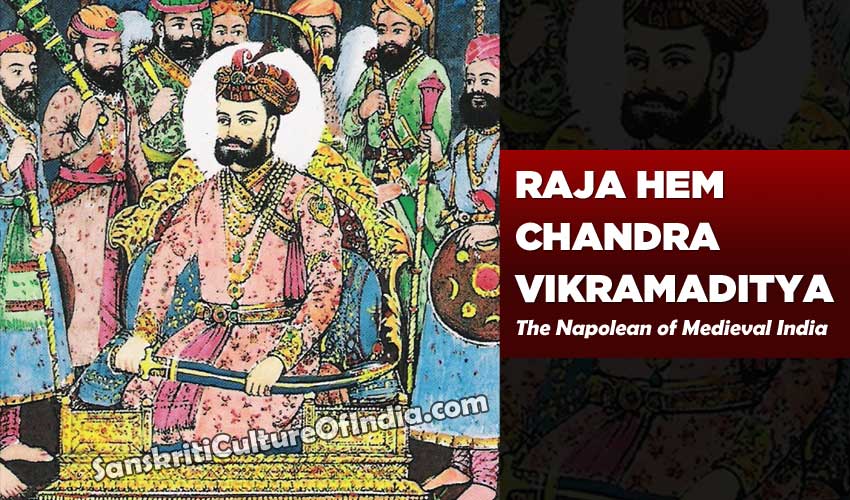
Hem Chandra Bhargawa or Hemu (1501-1556), son of Rai Puran Das, born in Alwar, Rajasthan was the Chief of Army & Prime Minister during the regime of Adil Shah Suri of the Suri Dynasty.
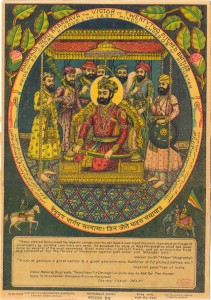 Not much is known about his childhood and early life and many historians disagree about many aspects of his life, from his birth name to his birth place and family position. They do, however, agree that he was brought up in a religious environment, educated in Sanskrit, Hindi, Persian Arabic and Arithmetic, trained in horseback riding and was fond of kushti (wrestling).
In the early 1500s, huge portions India were under afghan occupation. Under the Afghan occupation, Indians was already burdened by the crushing Jizya tax. At such point in 1526, a Central Asian tribal warrior named Babur attacked India. His armies marched from Kabul to Delhi via Punjab and soon controlled north-western India as well as parts of the Gangetic Plains.
Babur’s reign was nothing short of disaster for India in general and Hindus in particular. Guru Nanak, who was a contemporary of Babur and witnessed cruelties of Babur’s armies on the people, wrote in detail about the atrocities committed by him and his troops. Guru Nanak poignantly wrote ‘The Creator has sent Babur the Mughal as Yama disguised. There was so much slaughter that the people screamed – Didn’t you feel compassion, Lord?’
Babur died before he could consolidate his hold on India and was succeeded by his son, Humayun, who was a weakling. Sensing an opportunity, Sher Khan Suri, an Afghan commander of the Lodis attacked Humayun, defeating the Mughals in battle, driving them out and capturing Delhi in May 1540. Declaring himself the emperor, he took the name of Sher Shah Suri.
 Hem Chandra was based in Rewari and started supplying cereals to Sher Shah’s army where he came in contact with Sher Shah’s son, Ismail Shah. After Sher Shah Suri’s death in 1545, Ismail Shah succeeded him and initially appointed Hem Chandra as “Shahang-i-Bazar”, a Persian word for Market Superintendent. He later went on to become the Daroga-i-Chowki or Chief of Intelligence until Ismail Shah’s death in 1553.
After his death, Ismail Shah’s nephew Adil Shah killed Ismail Shah’s 12 year old son Firuz and usurped the throne. But he was not a capable ruler. Soon after becoming king, he appointed Hem Chandra as his Wazir or Prime Minister and started neglecting his responsibilities. Unhappy with the murder of Firuz and Adil Shah’s overall incompetence, various members of the Suri dynasty revolted against him.
During this time as Prime Minister, Hem Chandra proved his mettle. Commanding Adil Shah’s army, he fought numerous battles defeating each rebelling governor. He defeated and killed Muhammad Shah Suri – self appointed ruler of Bengal. He defeated Ibrahim Shah Suri twice. Most importantly, with these victories, he not only controlled the administration and the treasury, but also the victorious armies of the empire.
Hem Chandra fought 22 battles in a row without even a single setback, striking fear in the hearts of his enemies, before his emperor was captured and killed in Fatehpur. This was one of the crucial periods in Indian history, when the Mughals and Afghans were desperately vying for power.
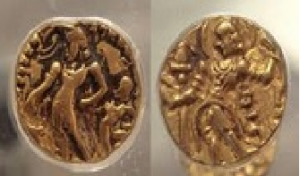
After his 22nd victory on 7th October 1556 against Tardi Beg Khan of Humayun’s Army, Hem Chandra crowned himself as the Emperor of Delhi instead of establishing the Islamic Flag of Suri Dynasty. He took the name ‘Samrat Hem Chandra Vikramaditya’, a title many kings had adopted since Vedic times. He re-established the native Hindu rule for a very brief period in North India after over 350 years of Muslim rule and even had coins struck bearing his name and title.
Hemu captured the Fort of Gwalior, Agra and Delhi, which were considered to be the most powerful forts of India. He captured areas which today comprises of Bihar, Uttar Pradesh, Madhya Pradesh, Delhi and Haryana.
His rule lasted only 1 month when on 5th November 1556, Mughal armies fought with him in the battle of Panipat and captured him in an unconscious state. It is said that Bairam Khan asked Akbar to behead Hemu to earn the title of Ghazi. So upon Bairam Khan’s request, Akbar struck Hemu and later Bairam Khan beheaded him. Some sources speak differently about his death not being quick but rather a painful one where he was slowly hacked to pieces.
His head was sent to Afghanistan to be hung outside the Delhi Darwaza in Kabul and his body was placed in a gibbet outside the Old Fort (then called the Shergarh).
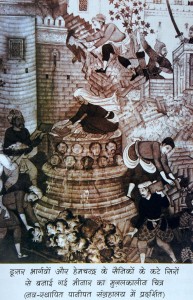
 After Hemu’s death, a massacre of Hemu’s community and followers was ordered by Bairam Khan. Thousands were beheaded and towers of skulls built with their heads, to instill terror among the Hindus. At least one painting of such minarets is displayed in the Panipat Wars Museum at Panipat, Haryana. These towers were still in existence about 60 years later as described by Peter Mundy, a British traveler who visited India during the time of Jahangir.
Today, this brave warrior is nothing but a forgotten hero whose bravery and courage have been lost in the mist of time.