By Swami Sivananda
Tulsidas was born in Rajapur, in the district of Banda in Uttar Pradesh, in Samvat 1589 or 1532 A.D. He was a Sarayuparina Brahmin by birth and is regarded as an incarnation of Valmiki, the author of Ramayana written in Sanskrit. His father’s name was Atmaram Shukla Dube and his mother’s name Hulsi. Tulsidas did not cry at the time of his birth. He was born with all the thirty-two teeth intact. In childhood his name was Tulsiram or Ram Bola.
Tulsidas’s wife’s name was Buddhimati (Ratnavali). Tulsidas’s son’s name was Tarak. Tulsidas was passionately attached to his wife. He could not bear even a day’s separation from her. One day his wife went to her father’s house without informing her husband. Tulsidas stealthily went to see her at night at his father-in-law’s house. This produced a sense of shame in Buddhimati. She said to Tulsidas, “My body is but a network of flesh and bones. If you would develop for Lord Rama even half the love that you have for my filthy body, you would certainly cross the ocean of Samsara and attain immortality and eternal bliss”. These words pierced the heart of Tulsidas like an arrow. He did not stay there even for a moment. He abandoned home and became an ascetic. He spent fourteen years in visiting the various sacred places of pilgrimage.
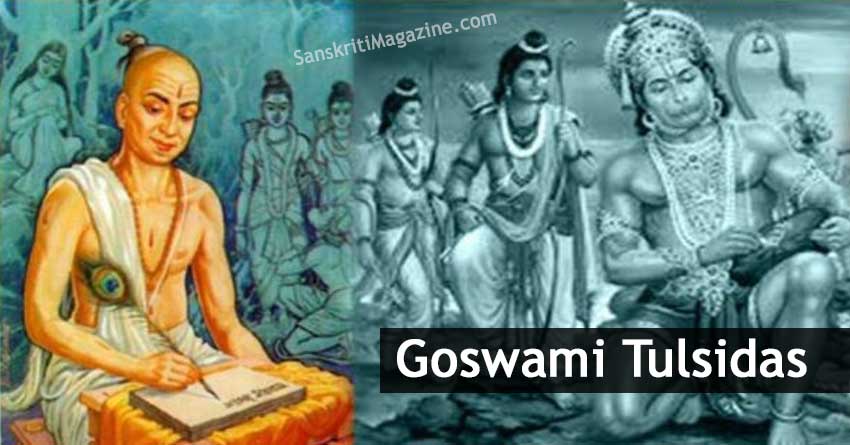
While returning from answering the calls of nature, Tulsidas used to throw the water that was left in his water-pot at the roots of a tree which a spirit was occupying. The spirit was very much pleased with Tulsidas. The spirit said, “O man! Get a boon from me”. Tulsidas replied, “Let me have Darshan of Lord Rama”. The spirit said, “Go to the Hanuman temple. There Hanuman comes in the guise of a leper to hear the Ramayan as the first hearer and leaves the place last of all. Get hold of him. He will help you”. Accordingly, Tulsidas met Hanuman, and through His grace, had Darshan or vision of Lord Rama.
Tulsidas wrote twelve books. The most famous book is his Ramayan—Ram-charit-manas—in Hindi. He wrote this book under the directions of Hanuman. This Ramayan is read and worshipped with great reverence in every Hindu home in Northern India. It is an inspiring book. It contains sweet couplets in beautiful rhyme. Vinaya Patrika is another important book written by Tulsidas.
Some thieves came to Tulsidas’s Ashram to take away his goods. They saw a blue-complexioned guard, with bow and arrow in his hands, keeping watch at the gate. Wherever they moved, the guard followed them. They were frightened. In the morning they asked Tulsidas, “O venerable saint! We saw a young guard with bow and arrow in his hands at the gate of your residence. Who is this man?” Tulsidas remained silent and wept. He came to know that Lord Rama Himself had been taking the trouble to protect his goods. He at once distributed all his wealth among the poor.
Tulsidas lived in Ayodhya for some time. Then he shifted to Varanasi. One day a murderer came and cried, “For the love of Rama give me alms. I am a murderer”. Tulsi called him to his house, gave him sacred food which had been offered to the Lord and declared that the murderer was purified. The Brahmins of Varanasi reproached Tulsidas and said, “How can the sin of a murderer be absolved? How could you eat with him? If the sacred bull of Siva—Nandi—would eat from the hands of the murderer, then only we would accept that he had been purified”. Then the murderer was taken to the temple and the bull ate from his hands. The Brahmins were put to shame.
Tulsidas once went to Brindavan. He visited a temple. He saw the image of Lord Krishna. He said, “How shall I describe Thy beauty, O Lord! But Tulsi will bow his head only when You take up bow and arrow in Your hands”. The Lord revealed Himself before Tulsidas in the form of Lord Rama with bow and arrows.
Tulsidas’s blessings brought the dead husband of a poor woman back to life. The Moghul emperor at Delhi came to know of the great miracle done by Tulsidas. He sent for Tulsidas. Tulsidas came to the emperor’s court. The emperor asked the saint to perform some miracle. Tulsidas replied, “I have no superhuman power. I know only the name of Rama”. The emperor put Tulsi in prison and said, “I will release you only if you show me a miracle”. Tulsi then prayed to Hanuman. Countless bands of powerful monkeys entered the royal court. The emperor got frightened and said, “O saint, forgive me. I know your greatness now”. He at once released Tulsi from prison.
Tulsi left his mortal coil and entered the Abode of Immortality and Eternal Bliss in 1623 A.D. at the age of ninety-one at Asighat in Varanasi.