IndianSanskriti
Tamil Nadu Will Not Allow Entry To Devotees Wearing Leggings And Skirts

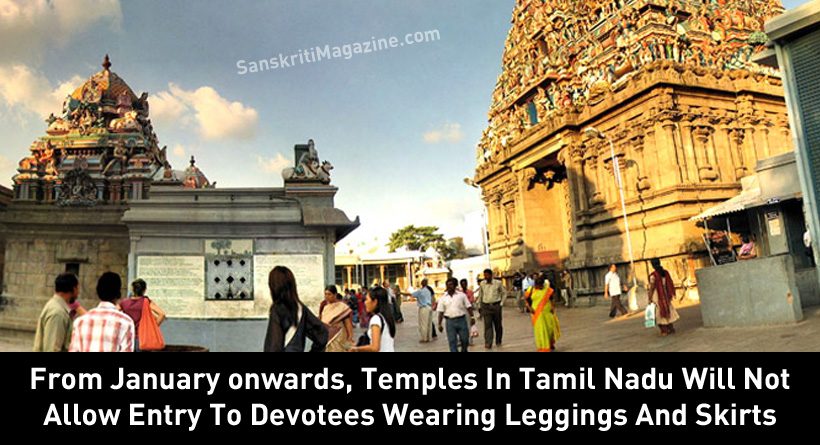
From January, Temples In Tamil Nadu Will Not Allow Entry To Devotees Wearing Leggings And Skirts

You could keep the faith but still not allowed entry into temples in Tamil Nadu from 1 January, 2016 if you’re dressed in denim pants, leggings and skirts.

According to Times Now, Tamil Nadu’s Hindu Religious and Charitable Endowments Department (HR & CE) has issued a notice to all temples, based on an earlier High Court ruling, asking them to enforce a dress code in temples.

From January, all temples under the department’s purview have to enforce the rule, reports Hindustan Times.

AIADMK spokesperson CR Saraswathi told Times Now: “This is not a government order alone. It has come from the High Court. Honourable Judge has given the statement telling that every state has their own traditional thing, so we have to follow it. It’s the court’s suggestion”.

A former commissioner of the HR & CE department told HT that the rules are not new, the court has just reinforced them. “Such rules (for Hindu temples) were already in place for many years. Each temple has had its own set of rules. One of the oldest and most important rule is that males should wear only a dhoti, while women should wear sarees. But over the years, the rules were given a go-by.”

The Madurai bench of Madras High Court had ordered earlier this month that police should ensure that men and women were following a dress code for entering temples.

Men are allowed a shirt with dhoti or pyjama and women can wear saree or a churidar-kurta combination. The upper body must be covered. There’s a dress code even for children — the court said they can wear “any fully covered dress”, according to the Indian Express.


You may also like

Search the website

Like us on Facebook

Get daily updates via Email

Enter your email address:

Recent Posts

Yogini Ekadashi 2026 — The Yaksha Who Missed the Morning Flowers, and the Ekadashi That Undid His Curse

On Friday, July 10, 2026, the rare Krishna Paksha Ekadashi of Nija Ashadha arrives. The Padma Purana tells the story of Hemamali — the Yaksha gardener of Bhagavan Kubera in Alaka, whose single morning of distraction with his wife Vishalakshi cost him his form, his wife, and his celestial city. Cursed to wander the earth of Bharata as a leper for a long time, he was at last shown the way back by Sage Markandeya — a single sincere keeping of Yogini Ekadashi.

Jamai Shashthi 2026 — The Story of Maa Shashthi, the Cat, and the Wife Who Was Forgiven

Jamai Shashthi 2026 — The Story of Maa Shashthi, the Cat, and the Wife Who Was Forgiven

On Saturday, June 20, 2026, Bengali households across Bharata will welcome their married daughters and sons-in-law home for the legendary jamai-aador feast and perform the Shashthi Vrata. But behind the warmth lies a story most Bengalis know by heart and most non-Bengalis have never heard — the wife who stole the hilsa, blamed the cat, lost six sons to Maa Shashthi’s wrath, and was finally forgiven. The Vrat Katha, the vidhi, the mantras, and the deeper teaching.

Vat Purnima 2026 — The Wife Who Argued Yama Into Returning Her Husband’s Life

On Monday, June 29, 2026, women across Maharashtra, Gujarat, and southern Bharata will tie red thread around banyan trees and hear the story of Savitri — the wife who walked behind Yamaraja Himself when He came for her husband, and out-argued the Lord of Dharma into returning Satyavan’s life. The Mahabharata’s Pativrata Mahatmya Parva, the vrat vidhi, and why the banyan witnessed everything.

Nija Jyeshtha 2026 — The Real Jyeshtha Begins, and the Calendar Resumes

Nija Jyeshtha 2026 — The Real Jyeshtha Begins, and the Calendar Resumes

With Adhik Maas now closed on the Somvati Amavasya of June 15, the long-postponed festivals of Jyeshtha return — Vat Purnima (June 29, the Savitri-Yamaraja katha), Jamai Shashthi (June 20, the Bengali festival of Maa Shashthi), Sankashti Chaturthi (June 28), Yogini Ekadashi (July 10), and Devshayani Ekadashi (July 16, opening the four-month Chaturmas of Bhagavan Vishnu’s yoga-nidra). A guide to what the next four weeks hold and what the household that kept Purushottam Maas now carries forward.

css.php