[hr]
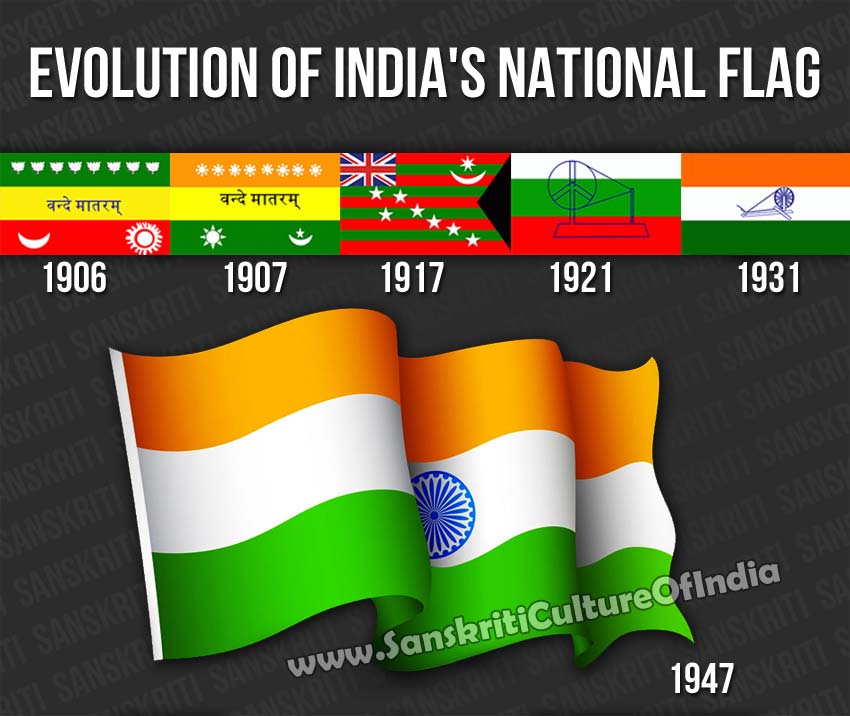
It is really amazing to see the various changes that our National Flag went through since its first inception. It was discovered or recognized during our national struggle for freedom. The evolution of the Indian National Flag sailed through many vicissitudes to arrive at what it is today. Some of the historical milestones in the evolution of our National Flag involve the following:
1906 – First Flag
- Also called Calcutta Flag or Lotus Flag
- The flag was first hoisted on 7 August 1906 at Parsee Bagan Square in Calcutta.
- This flag was composed of three colors – Green, Yellow and Red with the word – Vande Matram ( वन्देमातरम् ) inscribed in centre.
- The red strip at the top had eight white lotuses embossed on it in a row. On the yellow strip the words Vande Mataram were inscribed in deep blue in Devanagari characters. The green strip had a white sun on the left and a white crescent and star on the right.
1907 – Second Flag
- In 1907, the second form of Indian flag was hoisted in Paris by Madam Cama and her group of revolutionaries.
- Except for a few changes, the flag was similar to the first one.
- This flag was also exhibited at a socialist conference in Berlin.
1917 – Third Flag
- The third flag went up in 1917 when our political struggle had taken a definite turn. Dr. Annie Besant and Lokmanya Tilak hoisted it during the Home rule movement.
- This was the most colorful version of the Indian flag.
- This flag had five red and four green horizontal strips arranged alternately, with seven stars in the saptarishi configuration super-imposed on them. In the left-hand top corner (the pole end) was the Union Jack. There was also a white crescent and star in one corner.
- The presence of the Union Jack, however made the flag generally unacceptable.
1921 – Fourth Flag
- During the session of the All India Congress Committee which met at Bezwada in 1921 (now Vijayawada) an Andhra youth prepared a flag and took it to Gandhiji.
- The red and green color in the flag represents two communities – -Hindus and Muslims. As per Gandhiji’s suggestion, a white strip was included which indicated other religions and communities and a spinning wheel which portrays the progress of India.
- This was the flag approved by Gandhi in 1921.
- This flag was not formally adopted by the Indian National Congress, but nevertheless widely used.
1931 – Fifth Flag
- The year 1931 was a landmark in the history of the flag. A resolution was passed adopting a tricolor flag as our national flag.
- The three colors include saffron, white and green with Mahatma Gandhi’s spinning wheel or charkha in the center.
Flag of August 15 1947 – The present flag of India
- Our National Flag, which was born on July 22, 1947 with Nehruji’s words, “Now I present to you not only the Resolution, but the Flag itself”.
- This flag was first hoisted at the Council House on August 15, 1947
- In the national flag of India the top band is of Saffron color, indicating the strength and courage of the country. The white middle band indicates peace and truth with Dharma Chakra. The last band is green in color shows the fertility, growth and auspiciousness of the land.
- This Dharma Chakra depicted the “wheel of the law” in the Sarnath Lion Capital made by the 3rd-century BC Mauryan Emperor Ashoka. The chakra intends to show that there is life in movement and death in stagnation.
~Nikuni Jain