IndianSanskriti
vedic-electrical-cell

Electrical Batteries in Ancient India

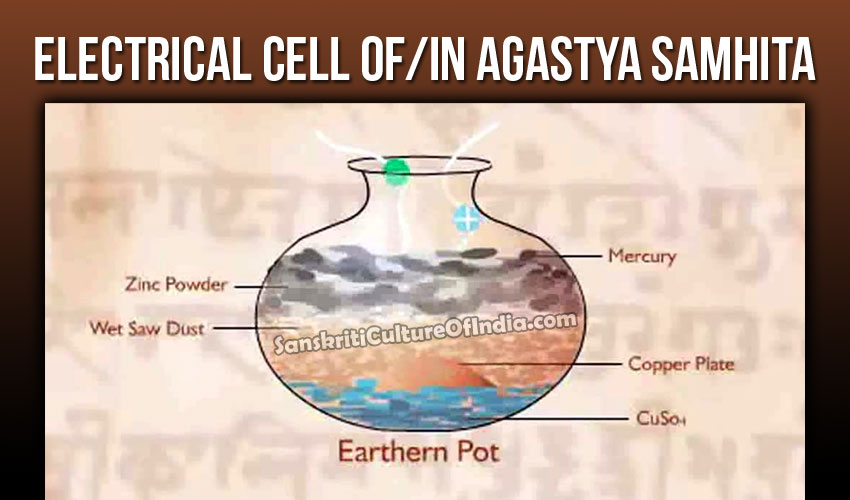
Agastya Samhita written around 4000 BC by sage Agatsya, describes method to make dry electric cell with 1.138 volts and 23 mA and electroplating process, hydrogen balloons.

The ancient text of Agastya Samhita describes the method of making electric battery, and that water can be split into oxygen and hydrogen.  Modern battery cell resembles Agastya’s method of generating electricity.

For generating electricity, Sage Agastya had used the following material:

1.One earthen pot

2.Copper plate

3.Copper sulphate

4.Wet saw dust

5.Zinc amalgam

His text says : “Sansthapya Mrinmaya Patre Tamrapatram Susanskritam Chhadyechhikhigriven Chardrarbhih Kashthpamsubhih. Dastaloshto Nidhatavyah Pardachhaditastah Sanyogajjayte Tejo Mitravarunsangyitam”

संस्थाप्य मृण्मये पात्रे ताम्रपत्रं सुसंस्कृतम्‌। छादयेच्छिखिग्रीवेन चार्दाभि: काष्ठापांसुभि:॥ दस्तालोष्टो निधात्वय: पारदाच्छादितस्तत:। संयोगाज्जायते तेजो मित्रावरुणसंज्ञितम्‌॥

Which means, “Place a well-cleaned copper plate in an earthenware vessel. Cover it first by copper sulfate and then by moist sawdust. After that, put a mercury-amalgamated zinc sheet on top of the sawdust to avoid polarization. The contact will produce an energy known by the twin name of Mitra-Varuna. Water will be split by this current into Pranavayu and Udanavayu. A chain of one hundred jars is said to give a very effective force. (p. 422)”

When a cell was prepared according to Agastya Samhita and measured, it gives open circuit voltage as 1.138 volts, and short circuit current as 23 mA.

Anen Jalbhangosti Prano Daneshu Vayushu Evam Shatanam Kumbhanamsanyogkaryakritsmritah.

if we use the power of 100 earthen pots on water, then water will change its form into life-giving oxygen and floating hydrogen.

Vayubandhakvastren Nibaddho Yanmastake Udanah Swalaghutve Bibhartyakashayanakam.

If hydrogen is contained in an air tight cloth, it can be used in aerodynamics, i.e. it will fly in air. (Today’s Hydrogen Balloon)
You may also like

Search the website

Like us on Facebook

Get daily updates via Email

Enter your email address:

Recent Posts

Jamai Shashthi 2026 — The Story of Maa Shashthi, the Cat, and the Wife Who Was Forgiven

Jamai Shashthi 2026 — The Story of Maa Shashthi, the Cat, and the Wife Who Was Forgiven

On Saturday, June 20, 2026, Bengali households across Bharata will welcome their married daughters and sons-in-law home for the legendary jamai-aador feast and perform the Shashthi Vrata. But behind the warmth lies a story most Bengalis know by heart and most non-Bengalis have never heard — the wife who stole the hilsa, blamed the cat, lost six sons to Maa Shashthi’s wrath, and was finally forgiven. The Vrat Katha, the vidhi, the mantras, and the deeper teaching.

Vat Purnima 2026 — The Wife Who Argued Yama Into Returning Her Husband’s Life

On Monday, June 29, 2026, women across Maharashtra, Gujarat, and southern Bharata will tie red thread around banyan trees and hear the story of Savitri — the wife who walked behind Yamaraja Himself when He came for her husband, and out-argued the Lord of Dharma into returning Satyavan’s life. The Mahabharata’s Pativrata Mahatmya Parva, the vrat vidhi, and why the banyan witnessed everything.

Nija Jyeshtha 2026 — The Real Jyeshtha Begins, and the Calendar Resumes

Nija Jyeshtha 2026 — The Real Jyeshtha Begins, and the Calendar Resumes

With Adhik Maas now closed on the Somvati Amavasya of June 15, the long-postponed festivals of Jyeshtha return — Vat Purnima (June 29, the Savitri-Yamaraja katha), Jamai Shashthi (June 20, the Bengali festival of Maa Shashthi), Sankashti Chaturthi (June 28), Yogini Ekadashi (July 10), and Devshayani Ekadashi (July 16, opening the four-month Chaturmas of Bhagavan Vishnu’s yoga-nidra). A guide to what the next four weeks hold and what the household that kept Purushottam Maas now carries forward.

The Closing of Purushottam Maas 2026 — Adhik Amavasya and the Sealing of the Month-Long Vrat

On Monday, June 15, 2026 — a rare Somvati Amavasya — the intercalary month that bears Bhagavan Vishnu’s own name comes to its close. The Acharyas teach that a vrat is not measured by its duration but by its closing. Here are the Padma Purana’s instructions for sealing the month-long Purushottam Maas vrat: the morning snan, the closing puja with the Vishnu Sahasranama, the day of dana, the Somvati Amavasya gift, and the final sarva-arpana — the offering of all merit at the feet of the Lord.

Parama Ekadashi 2026 — The Other Rare Ekadashi of Purushottam Maas, and the Poor Brahmin Who Kept It

Two weeks ago, Vaishnavas across Bharata kept Padmini Ekadashi — the rare Shukla Paksha Ekadashi of Adhik Maas. Padmini has a twin. On Thursday, June 11, 2026, the Krishna Paksha Ekadashi of the same intercalary month appears: Parama — the Supreme Ekadashi. The Padma Purana names it the rarer and more secret of the two, and reserves it for those whose poverty or sorrow has refused to lift in spite of every other vrat already kept. The story of Sumedha and Pavitra of Kampilya, the rishi Kaundinya, the prince sent by Bhagavan Brahma — and the vidhi for the day.

css.php