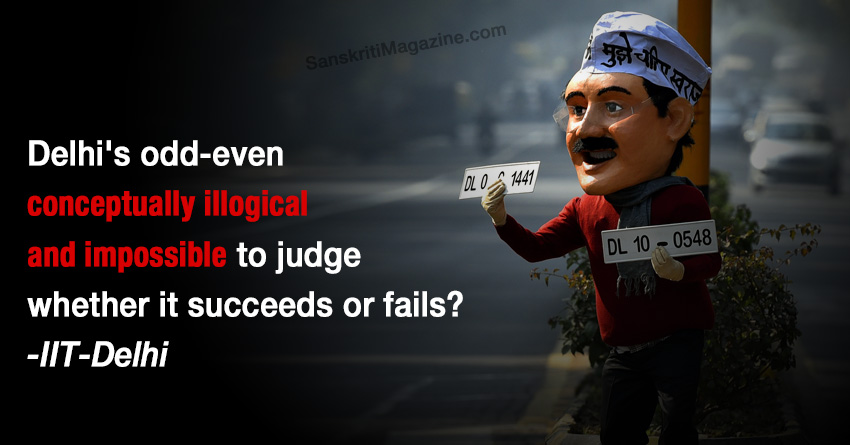
As the car-owning residents of Delhi struggle to comply with the return of Arvind Kejriwal’s odd-even scheme in the middle of a scorching April heatwave there’s one question that’s crying out for a definitive answer: Does odd-even make sense or is it both conceptually illogical and impossible to judge whether it succeeds or fails?
Dinesh Mohan, an emeritus professor of IIT-Delhi, insists the answer is unequivocally the latter. He says vehicular pollution is only 30% of all pollution and, within that, cars account for just 20%. This means cars are barely 6% of Delhi’s total pollution. Now, if odd-even is a 100% successful — which it cannot be simply because of the exemptions, leave aside those who defy it — the maximum impact on pollution will be only 3%.
A report commissioned by the Delhi government from IIT-Kanpur produces a more startling answer. It says total vehicular pollution is 20% and cars account for only 10% of that. This means cars are responsible for just 2% of Delhi’s total pollution. Even if odd-even is 100% successful the impact on pollution will be just 1%.
However, isn’t a 3% or even 1% reduction in pollution worth striving for? The answer is neither obvious nor simple. First, these percentages are so small that they can’t be measured with scientific accuracy. Three per cent is within the widely accepted margin of error. More importantly, how do you confirm this reduction is because of vehicular pollution and not changes in temperature, humidity or wind speed and direction? The simple answer is you cannot.
So, if Prof. Dinesh Mohan and IIT-Kanpur are correct, Mr Kejriwal is implementing a scheme whose success he cannot convincingly measure but could be as small as 1%, which, quite frankly, doesn’t make it worth the effort or inconvenience it entails.
However, that’s not all. IIT-Roorkee says that of the 20% pollution associated with vehicles, two-wheelers account for an astonishing 33%. Cars, as we already know, are just 10%. Yet cars are to be restricted but two-wheelers can ply freely. If pollution is your concern, does that make sense?
A few more facts: there are said to be 5.8 million two-wheelers in Delhi compared to just 2.7 million cars. Furthermore, when you restrict cars many people who also own motorcycles and scooters will obviously rely on them. Not only will that add to two-wheeler traffic but also, regrettably, to the likelihood of accidents. And two-wheeler accidents can be worse than car accidents.
Mr Kejriwal’s answer is to accept that the pollution impact of odd-even is not “as much as expected” and, instead, justify its return on the grounds it will reduce traffic and congestion. That’s what he said on the 13th.
That, however, is a clear case of moving the goalposts. It also begs the question: Did congestion diminish during the January experiment?
We don’t have a clear or convincing answer but Prof. Dinesh Mohan’s study suggests that whilst car-flow rates decreased by 7-9% this was counter-balanced by an increase in two-wheeler, three-wheeler and bus flow rates. That, perhaps, is why the odd-even scheme hasn’t ended traffic jams!
So, back to the opening question: Is odd-even justified or illogical and mistaken? I want to hear Mr Kejriwal answer the issues I’ve raised before I come to a definitive conclusion.