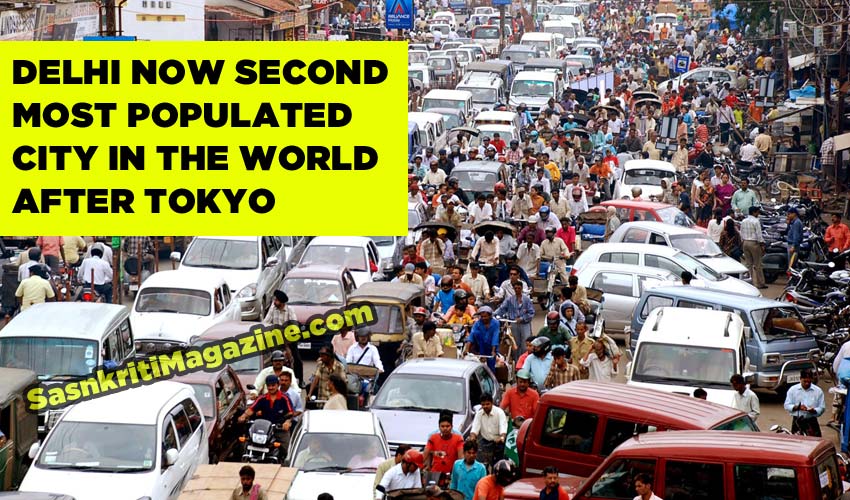
Delhi has become the world’s second most populous city after Tokyo, more than doubling its population since 1990 to 25 million, according to a UN report.
The 2014 revision of the World Urbanisation Prospects launched on Thursday said India was projected to add the highest number of people to its urban population by 2050, ahead of China.
The Indian capital was expected to retain the spot of the world’s second most populous city through at least 2030, when its population was expected to rise swiftly to 36 million, according to the report.
Tokyo topped the UN’s ranking of the most populous cities in 2014 with 38 million inhabitants. While its population is projected to decline, the Japanese capital will remain the world’s largest city in 2030 with 37 million people.
Click here to read the complete UN report
Mumbai, which ranks sixth in the 2014 list, is projected to climb to fourth position in 2030, by when its population is expected to grow to 28 million from 21 million currently.
Tokyo and New Delhi were followed in the UN report by Shanghai with 23 million, and Mexico City, Mumbai and Sao Paulo, each with around 21 million inhabitants, in 2014.
The report said that the most urban growth between 2014 and 2050 would take place in India, China and Nigeria, with these three countries accounting for 37 per cent of the projected growth of the world’s urban population.
By 2050, India was projected to add 404 million urban dwellers, way more than the projected 292 million in China. Nigeria was expected to add 212 million to its urban population.
India’s current urban population is 410 million people, and this was expected to grow to 814 million by 2050, the report said. China currently has the largest urban population of 758 million. India and China account for 30 per cent of the world’s urban population.
The two Asian giants, along with the US, Brazil, Indonesia, Japan and Russia, currently account for more than half of the world’s urban population. About 54 per cent of the world’s population currently lives in urban areas. This was expected to rise to 66 per cent by 2050, with the largest increases taking place in urban areas of Africa and Asia.
The world’s urban population, now close to 3.9 billion, was expected to reach 6.3 billion in 2050, according to the UN report.
The world’s rural population, on the other hand, has grown slowly since 1950, and was expected to peak in a few years.
Approximately 3.4 billion people currently live in rural areas around the world. Some time after 2020, this population would start to decline, and was expected to reach 3.2 billion in 2050, the report said.
India’s 857-million rural population is currently the world’s largest, followed by China’s (635 million). Together, these two countries account for 45 per cent of the world’s rural population.
Between 2014 and 2050, the number of rural residents in India is expected to decline by 52 million. Four cities — Ahmedabad, Bangalore, Chennai and Hyderabad — with populations of between 5 million and 10 million currently — are projected to become megacities in the coming years. India is expected to have seven megacities by 2030 — including, other than these four, Kolkata, Pune and Surat — which will add a total 27 million people to their population by 2030.
Kolkata, Bangalore, Chennai, Hyderabad are projected to be among the world’s 30 largest cities by 2030. The report notes that in 1990, there were 10 megacities of 10 million or more inhabitants, home to a total 153 million people. In 2014, the world has 28 megacities, home to 453 million people, or about 12 per cent of the world’s urban population. By 2030, the world was expected to have 41 megacities.
These cities will face great challenges in meeting the needs of housing, infrastructure, transportation, energy and employment, as well as basic services such as education and healthcare.
“Managing urban areas has become one of the most important development challenges of the 21st century. Our success or failure in building sustainable cities will be a major factor in the success of the post-2015 UN development agenda,” director of the Population Division in the UN’s Department of Economic and Social Affairs, John Wilmoth, said.
The report notes that well managed cities offer important opportunities for economic development and for expanding access to basic services, including healthcare and education, for large numbers of people.
Providing public transportation, housing, electricity, water and sanitation for a densely settled urban population is typically cheaper and less environmentally damaging than providing a similar level of services to a dispersed rural population, the report said.
~ by Yoshita Singh