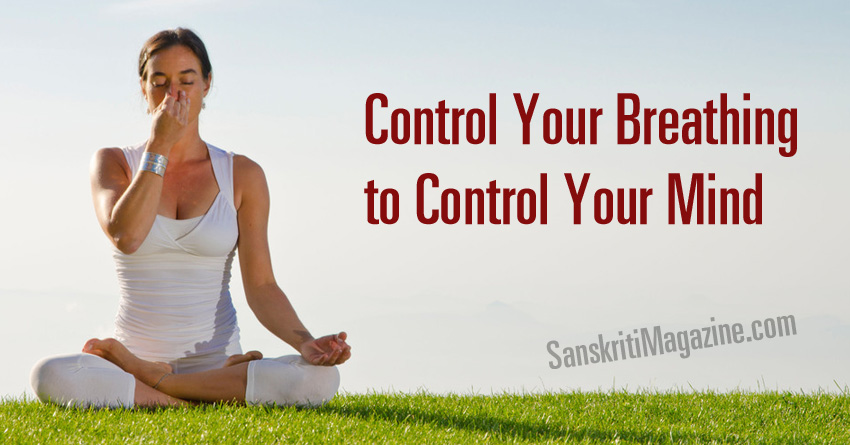
Have you ever noticed that when you are surprised by incredible news you tend to hold your breath? It is a natural reaction. This can also work backwards, i.e., if you can control your breathing, you can control your mind. This is the basic principle behind “pranayama” – the technique of yogic breathing exercises. Though on a gross level you are trying to gain control over your breathing, in essence subconsciously you are trying to gain control over your very prana (the vital life force). Prana means “life force” and “yama” means “practice”. So, pranayama is the science of gaining control over vital life force beginning with gaining control over your breath.
On an average a human being has a respiratory rate of 15 to 20 respirations. Ancient Indian yogis believed that by reducing the respiratory rate, longevity can be enhanced. Yogis have recommended that you should draw breath, hold breath, and breath out at the ratio of 1:4:2 for healthy living. Holding breath is called “Kumbaka pranayama”. Kumbaka pranayama helps you to gain control over the working of your mind and ultimately over your senses. A regular practice of this improves the pranic energy of an individual to a great extent. This is the reason that pranayama is mandatory before performing occult rituals in Indian tradition.
A regular practitioner of pranayama gains such pranic vitality that he can use his pranic energy for healing purposes. Very many occult siddhis (psi abilities) are obtained if a practitioner is successful in performance of pranayama. There are various types of pranayama: some are useful for purification of body (like bastika), some are useful for improving vitality, some to generate heat, some to cool your body (seethali pranayama),etc. These should be learnt under the close supervision of an expert as faulty practice of these can lead to undesirable side effects.
However there is one particular type of pranayama called suka-purvaka pranayama which anyone can practice with good results. In this respiration is done with alternate nostrils. Close your nostril with your right thumb. Draw in air for a duration of 5 seconds. After that close both nostrils and hold your breath for a duration of 20 seconds. Then release the air slowly for a duration of 10 seconds with your right nostril (by closing the left nostril with the little and ring fingers of your right hand). Now, closing the left nostril, draw in air using the right nostril for 5 seconds. Hold breath for 20 seconds, and leave out air through your left nostril (by closing your right nostril with your right thumb). This is one cycle of suka-puraka pranayama. Beginners should restrict themselves to 5 cycles per day and should progress gradually.
The practice of this pranayama mentioned above improves vitality, gives cure from respiratory diseases, improves the functioning of the lungs, and helps the yogi to convert ojas (physical vitality) into tejas (spiritual and psychic vitality). While practising this, you will observe that your mind comes under your control gradually. You will feel energized after this practice. The time duration I have mentioned above is for beginners. As you progress, you can gradually improve on the duration taking care to maintain the ratio of 1:4:2. Never exert yourself forcibly while doing this. This should be done with a conscious mind and deliberate rythm. You will find that this is a very good stress-busting exercise. However those suffering from chronic blood pressure ailments and heart patients should consult their physicians before practising this. Let the wisdom of ancient Indian seers help you to lead a better and healthy life.