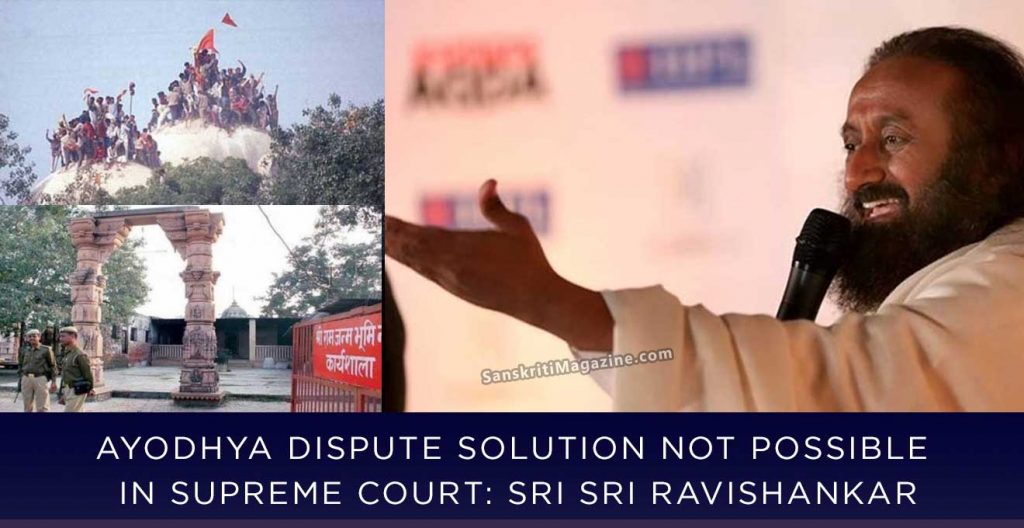
Sri Sri said that an out-of-court amicable settlement was the best way to resolve the Ayodhya dispute.
Spiritual guru and Art of Living founder Sri Sri Ravishankar has said that a solution to the Ram Janmabhoomi-Babri Masjid Ayodhya dispute is not possible in the court of law. He said that while one party will lose the case in the court and accept the verdict initially, they will again make noise about the same in future.
Sri Sri further said that an out-of-court amicable settlement was the best way to resolve the dispute. Hitting out at his critics, the AOL founder said that “everyone has the right exhibit their lack of knowledge”.
Sri Sri’s attempts for out-of-court settlement in the Ayodhya dispute has been opposed from various counters. While the Babri Action Committee asked Sri Sri to stay away from Ayodhya dispute, some politicians have also rejected his offer to mediate.
Earlier, the AOL founder had asked Hindus and Muslims to come together and solve the centuries-old dispute. “I am speaking to many stakeholders. Both the communities should come together. Out of court settlement is the best,” he had said.
Sri Sri has claimed that most Muslims are not opposing the construction of Ram temple in Ayodhya. “I know some may not agree with this, but Muslims by and large are not opposing the Ram temple,” he said, further adding that a solution may sometimes seem impossible “but our people, youth and leaders of both communities can make it possible.”
The Supreme Court began the final hearing in the Babri Masjid-Ram Janmabhoomi case on December 5, 2017.
The Supreme Court bench, headed by Chief Justice of India Dipak Misra, had said that it would deal with the instant matter as a “pure land dispute”. The special bench of the apex court was seized of a total 14 appeals filed against the high court judgement delivered in four civil suits, PTI reported.
A three-judge bench of the Allahabad HC, in a 2:1 majority ruling, had in 2010 ordered that the land be partitioned equally among three parties – the Sunni Waqf Board, the Nirmohi Akhara and Ram Lalla.