IndianSanskriti

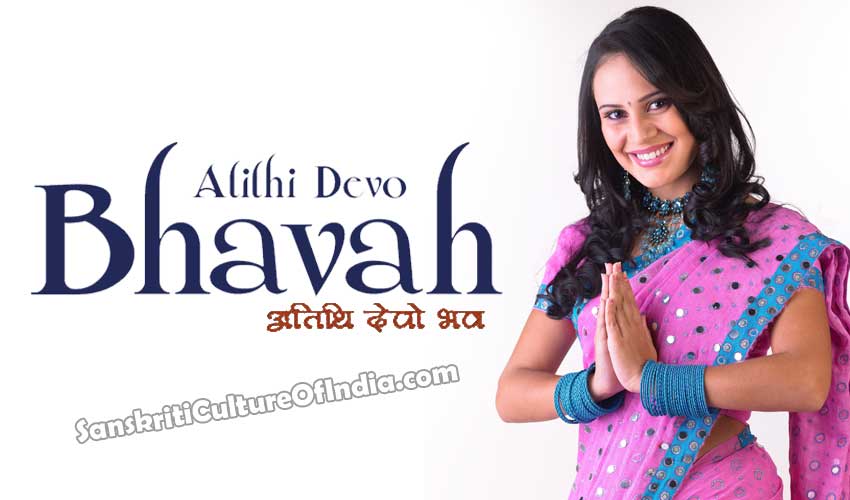
Atithi Devo Bhava

Atithi Devo Bhava,  an ancient line taken from the Hindu scriptures and was originally coined to depict a visiting person whose date of arrival and departure is not fixed.

‘Atithi’ originally meaning “without a fixed calendrical time”,’Devo’ meaning “God” and “Bhav” meaning Be or Is, hence signifies The Guest Is God. 

Atithi Devo Bhava, it is not just a catchy line to promote tourism but is a beautiful example of a text asking us to respect our guests as God.The host-guest relationship in India is truly one of the most revered relationships. The unique practice of giving utmost importance and preferential treatment to the guests clearly explains the fact that why our country’s history has several notable examples of ‘Atithi Satkar’ meaning to welcome the guest with warmth and respect.

An integral part of the Indian culture, it says that every guest should be treated like God. No distinction should be made based on the guests’s caste, colour or creed and he/she should be showered with all love, care and affection. This unique ‘code of conduct’ laid down in the ancient Hindi scriptures named ‘Taittiriya Upanishad’ upholds our culture’s values and heritage, and ensures no guest of ours feels shortchanged. Despite high degree of cultural and geographical diversity in the country, the sentiments towards the guests stays the same throughout.

Atithi Devo Bhava, has lost its true essence and spirit over the sands of time. Today trade globalization that has helped modernize India, but in the process has also begun to erode its culture. Today where everything travels the fast lane, how much time do we devote towards our rich, age old culture? Today the simplest question that arises is, how many of us are truly aware of the term’Atithi Devo Bhava’ and its origin ? Do we truly lead our lives in this spirit? Atithi Devo Bhava, is an important part of the Indian culture which may soon be lost with time and a country with a lost culture is simply without an identity.

Are we really prepared to leave our successors with a destroyed culture, even after knowing it could be preserved.

~ The Lost Essence
You may also like

Search the website

Like us on Facebook

Get daily updates via Email

Enter your email address:

Recent Posts

Jamai Shashthi 2026 — The Story of Maa Shashthi, the Cat, and the Wife Who Was Forgiven

Jamai Shashthi 2026 — The Story of Maa Shashthi, the Cat, and the Wife Who Was Forgiven

On Saturday, June 20, 2026, Bengali households across Bharata will welcome their married daughters and sons-in-law home for the legendary jamai-aador feast and perform the Shashthi Vrata. But behind the warmth lies a story most Bengalis know by heart and most non-Bengalis have never heard — the wife who stole the hilsa, blamed the cat, lost six sons to Maa Shashthi’s wrath, and was finally forgiven. The Vrat Katha, the vidhi, the mantras, and the deeper teaching.

Vat Purnima 2026 — The Wife Who Argued Yama Into Returning Her Husband’s Life

On Monday, June 29, 2026, women across Maharashtra, Gujarat, and southern Bharata will tie red thread around banyan trees and hear the story of Savitri — the wife who walked behind Yamaraja Himself when He came for her husband, and out-argued the Lord of Dharma into returning Satyavan’s life. The Mahabharata’s Pativrata Mahatmya Parva, the vrat vidhi, and why the banyan witnessed everything.

Nija Jyeshtha 2026 — The Real Jyeshtha Begins, and the Calendar Resumes

Nija Jyeshtha 2026 — The Real Jyeshtha Begins, and the Calendar Resumes

With Adhik Maas now closed on the Somvati Amavasya of June 15, the long-postponed festivals of Jyeshtha return — Vat Purnima (June 29, the Savitri-Yamaraja katha), Jamai Shashthi (June 20, the Bengali festival of Maa Shashthi), Sankashti Chaturthi (June 28), Yogini Ekadashi (July 10), and Devshayani Ekadashi (July 16, opening the four-month Chaturmas of Bhagavan Vishnu’s yoga-nidra). A guide to what the next four weeks hold and what the household that kept Purushottam Maas now carries forward.

The Closing of Purushottam Maas 2026 — Adhik Amavasya and the Sealing of the Month-Long Vrat

On Monday, June 15, 2026 — a rare Somvati Amavasya — the intercalary month that bears Bhagavan Vishnu’s own name comes to its close. The Acharyas teach that a vrat is not measured by its duration but by its closing. Here are the Padma Purana’s instructions for sealing the month-long Purushottam Maas vrat: the morning snan, the closing puja with the Vishnu Sahasranama, the day of dana, the Somvati Amavasya gift, and the final sarva-arpana — the offering of all merit at the feet of the Lord.

Parama Ekadashi 2026 — The Other Rare Ekadashi of Purushottam Maas, and the Poor Brahmin Who Kept It

Two weeks ago, Vaishnavas across Bharata kept Padmini Ekadashi — the rare Shukla Paksha Ekadashi of Adhik Maas. Padmini has a twin. On Thursday, June 11, 2026, the Krishna Paksha Ekadashi of the same intercalary month appears: Parama — the Supreme Ekadashi. The Padma Purana names it the rarer and more secret of the two, and reserves it for those whose poverty or sorrow has refused to lift in spite of every other vrat already kept. The story of Sumedha and Pavitra of Kampilya, the rishi Kaundinya, the prince sent by Bhagavan Brahma — and the vidhi for the day.

css.php