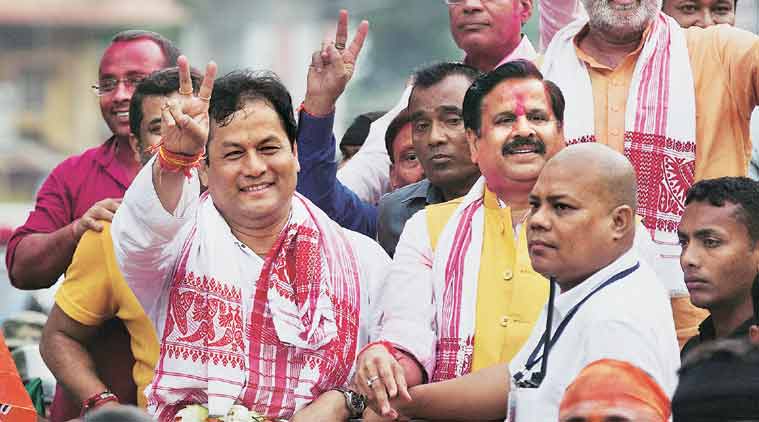
The survey results show the BJP gained from projecting Sarbanada Sonowal (left) as CM candidate. (Source: AP)
If there is one factor that overshadows all others in explaining the BJP’s victory in Assam, it is that of religion.
In a state where electoral outcomes were until recently largely understood in terms of multiple ethnicities, religious identity seems to have emerged as the main determinant of voting choices in this election.
Lokniti’s analysis of post-poll survey data for The Indian Express shows that at the heart of the BJP alliance’s success lies the aspect of Hindu consolidation. As high as 63% of voters who identified themselves as Hindu (on being asked their religion), ended up voting for the BJP and its election partners.
This, of course, is not entirely new.
The BJP had succeeded in rallying Hindus behind it in Assam in the 2014 election as well. At that time, 58% of the Hindu electorate had voted BJP — and if one were to add up the Hindu votes that the AGP got, this figure would be 65%. In fact, in 2014, Assam was second only to Gujarat in terms of Hindu preference for the BJP.
Clearly, one of the main challenges before the BJP was to retain the Lok Sabha success among Hindu voters. It was able to do that with only a marginal drop in the level of consolidation. Earlier, the BJP would do well only among a certain section of Hindus — and this was determined not as much by their religious identity as by the language they spoke.
For instance, in 2011, whereas 4 out of 10 Bengali-speaking Hindus had voted for the BJP (alone), the level of support for the party among Assamese Hindus was just 1 in 10. (Table 2) However this changed in 2014, with both Bengali Hindus and Assamese Hindus voting in almost equal measure for the BJP — 63% and 62% respectively.
2016 data show the same pattern: about two-thirds among each community voted for the BJP-AGP-BPF alliance.
It is worth noting that the survey found that 75% of Assamese Hindus and 68% of Bengali Hindus saw the ‘illegal migration’ issue as important — and not something that had been blown out of proportion.
This remarkable Hindu coalescing around the BJP was, however, not matched by a counter-consolidation of Muslims behind any one party. In a state where Muslims constitute 34% of the population (the highest outside J&K), Muslim voters did not vote en bloc.
In fact, they remained as badly divided between the Congress and Badruddin Ajmal’s AIUDF as they have been for the last several elections. Two-fifths voted for the Congress and a little over a third for AIUDF.
Moreover, while language has ceased to be a factor in determining Hindu political preferences, it continues to be a factor with Muslims. Whereas two-thirds of Assamese-speaking Muslims voted for the Congress, among Bengali Muslims, the vote was divided almost equally among the Congress and AIUDF. (Table 2) This divide was witnessed in 2006, 2011, and 2014 as well.
So strong a factor was religion in this election and so stark was the Hindu-Muslim divide that it overpowered every other identity, social characteristic or opinion on any political issue. For instance, a simple “vote by age” analysis of the survey data shows the Congress vote share to be only 7 percentage points behind the BJP’s in the 18-22 age group. However, when one breaks it down by religion, the real story emerges.
The Congress trailed the BJP by 46 percentage points among Hindu 18-22-year-olds and led it by 40 percentage points among Muslims belonging to same age group. The religious identity of voters also subdued their gender identity: the BJP secured 64% of the vote of Hindu women and only 5% of the Muslim women vote.
Survey questions on political matters elicited diametrically opposite answers. As high as 76% Muslims were satisfied with the Congress government’s performance, as opposed to just 47% Hindus. Hindu preference for Sarbananda Sonowal as Chief Minister was 15 times more than the preference for him among Muslims — 45 to 3. This divergence among Hindu and Muslim preferences on political matters has been seen in past elections, but never has the divide been this sharp.
Not only did the Hindus consolidate behind one party much more than Muslims, they also seem to have outdone them in voter turnout. Survey data suggest that a greater proportion of Hindus (86%) may have turned out than Muslims (82%).
Muslim turnout has almost always been greater than the Hindu turnout, though the gap has been narrowing of late.
It is not certain however, that the extraordinary consolidation of the Hindu vote automatically endorses all Hindutva arguments. Only 30% Hindus, and 34% Hindus who voted for BJP, supported a ban on beef eating. And even for BJP voters, linguistic and regional identity comes before religion. (Table 6)
Shreyas Sardesai is with Lokniti-CSDS. Dhruba Pratim Sharma teaches Political Science at Gauhati University, Guwahati