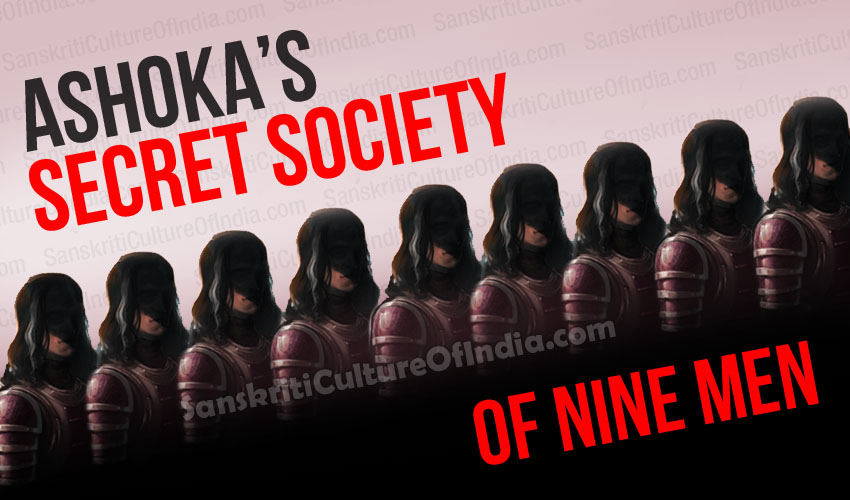
“Nine Unknown Men”, is a secret society founded by the Mauryan Emperor Asoka around 270 BC to preserve and develop knowledge that would be dangerous to humanity if it fell into the wrong hands. The nine unknown men were entrusted with guarding nine books of secret knowledge.
The Emperor founded the society of the Nine to preserve and develop knowledge that would be dangerous to humanity if it fell into the wrong hands. It is said that the Emperor Asoka once aware of the horrors of war, wished to forbid men ever to put their intelligence to evil uses. During his reign natural science, past and present, was vowed to secrecy. Henceforward, and for the next 2,000 years, all researches, ranging from the structure of matter to the techniques employed in collective psychology, were to be hidden behind the mystical mask of a people commonly believed to be exclusively concerned with ecstasy and supernatural phenomena. Asoka founded the most powerful secret society on earth: that of the Nine Unknown Men.
One can imagine the extraordinary importance of secret knowledge in the hands of nine men benefiting directly from experiments, studies and documents accumulated over a period of more than 2,000 years. What can have been the aim of these men? Not to allow methods of destruction to fall into the hands of unqualified persons and to pursue knowledge which would benefit mankind. Their numbers would be renewed by co-option, so as to preserve the secrecy of techniques handed down from ancient times.
Each of the Nine is supposedly responsible for guarding and improving a single book. These books each deal with a different branch of potentially hazardous knowledge. Traditionally, the books are said to cover the following subjects:
The Nine Books
Propaganda and Psychological warfare: is a concerted set of messages aimed at influencing the opinions or behavior of large numbers of people. Instead of impartially providing information, propaganda in its most basic sense presents information in order to influence its audience. It is the most dangerous of all sciences, as it is capable of moulding mass opinion. It would enable anyone to govern the whole world.
Physiology: is the study of the mechanical, physical, and biochemical functions of living organisms. The book of The Nine included instructions on how to perform the “touch of death (death being caused by a reversal of the nerve-impulse).” One account has Judo being a product of material leaked from this book.
Microbiology, and, according to more recent speculation, Biotechnology: In some versions of the myth, the waters of the Ganges are purified with special microbes designed by the Nine and released into the river at a secret base in the Himalayas. Multitudes of pilgrims, suffering from the most appalling diseases, bathe in them without harming the healthy ones. The sacred waters purify everything. Their strange properties have been attributed to the fact that they contain bacteriophages. But why should these not be formed in the Bramaputra, the Amazon or the Seine?
Alchemy: including the transmutation of metals. In India, there is a persistent rumor that during times of drought or other natural disasters temples and religious organizations receive large quantities of gold from an unknown source. The mystery is further deepened with the fact that the sheer quantity of gold throughout the country in temples and with kings cannot be properly accounted for, seeing that India has few gold mines.
Communication: including communication with extraterrestrials.
Gravitation: Book 6 The Vaiminaka sastra is said to contain the instructions necessary to build a Vimana, sometimes referred to as the “ancient UFOs of India.”
Cosmology: the capacity to travel at enormous speeds through spacetime fabric, and time-travel; including intra- and inter-universal trips.
Light: the capacity to increase and decrease the speed of light, to use it as a weapon by concentrating it in a certain direction etc.
Sociology: including rules concerning the evolution of societies and how to predict their downfall.