IndianSanskriti

A Cup of Masala Chai to Your Health

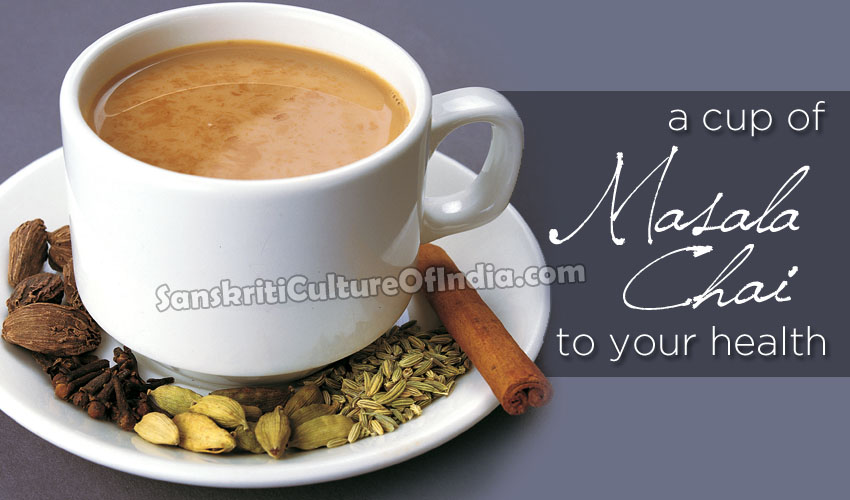
Masala Chai is a wonderful spice milk tea from India that is being discovered by contemplative beverage drinkers around the world.

You would have to drink three cups of chai tea to achieve the same amount of caffeine you get in a single cup of coffee. And this ratio increases to 5:1 or 6:1 when you compare chai to strong coffee. By virtue of this fact alone, switching to chai will cut your caffeine intake dramatically even if you have an extra cup. Finally we have an easy and enjoyable way to get off the stimulant/fatigue treadmill and enjoy something that is actually good for us!

Unlike coffee, chai has many inherently beneficial properties. The black tea in chai is rich in antioxidants and the spices in chai have been used for thousands of years to promote general health and well-being, as well as to treat various ailments.

According to Ayurvedic philosophy and medicine, these spices are considered to be “sattvic,” or calming, vitalizing and mentally clarifying – The perfect antidote to the stresses of modern life! Consider these traditional uses:

Cinnamon Cinnamon is thought to increase circulation and open breathing, increase awareness and vitality, and reduce fatigue. It is also reputed to be an aphrodisiac! (We won’t comment on this one.)

Cardamom A popular spice in both the Indian and Chinese preparations, cardamom is said to benefit the lungs, kidneys, and heart. It is also a mood elevator.

Clove Native to the spice islands of Indonesia, cloves have been used by the Chinese since 300 BC, and came to Europe in the 4th and 5th Centuries AD. Cloves have pain-relieving and antiseptic attributes. Like pepper and ginger, clove is also used to synergistically increase the potency of other herbal blends.

Black Pepper Widely used to support circulation and metabolism, black pepper can help to alleviate chronic coldness. (We can use more of that here, in the winter!) Attila the Hun demanded this spice as a ransom during the siege of Rome in 408 AD.

Nutmeg Nutmeg has been used for centuries to ease sciatica and promote the digestion of heavy foods. It was also used by ancient Arab physicians to treat kidney and lymph problems.

Star Anise Traditional Asian herbalists credit star anise with a variety of properties. It’s used frequently as a cough remedy and to freshen the breath.

Ginger Long valued as a stimulant for the circulatory and the immune systems, ginger has been used to treat such disparate conditions as impotence and motion sickness.

Fennel An important medicinal plant in the royal herb gardens of medieval France and Germany, fennel is still widely used to treat both kidney and ocular problems, as well as laryngitis.

Have you had your cup of chai tea today?
You may also like

Search the website

Like us on Facebook

Get daily updates via Email

Enter your email address:

Recent Posts

Yogini Ekadashi 2026 — The Yaksha Who Missed the Morning Flowers, and the Ekadashi That Undid His Curse

On Friday, July 10, 2026, the rare Krishna Paksha Ekadashi of Nija Ashadha arrives. The Padma Purana tells the story of Hemamali — the Yaksha gardener of Bhagavan Kubera in Alaka, whose single morning of distraction with his wife Vishalakshi cost him his form, his wife, and his celestial city. Cursed to wander the earth of Bharata as a leper for a long time, he was at last shown the way back by Sage Markandeya — a single sincere keeping of Yogini Ekadashi.

Jamai Shashthi 2026 — The Story of Maa Shashthi, the Cat, and the Wife Who Was Forgiven

Jamai Shashthi 2026 — The Story of Maa Shashthi, the Cat, and the Wife Who Was Forgiven

On Saturday, June 20, 2026, Bengali households across Bharata will welcome their married daughters and sons-in-law home for the legendary jamai-aador feast and perform the Shashthi Vrata. But behind the warmth lies a story most Bengalis know by heart and most non-Bengalis have never heard — the wife who stole the hilsa, blamed the cat, lost six sons to Maa Shashthi’s wrath, and was finally forgiven. The Vrat Katha, the vidhi, the mantras, and the deeper teaching.

Vat Purnima 2026 — The Wife Who Argued Yama Into Returning Her Husband’s Life

On Monday, June 29, 2026, women across Maharashtra, Gujarat, and southern Bharata will tie red thread around banyan trees and hear the story of Savitri — the wife who walked behind Yamaraja Himself when He came for her husband, and out-argued the Lord of Dharma into returning Satyavan’s life. The Mahabharata’s Pativrata Mahatmya Parva, the vrat vidhi, and why the banyan witnessed everything.

Nija Jyeshtha 2026 — The Real Jyeshtha Begins, and the Calendar Resumes

Nija Jyeshtha 2026 — The Real Jyeshtha Begins, and the Calendar Resumes

With Adhik Maas now closed on the Somvati Amavasya of June 15, the long-postponed festivals of Jyeshtha return — Vat Purnima (June 29, the Savitri-Yamaraja katha), Jamai Shashthi (June 20, the Bengali festival of Maa Shashthi), Sankashti Chaturthi (June 28), Yogini Ekadashi (July 10), and Devshayani Ekadashi (July 16, opening the four-month Chaturmas of Bhagavan Vishnu’s yoga-nidra). A guide to what the next four weeks hold and what the household that kept Purushottam Maas now carries forward.

The Closing of Purushottam Maas 2026 — Adhik Amavasya and the Sealing of the Month-Long Vrat

On Monday, June 15, 2026 — a rare Somvati Amavasya — the intercalary month that bears Bhagavan Vishnu’s own name comes to its close. The Acharyas teach that a vrat is not measured by its duration but by its closing. Here are the Padma Purana’s instructions for sealing the month-long Purushottam Maas vrat: the morning snan, the closing puja with the Vishnu Sahasranama, the day of dana, the Somvati Amavasya gift, and the final sarva-arpana — the offering of all merit at the feet of the Lord.

css.php