IndianSanskriti
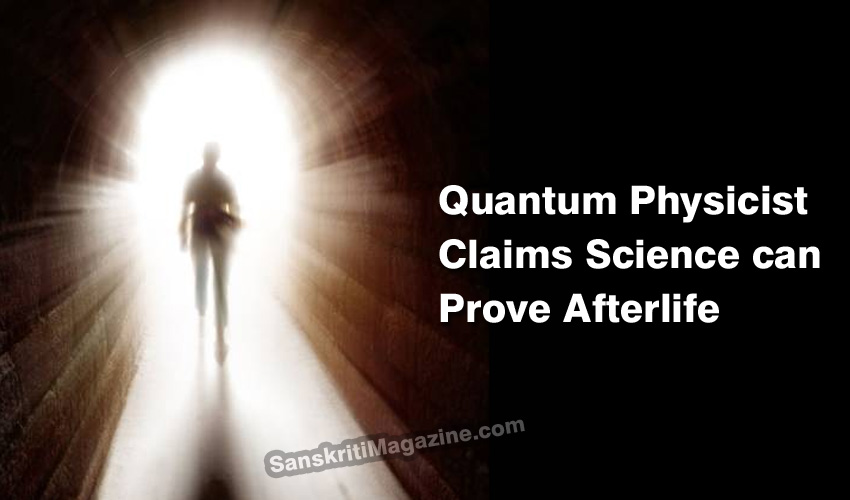
Quantum Physicist Claims Science can Prove Afterlife

Quantum Physicist Claims Science can Prove Afterlife

It’s a question pondered by philosophers, scientists and the devout since the dawn of time: is there an afterlife?

While the religious would argue that life on earth is a mere warm up for an eternity spent in heaven or hell, and many scientists would dismiss the concept for lack of proof — one expert claims he has definitive evidence to confirm once and for all that there is indeed life after death.

The answer, Professor Robert Lanza says, lies in quantum physics — specifically the theory of biocentrism. The scientist, from Wake Forest University School of Medicine in North Carolina, says the evidence lies in the idea that the concept of death is a mere figment of our consciousness.

Professor Lanza says biocentrism explains that the universe only exists because of an individual’s consciousness of it — essentially life and biology are central to reality, which in turn creates the universe; the universe itself does not create life. The same applies to the concepts of space and time, which Professor Lanza describes as “simply tools of the mind”.

In a message posted on the scientist’s website, he explains that with this theory in mind, the concept of death as we know it is “cannot exist in any real sense” as there are no true boundaries by which to define it. Essentially, the idea of dying is something we have long been taught to accept, but in reality it just exists in our minds.

Professor Lanza says biocentrism is similar to the idea of parallel universes — a concept hypothesised by theoretical physicists. In much the same way as everything that could possibly happen is speculated to be occurring all at once across multiple universes, he says that once we begin to question our preconceived concepts of time and consciousness, the alternatives are huge and could alter the way we think about the world in a way not seen since the 15th century’s “flat earth” debate.

He goes on to use the so-called double-slit experiment as proof that the behaviour of a particle can be altered by a person’s perception of it. In the experiment, when scientists watch a particle pass through a multi-holed barrier, the particle acts like a bullet travelling through a single slit. When the article is not watched, however, the particle moves through the holes like a wave.

Scientists argue that the double-slit experiment proves that particles can act as two separate entities at the same time, challenging long-established ideas of time and perception.

Although the idea is rather complicated, Professor Lanza says it can be explained far more simply using colours. Essentially, the sky may be perceived as blue, but if the cells in our brain were changed to make the sky look green, was the sky every truly blue or was that just our perception?

In terms of how this affects life after death, Professor Lanza explains that, when we die, our life becomes a “perennial flower that returns to bloom in the multiverse”. He added: “Life is an adventure that transcends our ordinary linear way of thinking. When we die, we do so not in the random billiard-ball-matrix but in the inescapable-life-matrix.”

Professor Lanza’s theory is explained in full in his book Biocentrism: How Life and Consciousness are the Keys to Understanding the True Nature of the Universe.

~ John Hall

 

You may also like

Search the website

Like us on Facebook

Get daily updates via Email

Enter your email address:

Recent Posts

Jamai Shashthi 2026 — The Story of Maa Shashthi, the Cat, and the Wife Who Was Forgiven

Jamai Shashthi 2026 — The Story of Maa Shashthi, the Cat, and the Wife Who Was Forgiven

On Saturday, June 20, 2026, Bengali households across Bharata will welcome their married daughters and sons-in-law home for the legendary jamai-aador feast and perform the Shashthi Vrata. But behind the warmth lies a story most Bengalis know by heart and most non-Bengalis have never heard — the wife who stole the hilsa, blamed the cat, lost six sons to Maa Shashthi’s wrath, and was finally forgiven. The Vrat Katha, the vidhi, the mantras, and the deeper teaching.

Vat Purnima 2026 — The Wife Who Argued Yama Into Returning Her Husband’s Life

On Monday, June 29, 2026, women across Maharashtra, Gujarat, and southern Bharata will tie red thread around banyan trees and hear the story of Savitri — the wife who walked behind Yamaraja Himself when He came for her husband, and out-argued the Lord of Dharma into returning Satyavan’s life. The Mahabharata’s Pativrata Mahatmya Parva, the vrat vidhi, and why the banyan witnessed everything.

Nija Jyeshtha 2026 — The Real Jyeshtha Begins, and the Calendar Resumes

Nija Jyeshtha 2026 — The Real Jyeshtha Begins, and the Calendar Resumes

With Adhik Maas now closed on the Somvati Amavasya of June 15, the long-postponed festivals of Jyeshtha return — Vat Purnima (June 29, the Savitri-Yamaraja katha), Jamai Shashthi (June 20, the Bengali festival of Maa Shashthi), Sankashti Chaturthi (June 28), Yogini Ekadashi (July 10), and Devshayani Ekadashi (July 16, opening the four-month Chaturmas of Bhagavan Vishnu’s yoga-nidra). A guide to what the next four weeks hold and what the household that kept Purushottam Maas now carries forward.

The Closing of Purushottam Maas 2026 — Adhik Amavasya and the Sealing of the Month-Long Vrat

On Monday, June 15, 2026 — a rare Somvati Amavasya — the intercalary month that bears Bhagavan Vishnu’s own name comes to its close. The Acharyas teach that a vrat is not measured by its duration but by its closing. Here are the Padma Purana’s instructions for sealing the month-long Purushottam Maas vrat: the morning snan, the closing puja with the Vishnu Sahasranama, the day of dana, the Somvati Amavasya gift, and the final sarva-arpana — the offering of all merit at the feet of the Lord.

Parama Ekadashi 2026 — The Other Rare Ekadashi of Purushottam Maas, and the Poor Brahmin Who Kept It

Two weeks ago, Vaishnavas across Bharata kept Padmini Ekadashi — the rare Shukla Paksha Ekadashi of Adhik Maas. Padmini has a twin. On Thursday, June 11, 2026, the Krishna Paksha Ekadashi of the same intercalary month appears: Parama — the Supreme Ekadashi. The Padma Purana names it the rarer and more secret of the two, and reserves it for those whose poverty or sorrow has refused to lift in spite of every other vrat already kept. The story of Sumedha and Pavitra of Kampilya, the rishi Kaundinya, the prince sent by Bhagavan Brahma — and the vidhi for the day.

css.php