
IndianSanskriti

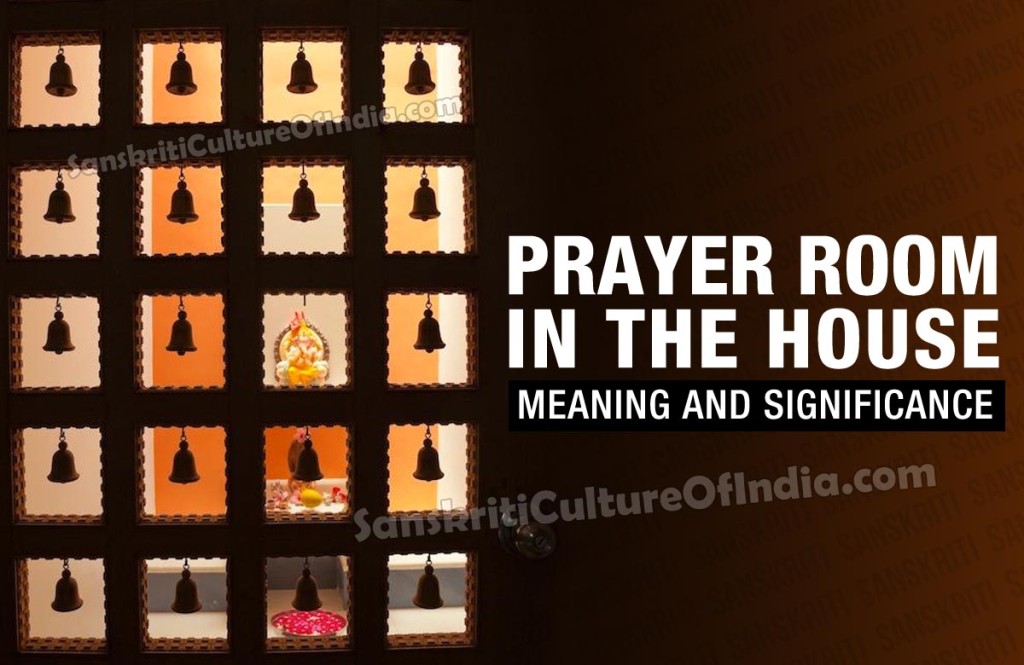
Prayer Room in the House – Meaning & Significance

Most Indian homes have a prayer room or altar. A lamp is lit and the Lord worshipped each day. Other spiritual practices like japa (repetition of the Lord’s name), meditation, paaraayana (reading of the scriptures), prayers, and devotional singing etc is also done here. Special worship is done on auspicious occasions like birthdays, anniversaries, festivals and the like. Each member of the family – young or old – communes with and worships the Divine here.

The Lord is the entire creation. He is therefore the true owner of the house we live in too. The prayer room is the Master room of the house. We are the earthly occupants of His property. This notion rids us of false pride and possessiveness. The ideal attitude to take is to regard the Lord as the true owner of our homes and us as caretakers of His home. But if that is rather difficult, we could at least think of Him as a very welcome guest. Just as we would house an important guest in the best comfort, so too we felicitate the Lord’s presence in our homes by having a prayer room or altar, which is, at all times, kept clean and well-decorated.

Also the Lord is all pervading. To remind us that He resides in our homes with us, we have prayer rooms. Without the grace of the Lord, no task can be successfully or easily accomplished. We invoke His grace by communing with Him in the prayer room each day and on special occasions.

Each room in a house is dedicated to a specific function like the bedroom for resting, the drawing room to receive guests, the kitchen for cooking etc. The furniture, decor and the atmosphere of each room are made conducive to the purpose it serves. So too for the purpose of meditation, worship and prayer, we should have a conducive atmosphere – hence the need for a prayer room.

Sacred thoughts and sound vibrations pervade the place and influence the minds of those who spend time there. Spiritual thoughts and vibrations accumulated through regular meditation, worship and chanting done there pervade the prayer room. Even when we are tired or agitated, by just sitting in the prayer room for a while, we feel calm, rejuvenated and spiritually uplifted.

~ Author Unknown  

You may also like

Search the website

Like us on Facebook

Get daily updates via Email

Enter your email address:

Recent Posts

Yogini Ekadashi 2026 — The Yaksha Who Missed the Morning Flowers, and the Ekadashi That Undid His Curse

On Friday, July 10, 2026, the rare Krishna Paksha Ekadashi of Nija Ashadha arrives. The Padma Purana tells the story of Hemamali — the Yaksha gardener of Bhagavan Kubera in Alaka, whose single morning of distraction with his wife Vishalakshi cost him his form, his wife, and his celestial city. Cursed to wander the earth of Bharata as a leper for a long time, he was at last shown the way back by Sage Markandeya — a single sincere keeping of Yogini Ekadashi.

Jamai Shashthi 2026 — The Story of Maa Shashthi, the Cat, and the Wife Who Was Forgiven

Jamai Shashthi 2026 — The Story of Maa Shashthi, the Cat, and the Wife Who Was Forgiven

On Saturday, June 20, 2026, Bengali households across Bharata will welcome their married daughters and sons-in-law home for the legendary jamai-aador feast and perform the Shashthi Vrata. But behind the warmth lies a story most Bengalis know by heart and most non-Bengalis have never heard — the wife who stole the hilsa, blamed the cat, lost six sons to Maa Shashthi’s wrath, and was finally forgiven. The Vrat Katha, the vidhi, the mantras, and the deeper teaching.

Vat Purnima 2026 — The Wife Who Argued Yama Into Returning Her Husband’s Life

On Monday, June 29, 2026, women across Maharashtra, Gujarat, and southern Bharata will tie red thread around banyan trees and hear the story of Savitri — the wife who walked behind Yamaraja Himself when He came for her husband, and out-argued the Lord of Dharma into returning Satyavan’s life. The Mahabharata’s Pativrata Mahatmya Parva, the vrat vidhi, and why the banyan witnessed everything.

Nija Jyeshtha 2026 — The Real Jyeshtha Begins, and the Calendar Resumes

Nija Jyeshtha 2026 — The Real Jyeshtha Begins, and the Calendar Resumes

With Adhik Maas now closed on the Somvati Amavasya of June 15, the long-postponed festivals of Jyeshtha return — Vat Purnima (June 29, the Savitri-Yamaraja katha), Jamai Shashthi (June 20, the Bengali festival of Maa Shashthi), Sankashti Chaturthi (June 28), Yogini Ekadashi (July 10), and Devshayani Ekadashi (July 16, opening the four-month Chaturmas of Bhagavan Vishnu’s yoga-nidra). A guide to what the next four weeks hold and what the household that kept Purushottam Maas now carries forward.

css.php




