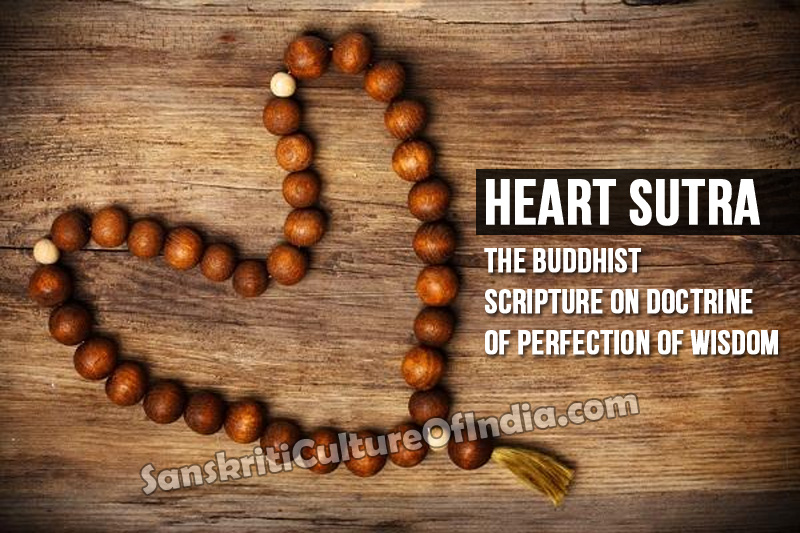
Prajnaparamita Hridaya Sutra or the Heart Sutra is the shortest yet the most meaningful and impacting of all sutras. It explains that one should not give any value to materialistic world or Maya as it only exists in our thoughts. Bodhisattva Avalokiteshvara explains the concept of emptiness by saying that there is no specific start or end to our eyes in any time or space. Our eyes are not independent; they are connected to the nose, which is connected to the mouth; which in turn connects to the head, feet, hands and so on. In other words, nothing is independent and everything is inter-connected; nothing has its own characteristics or influence and everything is intertwined in our thoughts. If we learn the power of emptiness, we have no fear or happiness, we transcend to the state of pure bliss.
 The Background
Buddhism is believed to have originated in India and then progressively spread across the globe to Nepal, Thailand, Sri Lanka and China, among other countries. Buddhism preaches simple living and cites that desires cause the suffering; so a living being should forsake all their desires to attain salvation (nirvana).
Over a period of time, Buddhism has split into two sects – Mahayana and Hinayana. Followers of Mahayana sect worship Buddha’s image as God. They have given up on meticulous ascetic life style followed in monasteries and participate in elaborate rituals. Hinayana sect, on the other hand, has stuck to original Buddhist style of living. Followers of Hinayana sect live an austere life and seek self-enlightenment. Followers of Mahayana sect, in contrast, seek enlightenment for all beings.
Mahayana sect follows the doctrine of becoming a “Bodhisattva” in order to attain redemption from the cycle of life and death. Sutras are an integral part of the Mahayana sect. Sutra in Sanskrit means a thread. Sutras are the scriptures that help you understand the simple truth about salvation or moksha.
Numerous important Mahayana Sutras are believed to be written between 100 BC and 400 BC. The long list of them includes Brahmajala Sutra, Shurangama Sutra, Avatamsaka Sutra, Ratnakuta Sutra, Vajrachedak Sutra, Prajnaparamita Hridaya Sutra, Lankavatara Sutra, Mahaparinirvana Sutra and Saddharma Pundarika Sutra, which are dogmatically followed by the Mahayana Sect even to this day.
Prajnaparamita Hridaya Sutra, better known as The Heart Sutra, is the most important of all the sutras followed by the Mahayana sect.
Prajnaparamita Hridaya Sutra or the Heart Sutra
The doctrine of Prajnaparamita Hridaya Sutra or the Heart Sutra is distillation of wisdom. This sutra has a meaning within itself and it also explains the meaning of other Sutras.
The sutra is said to be written by Avalokiteshvara. It is renowned for its conciseness and deep meaning. It is originally written in Sanskrit and has 14 verses (shlokas). Each shloka in Sanskrit contains 232 syllables. The Heart sutra is the shortest of all the sutras in the Mahayana school of thought.

Scriptures mention that Bodhisattva Avalokiteshvara attained profound illumination when he was addressing a gathering of monks in Rajgriha at the Vulture Peak Mountains. It is said that he entered the stage of Samadhi and started chanting, “No eye, ear, nose, tongue, body, mind; no color, sound, smell, taste, touch, thing.”
He later explained the relevant doctrine and deeper meaning of “emptiness” or Shunyata to King Sariputra, who was present at Rajgriha at that time. Bodhisattva Avalokiteshvara further elucidated that,
‘There is no other form than emptiness and emptiness is the only form. It does not have any characteristics. There is no color, smell, texture or shape.”
Later in Heart Sutra, Bodhisattva Avalokiteshvara also added that:
“There is no birth or death; there is no attainment or obscuration of mind; there is neither youth nor old age; everything is empty and has no unique identity.”
Thus, the sutra was written on concept of Shunya or zero. It suggests that five senses (skandhas) are empty and thus free from all desires. The sutra means that we should understand and believe that everything exists in our thoughts and has no individual identity whatsoever. It suggests that our thoughts are the roots of existence of pain, joy, misery, attachments et al. If we are able to understand and give up our desires and attachments, we shall attain the perfect wisdom.
The Heart Sutra has also been re-written in Chinese and English. Chinese translation was completed by the monk Chih-ch’ien. The Chinese version of Heart Sutra has 260 Chinese characters vis-à-vis the 14 shlokas of Sanskrit. The sutra ends with the chanting,
“Gaté Gaté Paragaté Parasamgaté Bodhi Svaha”
Translation: “Gone, gone, all the way across to the other shore” or “Gone, gone, gone beyond, gone altogether beyond, O what an awakening”.
Buddha makes clear that radical transformation of the heart is the fruit of practice.
Understanding the doctrine of Heart Sutra is believed to redeem oneself from the suffering caused by ones false egos and worldly attachments. The concept of Shunyata states that Buddha nature is absolute and perpetual. It aims at enlightenment of all living beings because everyone is inter-connected.
In the end, the Heart Sutra is considered to be the most important in the Zen school of Mahayana. This mantra is constantly chanted in various monasteries and schools in China. Music CDs of this mantra are also available for individuals who like to hear it and chant it.
~ By Team GangesIndia