“Everything is governed by one law. A human being is a microcosmos, i.e. the laws prevailing in the cosmos also operate in the minutest space of the human being.”
Hindu Temples take their cue from the structure of Human body. The vast Hindu canonical literature on Agamic texts, Devalaya Vastu (Temple Vastu astrology) and sacred geography describe the temple as a cosmic man, the ‘Purusha’ (cosmic man). The legend of the ‘Vastu Purusha’ states that Vastu Purusha blocked the heaven from the Earth and Lord Brahma along with many other Gods trapped him to the ground.

The science of Vastu is believed as part of the Indian architecture. Vastu Shastra developed during the period of 6000 BC and 3000 BC and the ancient Indian text Mayamatamrepresents Vastu Purusha as the presiding deity for all land structure meant for temples or houses. Vastu Purusha Mandala is the metaphysical plan of a temple incorporating course of the heavenly bodies and supernatural forces. This Mandala square is divided into (8×8 =64) 64 metaphysical grids / modules or pada for temples. (For dwelling places 9×9=81 metaphysical grids / modules or pada). At this square Vastu Purusha is shown lying with his chest, stomach and face touching on the ground – his head is shown at Ishanya (north-east) and his legs shown at Nairutya (south west). The center point is known as Brahmasthanaand at this vital energy point Lord Brahma presides over the temple site and protects it.
Directions in Hindu tradition are called as Disa, or Dik. There are four primary directions and a total of 10 directions: East, South-East (Agneya), West, North-West (Vayavya), North, North-East (Isanya), South, South-West (Nauritya), Zenith (Urdhva), Nadir (Adho). There are ‘Guardians of the Directions’ (Dikpala or Dasa-dikpala) who rule the specific directions of space.

1. North east Direction ruled by Ishanya Shiva (Load of Water) influences balanced thinking
2. East Direction ruled by Indra (Load of Solar) – influences long life
3. South east Direction ruled by Agneya or Agni (Load of Fire) (Energy Generating) influences comfort, peace, prosperity and progeny.
4. South Direction ruled by Yama (Lord of Death or Lord of Death / Damage) yields nothing but mourning, depression and pain. If this direction used properly safeguards from envy of others and cast of all evils.
5.West Direction ruled by Varuna (Load of Water / Lord of Rain) (Neptune) influences reputation, fame, prosperity and success.
6. South west Direction ruled by Nairitya – Deity Lord (Demon) Nairitya influences Protection, strength and stability
7. North west Direction ruled by Vayu or Vayavya (Load of Wind) influences peace
8. North (Kuber) – Deity Lord Kuber or Lord of Wealth (Finance) and keeper of riches influences good strength, better business sufficient in flow of money, education, industrial growth etc.
9. Center ruled by Lord Brahma (Creator of Universe)
The ‘Aham Brahmasmi‘ (“I am Brahman. I am part of the Universe.”) is the great sayings (Mahavakya) mentioned in Brihadaranyaka Upanishad 1.4.10. of Yajur Veda. The meaning is that ‘Whatever is in the Universe, is present in me’ (and ‘whatever is in me, is part of the Universe’). Indian temples represents the macrocosm of the universe and the structure of the human body represents the microcosm. Veda also says “Yatha Pinde tatha Brahmande“. It means what is going on within human being is the same as what is going on in universe. According to the Tamil Saint Tirumular “our body is a temple“. Here I would like to quote Stella Kramrisch:
“The vastu-purusha-mandala represents the manifest form of the Cosmic Being; upon which the temple is built and in whom the temple rests. The temple is situated in Him, comes from Him, and is a manifestation of Him. The vastu-purusha-mandala is both the body of the Cosmic Being and a bodily device by which those who have the requisite knowledge attain the best results in temple building.” (Stella Kramrisch,; The Hindu Temple, Vol. I)
The concept of chakra features in tantric and yogic traditions of Hinduism. In Yoga,Kundalini Shakti means the ‘coiled power.’ It is compared to a serpent that lies coiled while resting or sleeping.
Chakras are vital energy points (Kundalini energy) in the human anatomy, i.e. breath channels, or nadis, and the winds (vayus), that are centres of life force (prana), or vital energy. They include: 1. Muladhara, 2. Swadhisthana, 3. Manipura or manipuraka, 4. Anahata, Anahata-puri, or padma-sundara, 5. Vishuddha or Vishuddhi, 6. Ajna and 7. Sahasrara.
1. Muladhara or root chakra located at the base of the spine in the coccygeal region (governs senses). According to Vastu Mandala South-West (Nauritya) – Deity Lord (Demon)Nauritya influences protection, strength and stability.
2. Swadhisthana or Adhishthana at the lower stomach region or the sacrum of the human. Vastu direction West (Varuna) – Lord Varuna (Neptune) Lord of Water or Rain. Formation of temple tank or water bodies in South or West will influence reputation, fame, prosperity and success.
3. Manipura or Manipuraka at the digestive glands (governs digestion through pancreas and adrenal glands) of the human. Digestion involves energy of fire. Female bears navel, womb and umbilical chord. According to Vastu Mandala Lord Brahma or Lord of Creation seated on lotus flower base (Adishtana) rules this point. Cosmic Brahma bridges the cosmic humannavel or life. If this point in temple should be left open, the vital energy flows and the wholeness resides with blessings and protection.
4. Anahata, Anahata-puri, or Padma-sundara located at chest (governs lungs, immune system – thymus of human being). As per Vastu Mandala Lord Vayu or Lord of Wind rules this point. This grid relates to air and regulation of air. If this grid is allowed to flow air and the peace and comfort resides.
5. Vishuddha or Vishuddhi located at the throat i.e., thyroid glands (governs sound, speech communication and sence of security of human being). Mantras chanted by cosmic humanbeing bridges with cosmic Ishanya. Comic Ishanya is represented in OM, a Pranava Mantra form. According to Vastu Mandala Lord Shiva in Ishanya form rules this grid and represents the space or Akasha. Mantras chanted here will reverberate in space. If left free from obstacles and less occupation or weight, there will be balanced power.
6. Ajna or third eye located at pineal glands or between the eye brows; the two side nadis ‘Ida‘ (yoga) and ‘Pingala‘ are terminating and merge with the central channel ‘Sushumna‘ (governs higher and lower selves and trusting inner guidance of human being). As per Vastu Mandala this direction is also related to open spaces (‘Akasha’) and to the North East corner (Ishanya). The sanctum (Garbagriha or womb chamber) is recommended at this grid, the seat of the divinity.
7. Sahasrara or pure consciousness chakra located at the crown of the head – symbolized by a lotus with one thousand multi-coloured petals. According to Vastu Mandala Anja is the sanctum. The vimanam and shikara forms the space element and the currents of life ascends through the ‘Brahma-randra shila’ or stone slab placed at ‘griva‘ (neck)of the vimana. The finial of the shikara of the vimanam is the grid at which unseen sahasrara located.
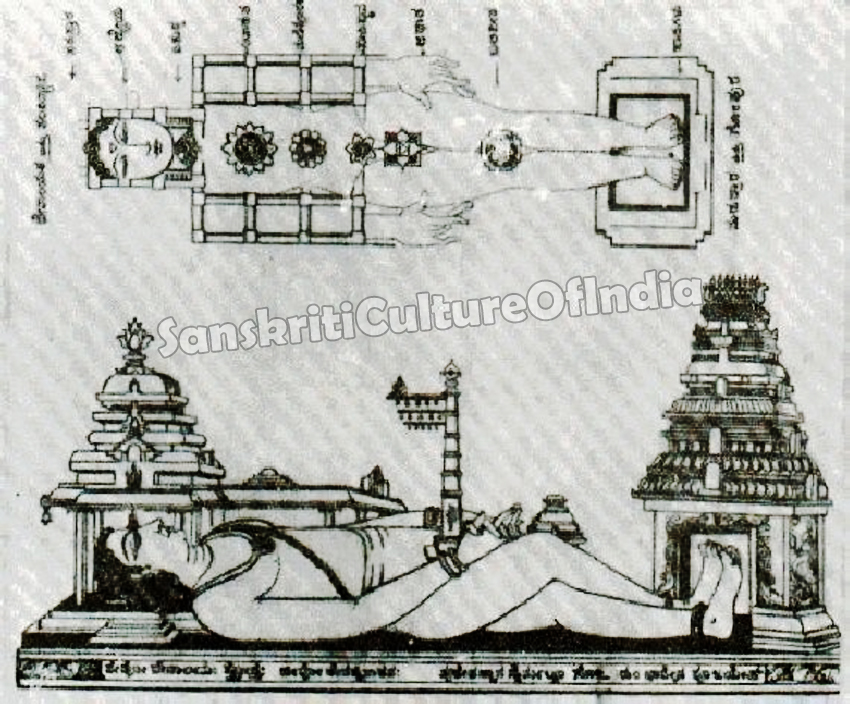
The main picture shown here is reproduced from Hindu Temple vol 1. by Stella Kramrisch demonstate how the temple structure can be compared with the human body. It is apt to quote the Sanskrit sloga from “Viswakarmyam Vastu Shastra”:
“Garba Gruha Sirahapoktam antaraalam Galamthatha
Ardha Mandapam Hridayasthanam Kuchisthanam Mandapomahan
Medhrasthaneshu Dwajasthambam Praakaram Janjuangeecha
Gopuram Paadayosketha Paadasya Angula Pokthaha
Gopuram Sthupasthatha Yevam Devaalayam angamuchyathe”
Meaning: Garba-griham (main sanctum) is equated with human head; antarala (vestibule) is equated with human neck; ardha – mandapam (half-hall) is compared with human chest; maha – mandapam (main hall) is equated with the stomach; flag-post is viewed along with human male organ;and gopuram or temple gateway tower is viewed along with human feet.
Reference:
- About Vastu Shastra. Divine Vastu (http://www.divinevastu.net/)
- Temple Architecture: Devalaya Vastu by Srinivasa Rao,S.~ R Muthusamy