Known as “Tengai” (literally “honey fruit”) in Tamil, and as “Nariyal” in Hindi (literally “fruit containing water”, from the root word “nari” meaning “water”).The coconut is a resilient fruit whose shell can withstand the pressure of sea water, so it is not impossible for it to have made the transit across the water without human assistance. A hardy plant, the coconut would have been able to survive in relatively inhospitable weather without much upkeep. It grows in sandy soil, requires little water, and requires virtually no maintenance.
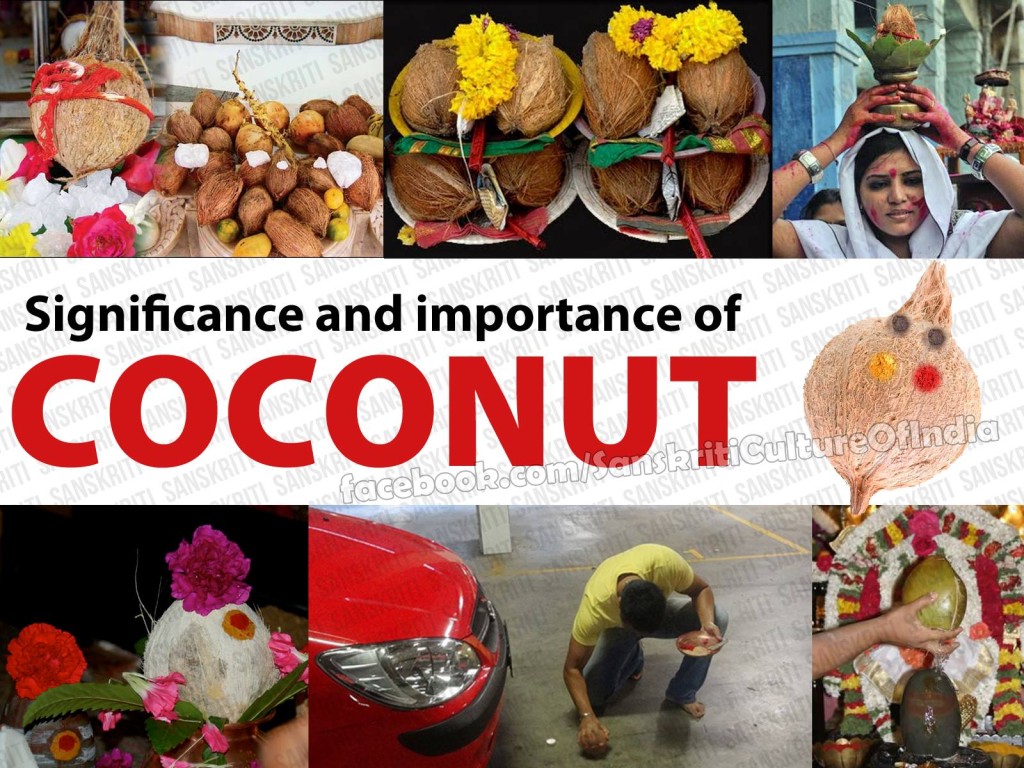
In Indian culture ‘Nariyal’ or ‘Copra’ is a symbol of good luck and prosperity. Every auspicious work begins with the breaking of the coconut and the offering of ‘Nariyal’ is a traditional ritual. For success and prosperity at all occasions, the launch is done with the breaking of a sanctified coconut. All religious functions and rituals start with the offering of the coconut since it is regarded as the symbolic Ganesh, the deity who helps in the successful completion of any work undertaken.
Sage Vishwamitra is said to be the creator of the coconut. Its hard kernel inspires one to do hard work for attaining success. People get strength and improved eyesight by eating the kernel. The sick and the elderly find its water nourishing and ladies apply its oil for luxurious hair. Germs can’t penetrate its hard kernel so it remains intact for months together. Coconut is used both as a food item and as a medicine. It is a rich source of vitamin E, B, C and calcium, iron, phosphorus and other minerals. It has high quality alkaline oil and is a rich source of fat. The protein found in coconut is also of high quality. Coconut is easily digestible, nutritious, blood enhancer, urinary tract purifier, strength giving and remover of the three doshas.
In Indian culture one of the most common offerings in a temple is a coconut. It is also offered at occasions like weddings, festivals, the use of a new vehicle, bridge, house, etc. It is offered in the sacrificial fire while performing hawan. The coconut is broken and placed before the Lord. It is later distributed as prasad (a holy gift). At the beginning of any religious occasion, a coconut is turned around the person or diety and broken at the entrance; this is to remove negativity and bring out the goodness. The whiteness inside the coconut denotes purity.
The fibre covering of the dried coconut is removed except for a tuft on the top. The marks on the coconut make it look like the head of a human being. The coconut is broken, symbolising the breaking of the ego. The juice within, representing the inner tendencies (vasanas), is offered along with the white kernel – the mind, to the Lord.
A mind thus purified by the touch of the Lord is used as prasad. In the traditional abhishekha ritual done in all temples and many homes, several materials are poured over the deity like milk, curd, honey, tender coconut water, sandal paste, holy ash, etc. Each material has a specific significance of bestowing certain benefits on the worshipers. Tender coconut water is used in abhisheka rituals since it is believed to bestow spiritual growth on the seeker. The marks on the coconut are even thought to represent the three-eyed Lord Shiva and therefore it is considered to be a means to fulfill our desires.
The coconut also symbolises selfless service. Every part of the tree -the trunk, leaves, fruit, coir, etc. are used in innumerable ways like thatches, mats, tasty dishes, oil, soap, etc. It takes in even salty water from the earth and converts it into sweet nutritious water that is especially beneficial to sick people. It is used in the preparation of many ayurvedic medicines and in other alternative medicinal systems.
Ancient Indian doctors used to burn its outer shell to prepare tooth powder, creams and ointments for burns. Every inch of the coconut plant is very beneficial to humans hence Indians consider it a good omen to receive or give coconut as gifts. It is also called ‘Shreephal’ because it denotes prosperity.
Coconut is a crop with unique features. Owing to its versatile uses, the demand for coconut and its products has been on the increase having already attained the premier position in the world. Moreover coconut is an eco-friendly crop which permits co-existence of multi-species of plants. It enriches soil fertility in association with other crops and is quite amenable to organic farming if appropriate intercrops are grown in the inter-spaces. Due to multifarious uses, the future of the crop is very bright irrespective of the location where it is grown in the world.