Thursday, October 29, 2026 · Kartik, Krishna Paksha Chaturthi · Karva Chauth · Karak Chaturthi · Religion · Festivals
One fast, kept without a drop of water from before sunrise until the moon rises — and behind it, three women who would not let death have the last word.
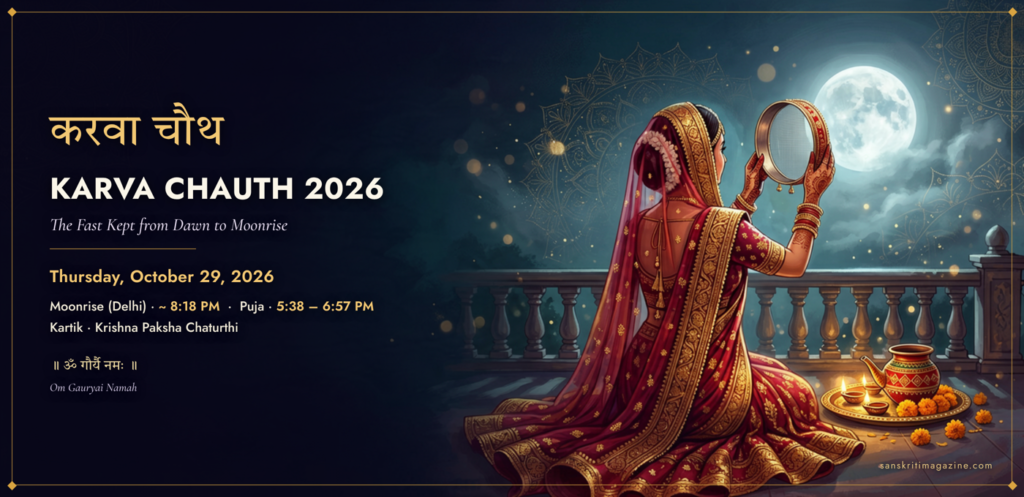
There is a particular quality to the evening of Karva Chauth that anyone who has stood on an Indian rooftop at dusk in late Kartik will know. The whole day has been a long discipline of thirst. Now the sky deepens. Women in bridal red gather on terraces and in courtyards, a steel thali in hand — a small earthen karva, a lit diya, a handful of rice, a sieve. They are all looking at the same thing: the eastern horizon, where the late-rising moon of the fourth night of the waning fortnight is about to appear. When at last a thin silver arc lifts over the rooftops, a hundred terraces exhale at once. The fast is nearly done — but not yet. First the moon must be offered water; then it must be seen through the mesh of a sieve; and only then, turning to see her husband’s face through that same mesh, does a woman take from his hand the first sip of water she has had in some fourteen hours.
In 2026, that evening falls on Thursday, October 29. This is a guide to the day — its timings, its ritual from the pre-dawn sargi to the moonrise arghya — and to the stories, far older and far fiercer than the festival’s gentle reputation suggests, that gave the fast its meaning.
Karva Chauth 2026 — Date and Timings
Timings as per standard Drik Panchang reckoning (IST). Moonrise and muhurat vary by city — a difference of 15 to 45 minutes is normal. Always confirm with your local panchang on the day.
| Chaturthi Tithi Begins | approx. 01:06 AM, Thursday, October 29, 2026 |
|---|---|
| Vrat Day | Thursday, October 29, 2026 |
| Puja Muhurat | approx. 05:38 PM to 06:57 PM |
| Moonrise (Delhi) | approx. 08:18 PM |
The fast is a nirjala vrat — kept without food or water — observed from before sunrise until the sight of the moon. The puja is performed in the short, sacred window of the evening muhurat, when the women of a neighbourhood gather to hear the Karva Chauth katha together; the fast itself is broken only after the moon has risen and been offered arghya.
Why the Fourth Night of Kartik?
Karva Chauth falls on the Chaturthi — the fourth day — of the Krishna Paksha, the waning fortnight, of the month of Kartik. It is also called Karak Chaturthi, from karak or karva, the spouted earthen pot that is the central object of the rite. The pot holds the water that will be offered to the moon; it is filled, worshipped, and in many families later given away to a priest or an elder, carrying with it the prayers of the fast.
And why the moon? Because Chandra, the moon-god, is in the tradition the lord of soma — the nectar of immortality — and the giver of coolness, serenity, and long life. A fast that prays for the long life of one’s husband is, fittingly, released only at the sight of the very deity who presides over longevity itself. The parched discipline of the day ends in the cool light of the amrita-bearing moon.
The Story of Veervati — the Heart of the Vrat
The central katha of Karva Chauth, told in the puja circle every year, is the story of Veervati.
Veervati was the only sister of seven devoted brothers, and the darling of the household. On the first Karva Chauth after her marriage, she returned to her parents’ home and kept the fast as a new bride should — nothing to eat, nothing to drink, from before dawn. But Veervati was tender, and unused to the discipline, and as the long day wore on she grew faint with hunger and thirst. By evening she could barely stand, waiting for a moon that would not rise until late in the night.
Her seven brothers could not bear the sight of their beloved sister suffering. And so they devised a deception born of love. They went beyond the town, climbed a pipal tree, and behind its leaves lit a lamp — or in another telling, held up a sieve before a fire on a distant hill — so that from the house it looked exactly like the glow of the rising moon.
“Look, sister — the moon has risen. Break your fast, and eat.”
Trusting her brothers, Veervati offered her arghya to the false moon and sat down to eat. But the moment the food touched her lips, word came to the house: her husband had fallen gravely ill — and, the katha says, in that same moment he died.
Veervati was shattered. She wept through the night and would not be consoled. And as she grieved, a Devi — Parvati herself, in the tradition — appeared before her and revealed what her brothers had done: she had broken her fast not at the true moonrise but at a false light, and so the vrat had been undone.
Then the Devi gave her a path. Keep the vrat again, she was told, and keep it with perfect devotion and perfect correctness, and your husband will be restored. Veervati did. Through the year she observed every Chaturthi, and on the next Karva Chauth she kept the nirjala fast flawlessly, breaking it only at the true rising of the moon. By the force of that steadfast devotion, her husband was returned to life.
This is why, to this day, the fast is kept to the true moonrise and not a moment before — and why it is not broken on the sight of the moon alone, but only after the moon is seen through a sieve, and then the husband’s face through the same mesh. The sieve is Veervati’s lesson, woven into ritual: look carefully; be sure it is real; love is not an excuse to cut the discipline short.
Karva — the Wife Who Threatened Yama
There is a second story, older and fiercer, from which the festival takes its very name.
A devoted wife named Karva lived with her husband on the bank of a river. One day, as her husband bathed, a crocodile seized him and began to drag him under. Karva ran to the water’s edge. With the spiritual power she had gathered through years of faithful married life — the power of the pativrata — she bound the crocodile fast with a single thread of cotton, and then she called upon Yama, the Lord of Death, to send the crocodile to Yamaloka and spare her husband.
Yama refused. The crocodile’s time was not yet come, He said, and Karva had no claim upon His judgement.
Karva did not flinch. She warned the Lord of Death that if He would not do justice, she would curse Him with the full accumulated force of her devotion — and reduce Him to ashes where He stood.
Yama, Lord of Death, who fears nothing in the three worlds, feared the curse of a faithful and righteous wife. He sent the crocodile to hell, and granted Karva’s husband a long life.
Here, beneath the gentle surface of a wives’ festival, is the tradition’s real claim: that the consecrated devotion of a sincere heart is a power that even Death must reckon with. It is the same claim the Mahabharata makes through Savitri, who walked behind Yama and out-argued Him for her husband’s life — and Karva Chauth belongs to exactly that lineage of women who would not accept death as the final word.
Draupadi and the Pandavas
The vrat has its place in the Mahabharata as well. When Arjuna withdrew to the Nilgiris for tapasya and misfortune pressed upon the Pandavas, Draupadi, anxious for her husbands, is said to have turned to Bhagavan Krishna. Krishna reminded her that Parvati had once asked the same of Shiva, and had been told of this very fast kept by devoted wives. On His counsel, Draupadi observed the Karva Chauth vrat for the welfare of the Pandavas — and their difficulties were overcome.
And the thread runs back further still, to Parvati herself, from whom the tradition ultimately traces the vrat — the Devi who won Shiva through the austerity of her own longing, keeping fasts of a severity that moved the Great Lord Himself.
How the Day Is Kept
- Sargi, before sunrise. In the pre-dawn dark, the fasting woman eats the sargi — a meal traditionally sent with love by her mother-in-law: fruit, sweets, feni, dry fruits, and water to carry her through the day. After sunrise, not a morsel or a drop passes her lips.
- The fast through the day. The nirjala vrat is held through the daylight hours. Many women dress through the day in bridal finery — red or other auspicious colours, bangles, mehndi, and the sixteen adornments of the solah shringar.
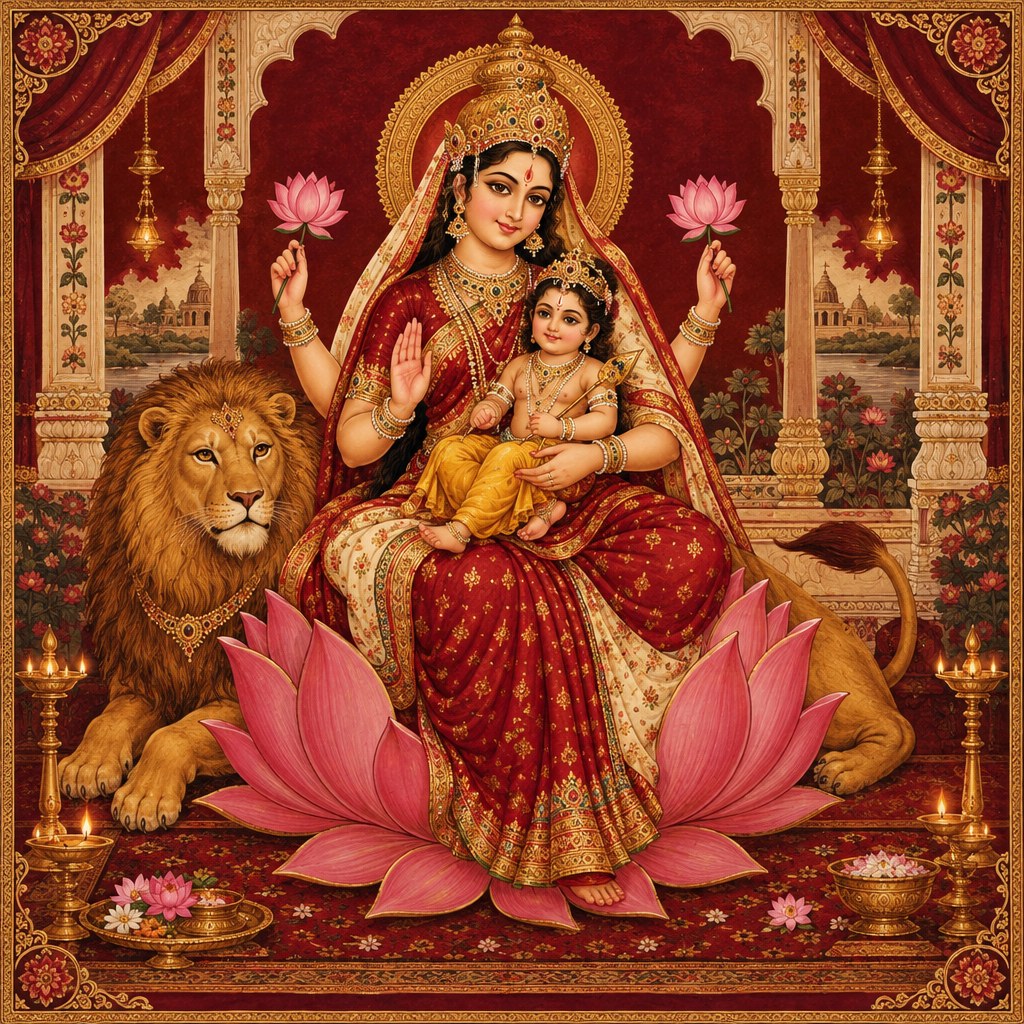
- The evening puja. In the muhurat window, the women gather. The karva is filled with water; Gauri (Parvati), Ganesha, and the karva are worshipped; and the Karva Chauth katha is heard together, with the puja thalis passed in a circle.
- Moonrise and arghya. When the moon rises, water is offered to it from the karva as arghya. The woman then looks at the moon through the mesh of a sieve, and immediately after, turns to look at her husband’s face through the same sieve.
- Breaking the fast. The husband gives his wife the first sip of water and the first morsel of food from his own hand, and offers his blessing. The long fast is complete.
Though the fast is kept by the wife, the day is understood as a bond that runs both ways — a mutual vow of care, in which the husband’s role at the moment of breaking the fast is not incidental but essential. In recent times many husbands keep the fast alongside their wives, making of it a shared discipline rather than a one-sided one.
Mantras for the Day
Salutations to Gauri and to Shiva — the divine couple invoked for a long and harmonious married life.
Om Somaya Namah — the salutation to Chandra, the moon, offered with the arghya at moonrise.
The Meaning Beneath the Fast
It is easy, from the outside, to read Karva Chauth as a quaint ritual of wifely devotion, all mehndi and moonlight. The stories tell a sterner tale. Veervati’s husband is returned from death by the perfection of a repeated vow. Karva binds a crocodile with a thread and makes the Lord of Death Himself step back. Savitri, their elder sister in spirit, walks into Yamaloka and will not turn around. Draupadi keeps the fast and the fortunes of the five greatest warriors of the age are turned.
What the tradition is saying through all of them is the same thing it says through the Savitri katha of Vat Purnima: that there exists in Sanatana Dharma a force stronger than prarabdha, stronger than illness, stronger than Yama’s own noose — and that force is the steady, consecrated will of a sincere heart that refuses to bend. The thirst of the day is a small enactment of a very large claim. The woman who holds the fast without a drop of water from darkness to moonrise is rehearsing, in her own body, the steadfastness of the women who once made Death itself relent.
When the moon rises on the evening of October 29 and a hundred terraces lift their sieves toward it, that is what is being remembered.
A pot of water, a lamp, a sieve, and a moon — and behind them, the oldest claim of all: that love held steady and true is a power even death must answer to.
Om Gauryai Namah