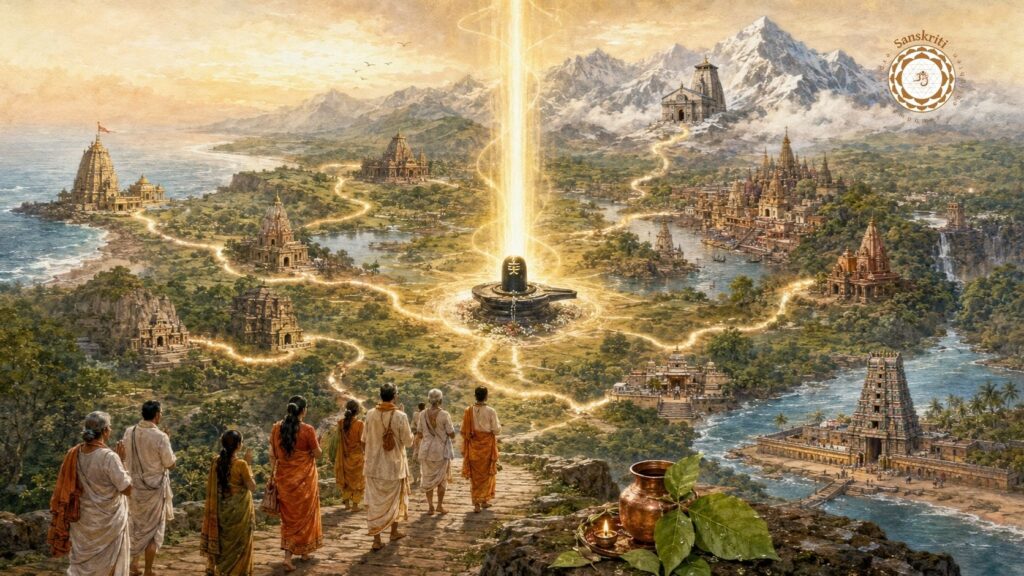
Twelve points on the map of Bharata where, the Puranas say, the endless light of Shiva broke through the earth — and never went out.
There is a story the tradition tells to explain them all. Once, Brahma and Vishnu fell into a dispute over which of them was the greater. As they argued, there appeared before them a pillar of fire without top or bottom — a shaft of light that pierced the earth and vanished into the sky beyond sight. A voice told them that whoever found its end would be proved supreme. Vishnu took the form of a boar and dug downward for an age; Brahma took the form of a swan and flew upward for an age. Neither found an end. The pillar was Shiva Himself — the Jyotirlinga, the linga of light, without beginning or end, the formless made visible as a column of fire.
Where that infinite light is held to have manifested on the earth, a shrine stands. There are twelve such places — the Dwadasha Jyotirlingas — and together they map the whole of Bharata, from the western sea to the far south, from the Himalayan snows to the banks of the Ganga. To visit all twelve is one of the greatest pilgrimages in Sanatana Dharma. This Shravan, on the last of the four sacred Mondays, we walk them all — if not with our feet, then in the heart.
The Twelve, at a Glance
| # | Jyotirlinga | Where it stands |
|---|---|---|
| 1 | Somnath | Prabhas Patan, Saurashtra, Gujarat |
| 2 | Mallikarjuna | Srisailam, Andhra Pradesh |
| 3 | Mahakaleshwar | Ujjain, Madhya Pradesh |
| 4 | Omkareshwar | Mandhata island, Narmada, Madhya Pradesh |
| 5 | Kedarnath | Rudra Himalaya, Uttarakhand |
| 6 | Bhimashankar | Sahyadri hills, Maharashtra |
| 7 | Kashi Vishwanath | Varanasi (Kashi), Uttar Pradesh |
| 8 | Trimbakeshwar | Nashik, Maharashtra |
| 9 | Vaidyanath (Baidyanath) | Deoghar, Jharkhand |
| 10 | Nageshwar | Near Dwarka, Gujarat |
| 11 | Rameshwaram (Ramanathaswamy) | Rameswaram island, Tamil Nadu |
| 12 | Grishneshwar | Near Ellora, Aurangabad, Maharashtra |
1. Somnath — the Shrine That Rose Again
On the shore of the western sea in Gujarat stands the first of the Jyotirlingas — Somnath, “the Lord of the Moon.” Here, the Puranas say, Chandra the Moon-god, cursed to waste away, worshipped Shiva and was restored, his light waxing again. No temple in Bharata has been destroyed and rebuilt as many times as Somnath, and none has risen again as often — the very emblem of a faith that cannot be extinguished.
2. Mallikarjuna — the Kailasa of the South
On the Srisailam hill above the Krishna river, Mallikarjuna is worshipped with the Devi as Bhramaramba. When their son Kartikeya left home in a sulk, the story goes, Shiva and Parvati followed him south and settled here to be near him — and so this hill is called the southern Kailasa, where the divine parents dwell for love of their child.
3. Mahakaleshwar — the Lord of Time
In the ancient city of Ujjain stands Mahakaleshwar, the only Jyotirlinga that faces south — the dakshinamukhi — and the Lord of Kala, of Time and death itself. Its famous Bhasma Aarti, performed before dawn with sacred ash, is among the most powerful sights in all of Shiva worship.
4. Omkareshwar — the Island Shaped Like Om
Where the Narmada divides around the Mandhata island — an island tradition holds to be shaped like the sacred syllable Om — stands Omkareshwar. The river itself flows here in the form of the pranava, and the Lord is worshipped as the sound from which all creation arose.
5. Kedarnath — the Highest Shrine
High in the Garhwal Himalayas, reachable only by a long mountain trek and open only in the warmer months, Kedarnath is the most remote of the twelve. Here, the tradition says, the Pandavas sought Shiva to be absolved after the war, and He, unwilling to face them, dived into the earth in the form of a bull — leaving His hump at Kedarnath, worshipped to this day.
6. Bhimashankar — Source of a River
In the Sahyadri hills of Maharashtra, Bhimashankar marks the spot where Shiva destroyed the demon Tripurasura (or, in another telling, Bhima the asura). From here rises the Bhima river, and the surrounding forest is one of the last homes of the great Indian giant squirrel — a sanctuary guarded, in effect, by the Lord.
7. Kashi Vishwanath — the Lord of the City of Light
On the banks of the Ganga in Varanasi — Kashi, the oldest living city and the “city of light” — stands Vishwanath, the Lord of All. Kashi is held to rest upon Shiva’s trident, beyond the ordinary earth; to die within it, the tradition says, is to receive the Taraka mantra from Shiva’s own lips and cross the ocean of rebirth.
8. Trimbakeshwar — the Threefold Lord and the Godavari
Near Nashik, at the source of the great Godavari, stands Trimbakeshwar, unique among the twelve for its linga of three faces — Brahma, Vishnu, and Shiva together. Here the sage Gautama drew the Ganga down as the Godavari to absolve himself of a sin, and the river of the south was born.
9. Vaidyanath — the Divine Physician
At Deoghar in Jharkhand stands Vaidyanath, “the Lord of Physicians,” worshipped for healing. Here Ravana, the great devotee, offered his own ten heads one by one to Shiva; pleased, the Lord descended as a physician and restored him — and left this linga upon the earth when Ravana, tricked, could not lift it back to Lanka.
10. Nageshwar — the Lord of Serpents
Near Dwarka in Gujarat stands Nageshwar, where Shiva is worshipped as the protector against all poison and the lord of the Nagas. Here He rescued a devotee named Supriya from the demon Daruka, appearing as the Jyotirlinga to defend those who call upon Him — a fitting shrine to remember in this same Shravan that carries Nag Panchami.
11. Rameshwaram — the Linga Rama Worshipped
On the island of Rameswaram in the far south, where the land reaches toward Lanka, stands Ramanathaswamy — the linga worshipped by Sri Rama Himself before crossing the sea to rescue Sita. Rama installed a linga of sand fashioned by Sita here to atone for the war to come, and so the greatest devotee of Vishnu is remembered forever as a worshipper of Shiva. It joins the north to the south: pilgrims carry Ganga water from Kashi to bathe this linga.
12. Grishneshwar — the Last of the Twelve
Near the Ellora caves in Maharashtra stands Grishneshwar, the twelfth Jyotirlinga, whose story tells of a devout woman named Kusuma whose faith brought her dead son back to life by the grace of Shiva. It is the smallest and gentlest of the twelve in fame, and the tradition places it last — the reminder that the Lord’s greatest miracles are worked for the simplest and most sincere of hearts.
How to Make the Pilgrimage This Shravan
- In person: few can visit all twelve in one journey, but Shravan is the most auspicious time to visit even one. Somnath and Nageshwar (Gujarat), or Trimbakeshwar, Bhimashankar, and Grishneshwar (Maharashtra), each make a natural regional cluster.
- In spirit: the tradition holds that reciting the Dwadasha Jyotirlinga Stotram — the hymn naming all twelve — grants the merit of the pilgrimage itself. Reciting it daily through Shravan is a complete observance in its own right.
- At home: perform a simple abhishekam at your household altar while naming each of the twelve in turn, offering a bilva leaf for each — twelve leaves, twelve lights of the one endless flame.
The One Light in Twelve Places
The deepest teaching of the Jyotirlingas is hidden in the word itself. A jyoti is a flame, a light; a linga is a mark, a sign. The twelve are not twelve gods but twelve places where the one boundless light of Shiva — the pillar that neither Brahma nor Vishnu could measure — chose to become visible and stay. From the sea-shore of Somnath to the Himalayan height of Kedarnath, it is the same flame.
And that is the pilgrim’s true discovery. He sets out to visit twelve shrines across the length of Bharata and learns, somewhere on the road, that he has been circling a single light the whole time — the same light, the tradition says, that dwells within his own heart, waiting only to be recognised.
Twelve places on the map. One flame without beginning or end. This Shravan, wherever you stand, you are already before it.
The opening verse of the Dwadasha Jyotirlinga Stotram — “In Saurashtra, Somnath; at Srisailam, Mallikarjuna; in Ujjain, Mahakala; and Omkara, the pure Lord…”