Wednesday, August 26, 2026 · Thiruvonam · Shravana Nakshatra · Onam · Religion · Festivals
The one festival in all of Bharata where the people wait, year after year, for the homecoming of a king the gods sent away.
Every great festival of Sanatana Dharma remembers a victory of the divine. Onam remembers something rarer and more tender: the return of the one who lost. For ten days each year, the whole of Kerala prepares its home for a guest — sweeping the courtyards, laying flowers on the ground, cooking a feast fit for royalty — and the guest they await is not a god come to conquer but a much-loved king come to visit the land he once ruled. His name is Mahabali. He was an asura, a grandson of Prahlada, and by every rule of mythology he ought to be a villain. Instead, an entire people has loved him for millennia.
In 2026, the great day — Thiruvonam — falls on Wednesday, August 26, the crown of the ten-day festival that begins on Atham. To understand why Malayalis greet each other with “Onam is here — Maveli is coming”, we have to go back to the Bhagavata Purana and one of the most beautiful of all the avatar-stories: the coming of Vamana.
The King Who Was Too Good
Mahabali — Maveli, as Kerala fondly calls him — was the grandson of the great bhakta Prahlada, and he inherited his grandfather’s devotion along with the throne of the asuras. He was mighty in battle and, having won the three worlds, ruled them; but the tradition is emphatic about the kind of ruler he was.
Under Mahabali, the old songs say, there was no falsehood and no fear. No one lied. No one was cheated. There was no poverty, no disease, no theft. The measures in the market were honest, the harvests were full, and every subject was equal before the king. It was, quite simply, a golden age — a Ramarajya ruled by an asura.
“When Maveli ruled the land, all the people were equal. There was neither anxiety nor sickness; and there was no deceit, no lie, no fraud.” — the traditional Onam song, sung across Kerala to this day.
Here already is the puzzle at the festival’s heart. If the king was so good, and his rule so just, why did the story need him removed at all?
Why the Gods Grew Uneasy
Mahabali’s very virtue became the trouble. His generosity and his conquests had made him lord of heaven, earth, and the netherworld alike. The devas, displaced from their own realm, went to Bhagavan Vishnu. And the deeper matter, the Bhagavata makes clear, was subtler than a mere loss of territory: even the best of kings, holding the whole universe, stood at the edge of a pride that no amount of virtue can wholly escape. The dominion of the three worlds is not meant to rest in any single hand — not even a just one.
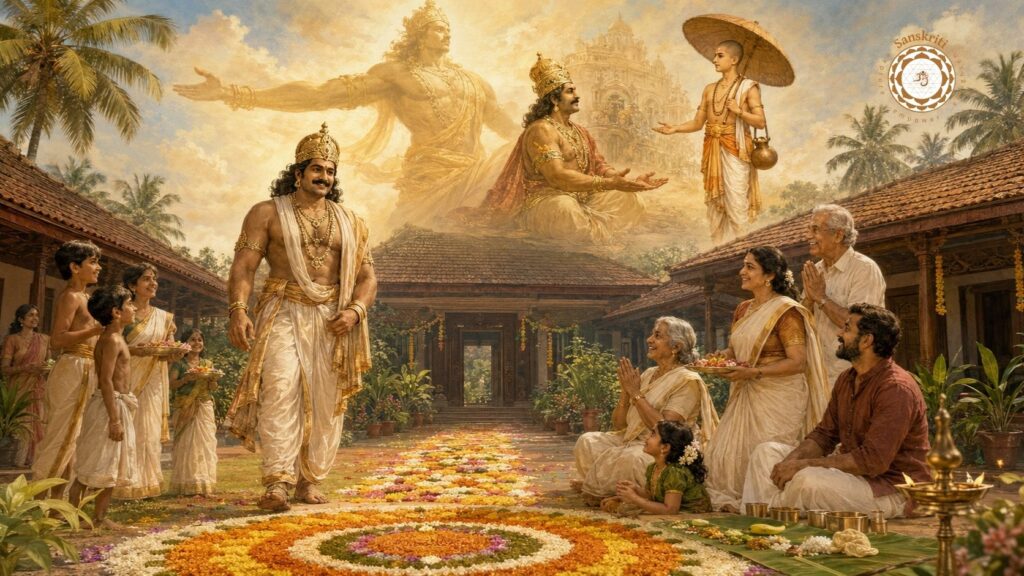
So Vishnu did not send an army. He did not send a weapon. He came Himself, in the smallest and gentlest form He ever took — as Vamana, a young brahmana boy, a dwarf, carrying nothing but a palm-leaf umbrella, a water pot, and a begging staff.
Three Steps of Land
Mahabali was performing a great Ashwamedha sacrifice on the banks of the Narmada, and had vowed that no one who came to him during it would be turned away empty-handed. Into that assembly walked the little brahmana, radiant beyond his size, and the king rose to receive him with joy.
“Ask,” said Mahabali. “Whatever you wish — gold, cattle, villages, whole provinces — name it, and it is yours.”
The boy asked for something absurdly small. “I ask only for three paces of land, measured by my own feet. No more than that.”
Mahabali laughed and pressed him — surely he wanted more? But the boy would take only his three steps. Now the king’s guru, Shukracharya, saw with his inner sight who the dwarf truly was, and he warned his king: this is Vishnu Himself; do not grant it; you will lose everything.
And here the story turns on the single decision that made Mahabali immortal in the heart of a people. He knew, or half-knew, that the beggar might be the Lord come to undo him. And he chose to keep his word anyway.
“If the Lord Himself has come to my door as a supplicant, what greater fortune could an asura ask? Let it never be said that Bali sent Vishnu away unsatisfied. I will give the three steps.”
He poured the water of the vow over his hands. The gift was sealed.
The Cosmic Form
And then the dwarf began to grow.
Vamana swelled until He filled the sky — the Trivikrama, “He of the three strides,” the form the Rigveda itself sings of. With His first step He covered the whole earth and all its realms. With His second step He covered the heavens and everything above. And then He paused, and asked the question to which there could be no answer: “Where shall I place my third step? Your kingdom of three worlds is measured by two. Where is the ground for the third?”
Mahabali stood stripped of everything he had ruled. But he did not flinch, and he did not break his word. He bowed his head and offered the only thing left in all the universe that was still his to give.
“Lord, there is one place your foot has not yet measured. Place your third step here — upon my head.”
Vishnu placed His foot on the head of the king, and pressed him down — not into destruction, but into Sutala, the most luminous of the netherworld realms, a place finer than heaven itself.
The Boon That Made a Festival
What Vishnu did next is the reason Onam exists. He did not merely spare Mahabali; He honoured him above almost every being in the scriptures. Moved by the king’s unbreakable truth and surrender, the Lord granted him boon after boon.
He made Mahabali the ruler of Sutala, richer and more secure than the heaven he had lost. He promised that in the coming age Mahabali would himself become Indra, king of the devas. And He, Vishnu — the Lord of all the worlds — promised to stand personally as the doorkeeper of Mahabali’s realm, a guardian at the gate of the very king He had displaced.
And then came the boon that Kerala keeps. Mahabali asked for one thing more: that he be permitted to return, once each year, to visit the land and the people he had loved and been loved by. Vishnu granted it.
So every year, on Thiruvonam, the good king comes home. And a whole people makes ready — because a beloved ruler is returning to see whether his subjects are still happy, still equal, still free.
Why Onam Is a Homecoming, Not a Defeat
This is the genius of the festival. The people of Kerala do not celebrate the day their king was sent away. They celebrate the day he is allowed to return. Every custom of Onam is, quite literally, the preparation of a home for a returning loved one.
- The pookalam — the intricate carpet of flowers laid fresh in every courtyard, growing larger each of the ten days — is the welcome mat spread for Maveli’s feet.
- The Onasadya — the grand vegetarian feast of dozens of dishes served on a banana leaf — is the meal set before an honoured guest, so that he sees his people are still prosperous and content.
- New clothes (Onakkodi), boat races (Vallamkali), the swings, the songs, the games — all of it is a people showing their returning king that the golden age he built has not been forgotten.
There is a deep theology hidden in this joy. Mahabali lost the three worlds and gained something greater — the personal, permanent nearness of the Lord, who chose to guard his gate. In the tradition’s reckoning, the asura who surrendered everything received far more than the devas who kept their heaven. What looked like defeat was the highest victory available to any soul: to give the Lord everything, including one’s own head, and to be lifted up for it.
Onam 2026 — The Ten Days
Onam follows the Malayalam solar calendar; Thiruvonam is the Shravana nakshatra in the month of Chingam. Dates as per standard Kerala calendar reckoning — confirm locally.
| Atham (Day 1 — festival begins) | approx. Saturday, August 15, 2026 |
|---|---|
| Uthradom (eve of Onam) | Tuesday, August 25, 2026 |
| Thiruvonam (the great day) | Wednesday, August 26, 2026 |
The Teaching of Maveli
Onam endures because it answers a question the harsher festivals do not. It is easy to love a story where good crushes evil. Onam asks us to love a story where the good and the divine meet not as enemies but as guest and host — where a king’s greatness is measured not by the three worlds he held but by the grace with which he gave them up, and where the Lord’s greatness is shown not by the foot that pressed the king down but by the door He then agreed to guard.
The boy who asked for three steps teaches that the divine can arrive in the smallest, most unassuming form, and that it asks, in the end, for everything — but only so that it can give back something immeasurably greater. And the king who offered his own head teaches the one lesson the whole of bhakti turns upon: that the soul which holds nothing back, and keeps its word even to its own undoing, is the soul the Lord will never leave.
Maveli is coming. Sweep the courtyard, lay the flowers, cook the feast — the good king returns to see that his people are happy. That is Onam.
Om Namo Bhagavate Vamanaya — salutations to Bhagavan Vamana, the Lord who measured the worlds in three steps.