Thursday, June 11, 2026 · Adhika Jyeshtha, Krishna Paksha Ekadashi · Purushottam Maas · Religion · Festivals
The Krishna Paksha twin of Padmini — and the Padma Purana’s promise to anyone whose poverty has refused to leave.
Two weeks ago, on Wednesday May 27, Vaishnavas across Bharata kept the rare Padmini Ekadashi — the Shukla Paksha Ekadashi of Adhik Maas, the one Bhagavan Krishna named to Yudhishthira as the Ekadashi “the Devas themselves descend in their viman to keep.”
What is less often spoken of is that Padmini has a twin.
In every Adhik Maas, two Ekadashis appear instead of one. The Shukla Paksha one is Padmini. The Krishna Paksha one — observed on the eleventh day of the dark fortnight of the same intercalary month — is Parama Ekadashi, the Supreme Ekadashi. And the Padma Purana, in the same conversation between Krishna and Yudhishthira, names it as the rarer and more secret of the two.
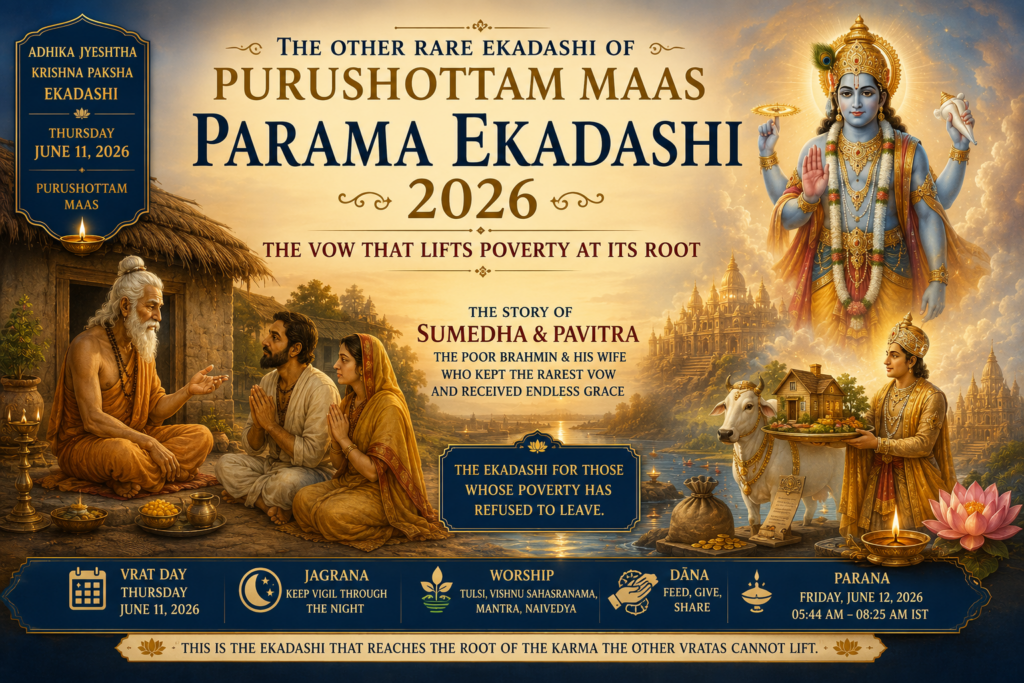
This year, Parama Ekadashi falls on Thursday, June 11, 2026 — and the Vaishnava tradition holds it especially for those whose poverty, sorrow, or material lack has refused to lift in spite of every other vrat already kept.
The Story Krishna Told
When Yudhishthira asked Bhagavan Krishna to tell him of the Krishna Paksha Ekadashi of Adhik Maas, Krishna told him the story of a Brahmin named Sumedha and his wife Pavitra, of the ancient city of Kampilya.
Sumedha was a Brahmin of the truest kind. He kept the Sandhya. He recited the Vedas. He turned no guest away from his door. But the karma of some past life sat on his household like a fog that would not lift — he was poor, and no matter how he sought work, the work did not come.
His wife Pavitra was a woman of luminous bhakti. Though she often had no second saree to change into and no second meal to eat, she gave what little they had to every guest who came. Her husband had a wife. The guests had a host. The house had nothing.
One day Sumedha could bear it no longer. He decided to leave the village in search of wealth abroad.
On the morning he was to set out, the great rishi Kaundinya arrived at the threshold.
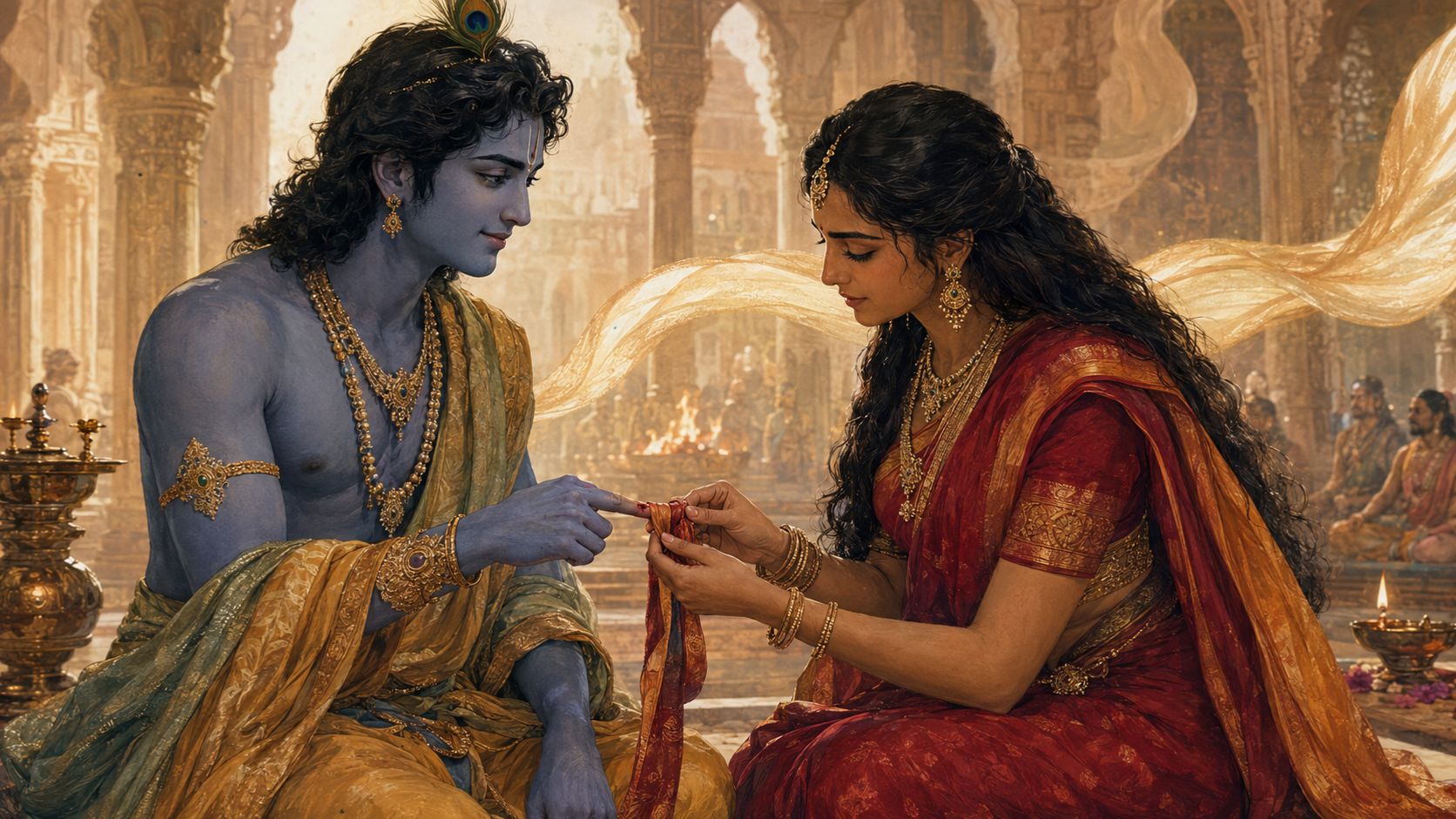
Sumedha and Pavitra received him with the usual offerings — water for his feet, a seat of woven grass, the last of the rice in the pot. The rishi ate. He saw the house. He understood without being told.
When the meal was done, he turned to them.
“Children, I do not need to ask. Your karma is heavy. Listen. There is one vrat I would not ordinarily speak of, because it appears so rarely that most lifetimes do not contain it. But this year it is upon us. In the Krishna Paksha of this Adhika Jyeshtha falls Parama Ekadashi — the rarest and most secret of the rare Ekadashis. Bhagavan Vishnu reserved it for households like yours, where the poverty is older than the present birth and no ordinary vrat has been able to reach to its root.”
He gave them the vidhi.
Sumedha and Pavitra kept the vrat with full sincerity.
The Padma Purana records what happened. On the morning after the parana, a young man — richly dressed, his bearing royal, his eyes calm — arrived at Sumedha’s door. He said he had been instructed in a dream by Bhagavan Brahma Himself to seek out a Brahmin named Sumedha and to place before him a house, a herd of cattle, and a village to support him for the rest of his days.
The prince gave what he had been instructed to give.
Sumedha and Pavitra lived from that day in aishwarya — material ease, peace, the time to keep their sadhana — and at the end of their long life, the Padma Purana says, they were taken directly to Vaikuntha.
When Krishna finished, He added to Yudhishthira: “Pandava, what was lifted from Sumedha’s household is not held back from any other where Parama is kept with sincerity. This is the Ekadashi for the karma the other vratas cannot reach.”
Parama Ekadashi 2026 — Timings
| Ekadashi Tithi Begins | 12:57 AM, Thursday, June 11, 2026 |
|---|---|
| Ekadashi Tithi Ends | 10:36 PM, Thursday, June 11, 2026 |
| Vrat Day | Thursday, June 11, 2026 |
| Parana | Friday, June 12, 2026 — 05:44 AM to 08:25 AM IST |
Vrat Vidhi
- Rise at Brahma Muhurta. Bathe in cool water with a few drops of Ganga jal added. Wear clean clothes — yellow or saffron is preferred.
- Take the sankalpa before Bhagavan Vishnu — name explicitly the karma you wish lifted: poverty, fear, lingering illness, blocked work. The Padma Purana enjoins that for Parama, the sankalpa be specific.
- Establish the puja with tulsi, yellow flowers, sandal paste, the dvadasha-akshara mantra chanted on a tulsi mala, and naivedya of fruits.
- Keep the fast — phalahari for householders, nirjala for those who can. The defining merit is in keeping the jagrana — the night vigil — through the small hours, with recitation of the Vishnu Sahasranama.
- Some traditions observe the Pancha-Parama — keeping the vrat for five consecutive days from Ekadashi to Purnima of Adhik Maas. This was the form Sumedha and Pavitra kept. Either is fruitful.
- Break the parana on Friday morning, June 12, within the prescribed window, after offering a meal to a Brahmana or a hungry person.
Mantras
Om Namo Bhagavate Vasudevaya — the dvadasha-akshara mantra
Om Namo Narayanaya — for the lifting of the karma named in the sankalpa
Recommended recitations: the Vishnu Sahasranama through the small hours, the Sankashtanashana Stotra, and Adhyaya 95 of the Uttara Khanda of the Padma Purana — the chapter that preserves this very katha.
The Deeper Teaching
The Acharyas teach that there are vratas which work on the prarabdha — the karma already in motion — and others which work on the sanchita — the deeper reservoir of unmanifest karma stored from earlier births. Most Ekadashis address the prarabdha. They lift the load of the present life.
Parama, the Vaishnavas teach, reaches further. It addresses the sanchita itself. It lifts the root.
This is why the Padma Purana frames it as the Ekadashi for those whose poverty or sorrow seems inexplicable — for whom every other observance has yielded only partial relief. The household where the basic karmic ledger is heavy with debt from before this birth is the household Parama is for. The merit Sumedha and Pavitra received was not for a single life. It was for an unbinding of the ledger itself.
In the Krishna Paksha of Adhik Maas — in the dark fortnight of the month that itself appears only once in many years — the Lord opens a door that He does not open at any other time. The door is narrow. The vrat is exact. But what passes through it is the rarest of His graces.
This year, that door opens on Thursday, June 11. May whoever needs it pass through.
Om Namo Bhagavate Vasudevaya