Wednesday, May 27, 2026 · Adhika Jyeshtha, Shukla Paksha Ekadashi · Purushottam Maas · Religion · Festivals
The rarest Ekadashi of the entire Hindu calendar is three days away. It will not return until 2029.
There are twenty-four Ekadashis in an ordinary year — one in the bright fortnight and one in the dark fortnight of every lunar month. Each is sacred. Each carries the name and the grace of Bhagavan Vishnu. The devotee who keeps all twenty-four with sincerity walks under His protective gaze for the whole of life.
But once every two and a half to three years, when the calendar opens that rare thirteenth chamber called Adhika Maas — the Purushottam Maas of Bhagavan Vishnu — two additional Ekadashis appear that the world will not see again for another thousand days. The Shukla Paksha one is called Padmini. The Krishna Paksha one is called Parama. The Vaishnava tradition holds them as the rarest and most fruit-bearing Ekadashis of the entire wheel of the calendar.
The reason the tradition holds the first of these — Padmini — in such particular reverence is a single conversation preserved in the Padma Purana. It is a conversation between Yudhishthira and Bhagavan Krishna, and the lines Krishna spoke that evening have echoed across two thousand years of Vaishnava bhakti.
The Question Yudhishthira Asked
After the Mahabharata war was over, when the dust of Kurukshetra had settled and the Pandavas had returned to the cool quiet of Hastinapura, Yudhishthira sat one evening at the feet of Bhagavan Krishna. He had been keeping the Ekadashi vrat through every month of the year for as long as he could remember — Utpanna, Mokshada, Saphala, Putrada, Sat-tila, Jaya, Vijaya, Amalaki, Papamochani, Kamada, Varuthini, Mohini, Apara, Nirjala, Yogini, Devshayani, Kamika, Pavitra, Aja, Parivartini, Indira, Pasankusha, Rama, Prabodhini. Twenty-four in the wheel of the year.
He turned to Krishna with the question of a devotee who has already drunk deep and wishes to drink deeper.
“Madhusudana — is there an Ekadashi greater than these twenty-four? Is there a vrat the Vaishnava keeps and finds the door of Bhagavan more open than ever before? Tell me, Janardana — for if such a day exists, I will not let my life pass without keeping it.”
Bhagavan Krishna smiled the slow, knowing smile the Bhagavata calls manda-haasa — the smile of one who has been waiting for the question.
“Pandava — there is one. It does not appear in the wheel of the ordinary year. It appears only when the calendar opens its rarest door — the door of Purushottam Maas, the month that bears My own name. On the eleventh day of the bright fortnight of that intercalary month falls an Ekadashi the great Rishis spend lifetimes waiting for. The Devas themselves descend in their viman to keep it. Its name is Padmini.”
The Vrat Katha — The Queen Who Could Not Have a Son
Krishna then told Yudhishthira the story.
In the long ago, on the throne of the ancient city of Mahishmati on the bank of the Narmada, ruled a king named Kritavirya of the Haihaya dynasty. He was righteous, brave, and beloved of his people. He performed the great yajnas. He gave gifts to the Brahmanas. He ruled the four quarters with a steady hand. But his palace held one sorrow that no offering had been able to lift: he had no son.
His chief queen, Padmini, was a woman of luminous bhakti — as radiant as her name, which means the Lotus. She bore him devotion, she bore him counsel, she bore him every kind of love a wife may bring to a husband. But she could not bear him a son. The kingdom waited, year after year, for an heir who never came.
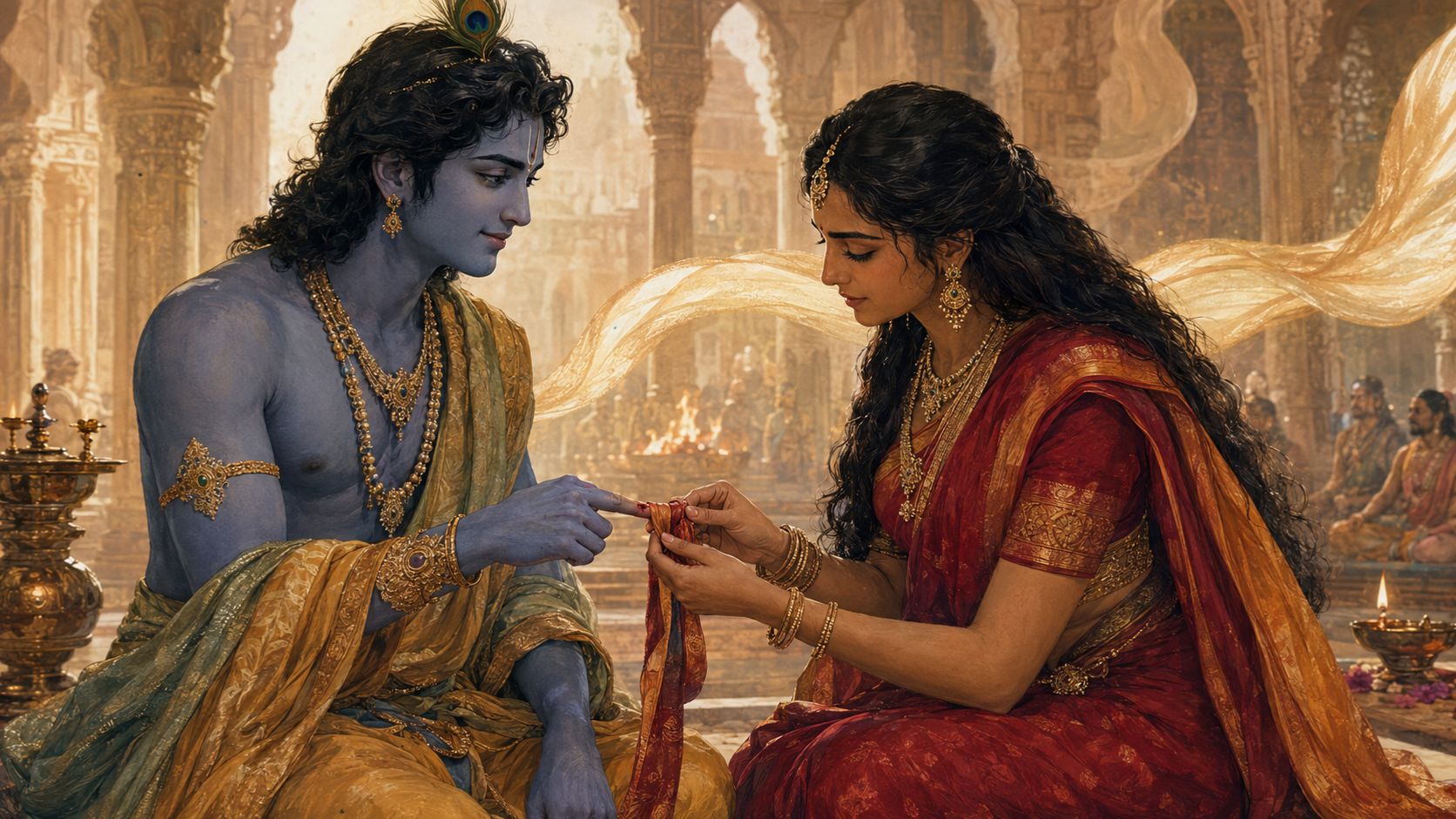
At last, when many years had passed and the king had grown grey at the temples, Padmini set aside her ornaments and went, on foot, to the ashrama of the great Rishi Anasuya — the wife of Maharishi Atri, mother of Dattatreya, and one of the most exalted of the sapta-sati, the seven exemplary women of Sanatana Dharma.
The queen prostrated. The Rishi listened. And after a long silence, Anasuya spoke.
“There is one vrat I would not advise to any sadhaka lightly, daughter. It is severe. It is exact. It is kept only once in many years — for it appears only during the month of Purushottam, and only on the eleventh of the bright fortnight. To keep it is to fast through the day, to keep jagrana through the night, to recite the Vishnu Sahasranama through the small hours, and to break the fast only at the prescribed parana on the morning of Dwadashi. It is not easy. And Bhagavan Vishnu has been known to grant the impossible to the one who keeps it well. It is called Padmini Ekadashi — and by good fortune, daughter, it falls within the year.”
Queen Padmini returned to Mahishmati. She waited for the day. When the eleventh of the bright fortnight of Purushottam Maas came, she rose at Brahma Muhurta, took the sankalpa before Bhagavan Vishnu, and kept the vrat with the perfection only love can bring. She fasted through the long day. She kept jagrana through the long night. She recited the Vishnu Sahasranama through the small hours. She broke the parana on Dwadashi morning with a single tulsi leaf and a sip of water tinged with sandal.
Before the year was out, the queen was holding a son in her arms. The Puranas record his name: Kartavirya Arjuna — the thousand-armed sovereign who would one day rule the four quarters of the earth, and whose name even Parashurama would speak with respect.
When Krishna finished the story, He looked at Yudhishthira and added the line that Vaishnava acharyas have been repeating for two thousand years:
“Pandava — what was given to Padmini is not held back from any other woman or man who keeps this vrat with sincerity. The Ekadashi remembers every devotee who has ever honoured it. The Devas keep it because they know what it gives. The Rishis wait for it because they know what it carries. Keep it well — and what is sealed in your life will open.”
Why the Name Is Padmini
The name is not arbitrary. Padmini in Sanskrit is the lotus — and the Acharyas teach that the choice of name carries the whole teaching of this Ekadashi.
The lotus does not bloom in a meadow. It does not bloom in fast-running water. It does not bloom in clean, predictable, gardened pools. It blooms in the darkest, stillest, most undisturbed water — in the silt that no other flower can survive. And when it blooms, it carries no trace of the silt that fed it. The petals come up pristine.
Padmini Ekadashi is named for this. What is rare is not less. What is rare is more. The devotee who has waited a long time for an answer should not despair when no answer comes in the ordinary months. The answer, the Acharyas say, may be saving itself for the rare lotus that blooms once in many years.
When that day comes, the one who has kept watch is the one given the flower.
The Vrat — Three Days Away
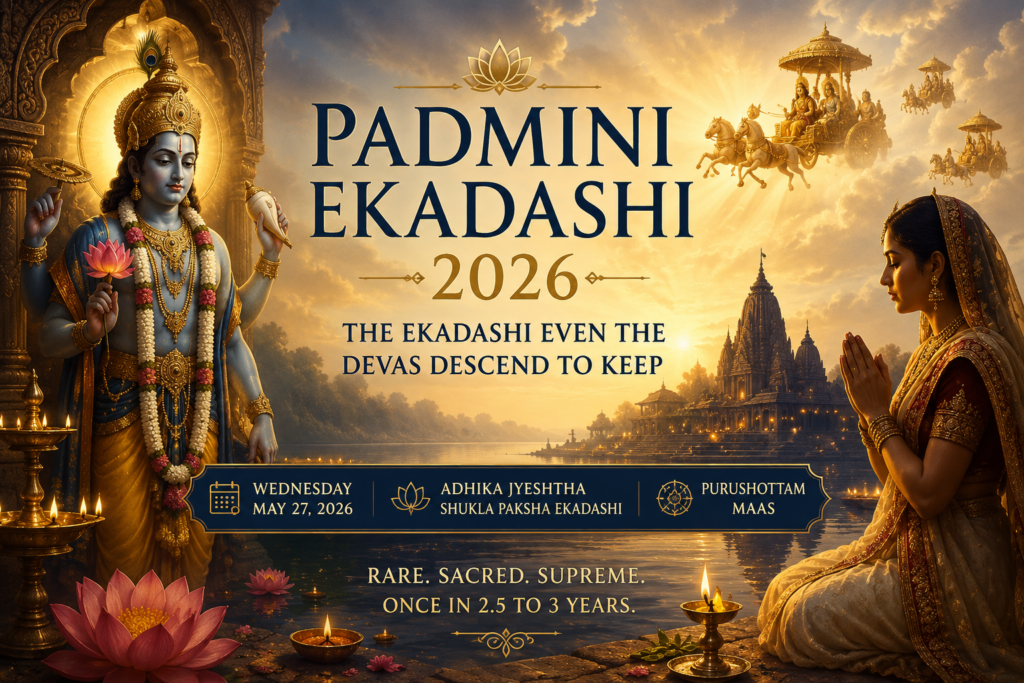
This year, that day is Wednesday, May 27, 2026 — the Shukla Paksha Ekadashi of Adhika Jyeshtha, the eleventh of the bright fortnight of Purushottam Maas. The Ekadashi tithi opens late on the evening of Tuesday, May 26, and closes late on the evening of Wednesday, May 27. The parana is on Thursday morning, May 28, after sunrise and within the Dwadashi window — and, as with every Mahaa-Ekadashi, the fast must not be broken during the Hari Vasara, the first quarter of Dwadashi which still belongs to Bhagavan Vishnu.
The defining practice of Padmini, more than the daytime fast, is the jagrana — the all-night vigil. The merit of this Ekadashi is sealed by the night more than by the day. The most sacred yama is the third — between roughly midnight and three in the morning — and the practice the Padma Purana most often names is the recitation of the Vishnu Sahasranama through that hour.
👉 Padmini Ekadashi 2026 — Full Vrat Vidhi, Mantras, and Parana Timings
A Closing Word
The Mahabharata records that after Krishna finished the story, Yudhishthira said nothing for a long time. He sat in silence as the evening lamps were lit in the Pandava court. When he finally spoke, he asked only one question.
“Janardana — when does the next Padmini come?”
Krishna told him.
Yudhishthira waited for it. He kept it. The Mahabharata does not tell us what he asked for. But Vyasa records, in a single line of the Padma Purana, that what was sealed in the eldest Pandava’s life that night opened in the morning.
What was sealed in Queen Padmini’s life opened in the morning.
What was sealed in the lives of the Devas, when they descended in their viman to keep this vrat, opened in the morning.
May 27 is, this year, that morning for any of us.
Om Namo Bhagavate Vasudevaya