Maa Siddhidatri
The Bestower of All Siddhis — The Final, Greatest Blessing
Nine days. Nine goddesses. Nine forms of the same single, infinite, inexhaustible divine power — moving through every quality and colour and expression of the cosmos, from the grounded mountain daughter to the blazing solar creator, from the fierce warrior to the tender mother, from the liberating darkness to the luminous dawn. And now, on this final, most auspicious day — the day that is also Ram Navami, the birth of Lord Rama — we arrive at the last and greatest of the Navdurga.
We arrive at Maa Siddhidatri.
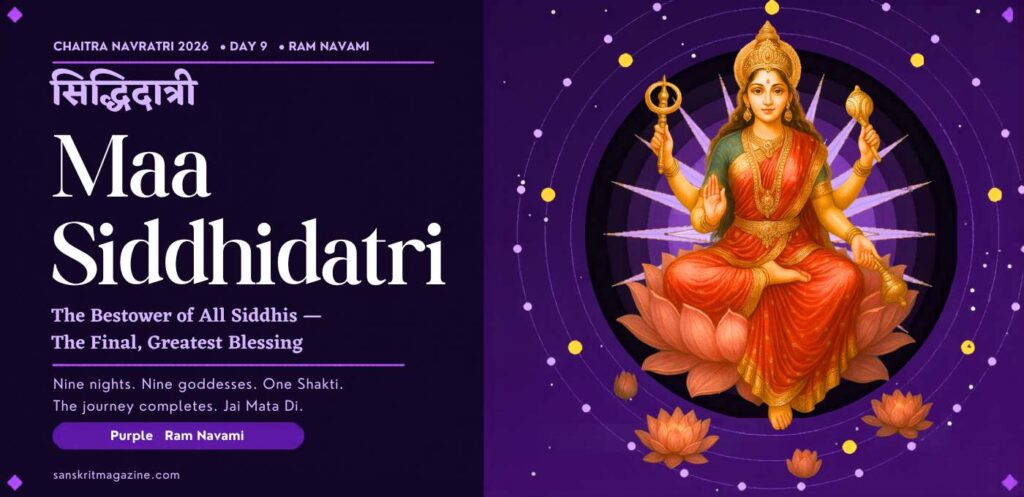
She sits on a lotus, as serene as still water after a great storm. In her four arms, she holds the cosmos lightly — a lotus, a mace, a chakra, a conch. And she gives. Without condition, without requirement, without holding anything back: she gives all eight siddhis, all supernatural perfections, all forms of divine power and realisation, to the sincere devotee who has walked these nine sacred nights and arrived, transformed, at her feet.
Who Is Maa Siddhidatri?
The name Siddhidatri is composed of Siddhi (सिद्धि) — perfection, supernatural power, spiritual accomplishment — and Datri (दात्री) — she who gives or bestows. She is, literally, the goddess who gives perfection.
In the cosmological understanding of the Navdurga, Siddhidatri is identified as Adi Parashakti — the primordial, original, absolute divine feminine power from which all other forms arise. She is not merely the ninth goddess in a sequence; she is the source from which all nine emerge, the ocean to which all nine rivers return. She is the complete form: having expressed herself as mountain, ascetic, warrior, creator, mother, righteous force, liberating darkness, and radiant purity, she now rests in her own completeness — and from that completeness, she gives everything.
The Eight Siddhis: What She Gives
The tradition enumerates eight specific siddhis — supernatural powers and perfections — that Maa Siddhidatri bestows upon her completely devoted worshippers. These are not merely magical powers in the fantasy sense; each siddhi represents a fundamental aspect of the relationship between individual consciousness and universal reality:
- Anima (अणिमा): The power to become infinitely small — to enter any space, to perceive at the most subtle level of reality. The spiritual meaning: the ability to reduce the ego to nothing, to become transparent to the divine.
- Mahima (महिमा): The power to become infinitely large — to expand without limit. Spiritually: the expansion of consciousness beyond the individual self to encompass all of existence.
- Garima (गरिमा): The power to become infinitely heavy — immovable, unshakeable. Spiritually: the immovability of the enlightened mind in the face of any circumstance.
- Laghima (लघिमा): The power to become infinitely light — to float, to be free of all heaviness. Spiritually: the lightness of being that comes from complete non-attachment.
- Prapti (प्राप्ति): The power to obtain anything, to go anywhere, to reach any state. Spiritually: the understanding that all of reality is already accessible to pure consciousness.
- Prakamya (प्राकाम्य): The power to realise any wish, to manifest any intention. Spiritually: the alignment of individual will with divine will, so that what you wish is what the universe wishes.
- Ishtva (ईशित्व): The power of supremacy — the ability to govern natural forces. Spiritually: mastery over the forces of one's own nature — the senses, the mind, the ego.
- Vashitva (वशित्व): The power to bring everything under one's influence. Spiritually: the natural authority that arises from a completely purified, aligned, divine-centred being — not force, but the irresistible gravity of truth.
The Sacred Iconography of Maa Siddhidatri
The Lotus Throne
Siddhidatri is seated on a full-bloom lotus — the most complete, most open form of the flower, every petal unfurled in the fullness of its flowering. The lotus throne is the seat of enlightenment, the position of one who has achieved the complete, unobstructed flowering of consciousness. Where Skandamata's lotus was the nurturing lotus of the mother, this is the lotus of the fully awakened being — the supreme state.
Four Arms: Lotus, Gada, Chakra, Shankha
Her four arms hold a lotus (divine beauty, spiritual perfection), a gada (mace — the power to overcome obstacles), a chakra (divine discus — the weapon of Vishnu, representing the cosmic wheel of dharma), and a shankha (conch — the primordial sound of creation, the first vibration, the Om made audible). Together, these four objects represent the entire range of divine reality: beauty, power, dharma, and the creative word.
Lion or Lotus — Her Complete Nature
In some traditions, Siddhidatri is seated on a lotus; in others, she rides a lion. Both are true, and the coexistence of both images is itself a teaching: she is simultaneously the serene, lotus-seated goddess of pure consciousness and the sovereign, lion-riding goddess of cosmic power. In her, these are not opposites. They never were.
- Form: Adi Parashakti in her complete, all-encompassing form; the source of all nine Navdurga
- Vehicle: Lotus / Lion
- Hands: Lotus, gada, chakra, shankha
- Colour worn today: Purple — wisdom, completion, divine consciousness
- Planet governed: Ketu — liberation, spiritual completion, the dissolving of karmic knots
- Bhog (offering): Halwa, chana, puri — the complete Navami bhog
- Day: Also Ram Navami — the birth of Lord Rama
Ram Navami: The Perfect Confluence
That Chaitra Navratri concludes on Ram Navami — the birthday of Lord Rama — is not a coincidence of the calendar. It is a revelation.
Rama is the ideal of human existence in the Hindu tradition — the Maryada Purushottama, the man who embodies dharma completely, who acts rightly even when it costs him everything, whose love for Sita, for his brothers, for his people, never wavers even under the most extreme circumstances. He is the fully realised human, the person in whom the divine and the human have found their most complete expression.
And he is born on the day we worship Siddhidatri — the goddess who gives all perfections. The conjunction is luminous: the goddess who bestows every siddhi celebrates her day alongside the birth of the man who perfectly embodies the highest siddhi of all, the one that all the others are meant to serve — the siddhi of dharma, the perfection of living rightly, completely, without compromise and without complaint, in the full recognition that every moment of human life is the divine taking itself out for a walk.
Rama was devoted to Shakti. The Ramayana describes him performing a Chandi Puja — a worship of the goddess — before crossing the sea to Lanka, seeking her blessings for the battle ahead. The goddess and the hero of dharma: inseparable, as they have always been. And on Ram Navami and Navratri together, we bow to both.
सिद्ध गन्धर्व यक्षाद्यैरसुरैरमरैरपि ।
सेव्यमाना सदा भूयात् सिद्धिदा सिद्धिदायिनी ॥
Siddha Gandharva Yakshadyair Asurairamarairapi
Sevyamaanaa Sadaa Bhooyaat Siddhida Siddhidayini
"Worshipped always by the Siddhas, Gandharvas, Yakshas, demons, and gods alike — may Siddhidatri, the giver of all perfections, be gracious unto us."
Navratri Parana: How to Break the Fast Correctly
Navratri Parana is the sacred act of ending the nine-day fast — and it is as important as the fast itself, done at the right time and with the right intention.
Navami Parana Timing for Chaitra Navratri 2026: The fast is broken after the completion of the Navami Puja on March 27, once the Ram Navami rituals are complete. The Navami tithi ends at 10:06 AM — Parana should ideally be performed before this time, or immediately after the puja if performed later in the morning.
- Step 1: Complete your Navami puja and Ram Navami prayers.
- Step 2: Offer the Navami bhog (halwa, puri, chana) to the Goddess.
- Step 3: Perform Kanya Puja if you did not do so on Ashtami.
- Step 4: Immerse the Navratri Kalash in a river, pond, or large vessel of water. Distribute the sprouted barley as prasad to all family members.
- Step 5: Break your fast with the prasad — begin with something light (fruit, milk, a small sweet) before eating a full meal.
- Step 6: Seek the blessings of elders in the family and offer gratitude to the Goddess for the completion of the vrat.
The Nine Days: A Complete Spiritual Arc
Looking back across the nine days, we can see that Navratri is not merely a sequence of nine separate goddesses but a single, coherent, carefully designed journey of the soul — from rootedness to liberation, from the individual to the universal:
Why Purple? The Significance of Today's Navratri Colour
Purple is the colour of Day 9 — and it is, perhaps, the most fitting final colour imaginable. Purple has always been the colour of royalty, of wisdom, of spiritual authority. In the chakra system, purple-violet is the colour of the Sahasrara — the crown chakra, the seat of pure consciousness, the point at which individual awareness dissolves into universal awareness and the self recognises itself as the divine. To wear purple on Siddhidatri's day is to declare, however quietly, however humbly: I am on my way home.
A Closing Benediction
You have walked nine sacred nights. You have bowed to nine forms of the one divine mother. You have been rooted, challenged, emboldened, illuminated, nurtured, enraged, liberated, purified, and finally, today, blessed with the fullness of completion.
Navratri does not end — it transforms. The nine teachings do not disappear on the morning of the tenth day. They settle into the cells, into the practice, into the daily lived texture of a life that has been, even incrementally, changed by nine days of sustained attention to the divine.
Maa Siddhidatri's greatest siddhi is not one of the eight listed above. It is something more fundamental and more extraordinary: the siddhi of seeing. The perfected vision that looks at a mountain and sees the Goddess. That looks at an ascetic's austerity and sees divine fire. That looks at a child in its mother's arms and sees the cosmos holding itself. That looks at the darkest night and sees the Shubhankari, the auspicious one, fighting the darkness on your behalf. That looks at every ordinary moment of an ordinary life and sees — clearly, certainly, with gratitude so deep it becomes indistinguishable from joy — the divine, present, always already here.
This is what nine nights of Navratri are meant to give you. Not the extraordinary. The ordinary — seen correctly.
🙏 Jai Maa Siddhidatri! Jai Shri Ram!
Wear purple today. Complete Kanya Puja and Navami Puja. Break your fast with gratitude and love. Chant ॐ देवी सिद्धिदात्र्यै नमः 108 times. And carry these nine teachings into every day that follows, until the next Navratri calls you home again.
Jai Mata Di. 🌟
Published by Sanskriti Magazine — India's largest digital platform for Hindu heritage, culture, and spirituality.
Read more at sanskritimagazine.com · Follow us on Instagram & Facebook: @indian_sanskriti
Thank you for walking the nine sacred nights with us. Jai Mata Di. 🙏 See you at Shardiya Navratri!