IndianSanskriti
monkey fever

Monkey fever grips Goa’s Sattari taluka, 35 people infected

The fever had claimed three lives in the coastal state’s remote Sattari taluka of North Goa district in 2016, and one in 2015.

At least 35 people in Goa have tested positive this year for the Kyasanur Forest Disease (KFD), or the ‘monkey fever’, a health official said.

The fever had claimed three lives in the coastal state’s remote Sattari taluka of North Goa district in 2016, and one in 2015.

All the 35 people, who have tested positive for the monkey fever this year, are also from the Sattari taluka and have been provided treatment for the viral infection, an official at the Valpoi community health centre (CHC) said.

“No death has been reported from KFD so far this year,” he said.

“Most of the positive cases have been found in the Sanvorderm panchayat area of Sattari. The health department has intensified its vaccination drive and distributed tick repellent oils in the villages there,” he said.

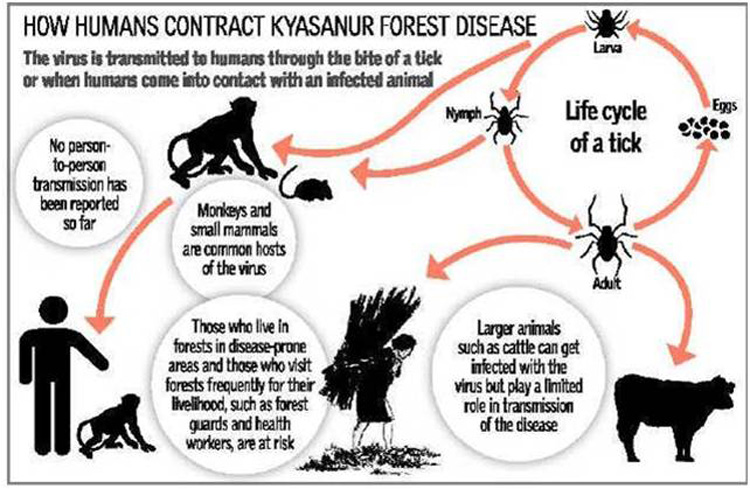
KFD, referred to as Makad Taap in local language, is a tick-borne viral hemorrhagic fever endemic to South Asia. The virus is transmitted to human beings through parasitic ticks which latch on to monkeys.

The disease was first detected in 1957 at the Kyasanur forest in Karnataka’s Shimoga district, and was later named after the place.

The KFD infection, which starts with high fever and bodyache, results in hemorrhage, similar to that in dengue.

People already suffering from kidney, heart and liver related issues are more vulnerable to KFD infection.

Between February and April 2015, several people were diagnosed with the disease at Palli village in Sattari taluka.

“In 2015, 30 villagers were found positive for KFD and one person was declared dead,” the official said.

Later, the Goa government permitted the Manipal Centre for Virus Research to set up its virology unit at the Valpoi CHC and conduct tests of suspected blood samples.

Between December 2015 and May 2016, tests were conducted on 807 samples of villagers from Sattari who suffered from fever and 277 tested positive for KFD. Three deaths were also reported in the area, the official said.

Last year, 88 patients tested positive for the infection but no death was reported.

“Both human beings and monkeys are victims of the disease, but once a monkey gets infected with the tick bite, it generally dies. The mortality rate in monkeys is very high as compared to human beings, the official said.

“The ticks drop as soon as the monkey dies, thus generating hot spots for spreading the infection,” he said, adding that about 50 metre radius around the site where a monkey carcass is found is vulnerable for the spread of infection.


You may also like

Search the website

Like us on Facebook

Get daily updates via Email

Enter your email address:

Recent Posts

Jamai Shashthi 2026 — The Story of Maa Shashthi, the Cat, and the Wife Who Was Forgiven

Jamai Shashthi 2026 — The Story of Maa Shashthi, the Cat, and the Wife Who Was Forgiven

On Saturday, June 20, 2026, Bengali households across Bharata will welcome their married daughters and sons-in-law home for the legendary jamai-aador feast and perform the Shashthi Vrata. But behind the warmth lies a story most Bengalis know by heart and most non-Bengalis have never heard — the wife who stole the hilsa, blamed the cat, lost six sons to Maa Shashthi’s wrath, and was finally forgiven. The Vrat Katha, the vidhi, the mantras, and the deeper teaching.

Vat Purnima 2026 — The Wife Who Argued Yama Into Returning Her Husband’s Life

On Monday, June 29, 2026, women across Maharashtra, Gujarat, and southern Bharata will tie red thread around banyan trees and hear the story of Savitri — the wife who walked behind Yamaraja Himself when He came for her husband, and out-argued the Lord of Dharma into returning Satyavan’s life. The Mahabharata’s Pativrata Mahatmya Parva, the vrat vidhi, and why the banyan witnessed everything.

Nija Jyeshtha 2026 — The Real Jyeshtha Begins, and the Calendar Resumes

Nija Jyeshtha 2026 — The Real Jyeshtha Begins, and the Calendar Resumes

With Adhik Maas now closed on the Somvati Amavasya of June 15, the long-postponed festivals of Jyeshtha return — Vat Purnima (June 29, the Savitri-Yamaraja katha), Jamai Shashthi (June 20, the Bengali festival of Maa Shashthi), Sankashti Chaturthi (June 28), Yogini Ekadashi (July 10), and Devshayani Ekadashi (July 16, opening the four-month Chaturmas of Bhagavan Vishnu’s yoga-nidra). A guide to what the next four weeks hold and what the household that kept Purushottam Maas now carries forward.

The Closing of Purushottam Maas 2026 — Adhik Amavasya and the Sealing of the Month-Long Vrat

On Monday, June 15, 2026 — a rare Somvati Amavasya — the intercalary month that bears Bhagavan Vishnu’s own name comes to its close. The Acharyas teach that a vrat is not measured by its duration but by its closing. Here are the Padma Purana’s instructions for sealing the month-long Purushottam Maas vrat: the morning snan, the closing puja with the Vishnu Sahasranama, the day of dana, the Somvati Amavasya gift, and the final sarva-arpana — the offering of all merit at the feet of the Lord.

Parama Ekadashi 2026 — The Other Rare Ekadashi of Purushottam Maas, and the Poor Brahmin Who Kept It

Two weeks ago, Vaishnavas across Bharata kept Padmini Ekadashi — the rare Shukla Paksha Ekadashi of Adhik Maas. Padmini has a twin. On Thursday, June 11, 2026, the Krishna Paksha Ekadashi of the same intercalary month appears: Parama — the Supreme Ekadashi. The Padma Purana names it the rarer and more secret of the two, and reserves it for those whose poverty or sorrow has refused to lift in spite of every other vrat already kept. The story of Sumedha and Pavitra of Kampilya, the rishi Kaundinya, the prince sent by Bhagavan Brahma — and the vidhi for the day.

css.php