IndianSanskriti

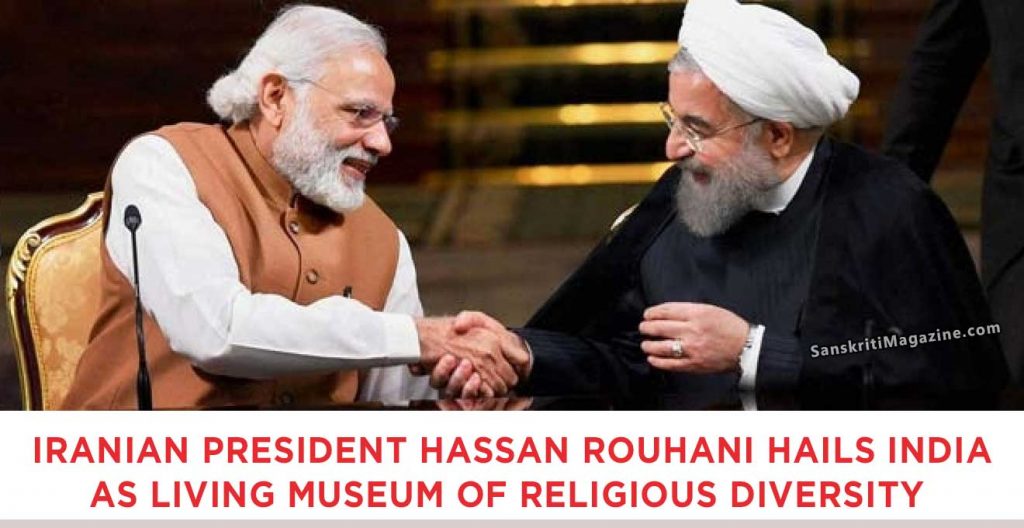
Iranian president Hassan Rouhani hails India as living museum of religious diversity

NEW DELHI: The visiting Iranian President Hassan Rouhani has applauded India’s religious diversity and called for unity between the Shia and Sunni communities in a statement that is being seen as important for the Islamic world in the backdrop of lukewarm ties between Iran and Saudi Arabia often ascribed to sectarian differences.

“India is a living museum of different ethnicities and religions peacefully co-existing. This process is going on for centuries. Shia, Sunnis, Sufis, Hindus, Sikhs and others are living together. They together built their country and built their civilisation,” Rouhani said in Hyderabad on Thursday night, in a speech delivered in Persian.

Addressing Muslim leaders and scholars belonging to different Islamic schools of thought, Rouhani called for unity among the Shias and Sunnis while blaming the West for sowing the seeds of discord among various sects of Muslims.

That the Iranian president chose India to call for unity among the Shia and Sunni communities is significant given India’s growing multi-faceted partnership with both Iran and Saudi Arabia, experts said. India has been able to maintain a balanced foreign policy outreach to engage with both the countries at the same time, they said.

Pointing out that there can be no military solution to conflicts, Rouhani said that Iran seeks brotherly relations with all Muslims nations and the countries of the region including India.

Rouhani on Friday visited the historic Makkah Masjid in Hyderabad and offered prayers for Shia-Sunni unity and peace across the Muslim world. The visit to the Sunni mosque is significant as it is aimed at conveying the message of Shia-Sunni unity. Iran is a Shia majority country.

You may also like

Search the website

Like us on Facebook

Get daily updates via Email

Enter your email address:

Recent Posts

Yogini Ekadashi 2026 — The Yaksha Who Missed the Morning Flowers, and the Ekadashi That Undid His Curse

On Friday, July 10, 2026, the rare Krishna Paksha Ekadashi of Nija Ashadha arrives. The Padma Purana tells the story of Hemamali — the Yaksha gardener of Bhagavan Kubera in Alaka, whose single morning of distraction with his wife Vishalakshi cost him his form, his wife, and his celestial city. Cursed to wander the earth of Bharata as a leper for a long time, he was at last shown the way back by Sage Markandeya — a single sincere keeping of Yogini Ekadashi.

Jamai Shashthi 2026 — The Story of Maa Shashthi, the Cat, and the Wife Who Was Forgiven

Jamai Shashthi 2026 — The Story of Maa Shashthi, the Cat, and the Wife Who Was Forgiven

On Saturday, June 20, 2026, Bengali households across Bharata will welcome their married daughters and sons-in-law home for the legendary jamai-aador feast and perform the Shashthi Vrata. But behind the warmth lies a story most Bengalis know by heart and most non-Bengalis have never heard — the wife who stole the hilsa, blamed the cat, lost six sons to Maa Shashthi’s wrath, and was finally forgiven. The Vrat Katha, the vidhi, the mantras, and the deeper teaching.

Vat Purnima 2026 — The Wife Who Argued Yama Into Returning Her Husband’s Life

On Monday, June 29, 2026, women across Maharashtra, Gujarat, and southern Bharata will tie red thread around banyan trees and hear the story of Savitri — the wife who walked behind Yamaraja Himself when He came for her husband, and out-argued the Lord of Dharma into returning Satyavan’s life. The Mahabharata’s Pativrata Mahatmya Parva, the vrat vidhi, and why the banyan witnessed everything.

css.php