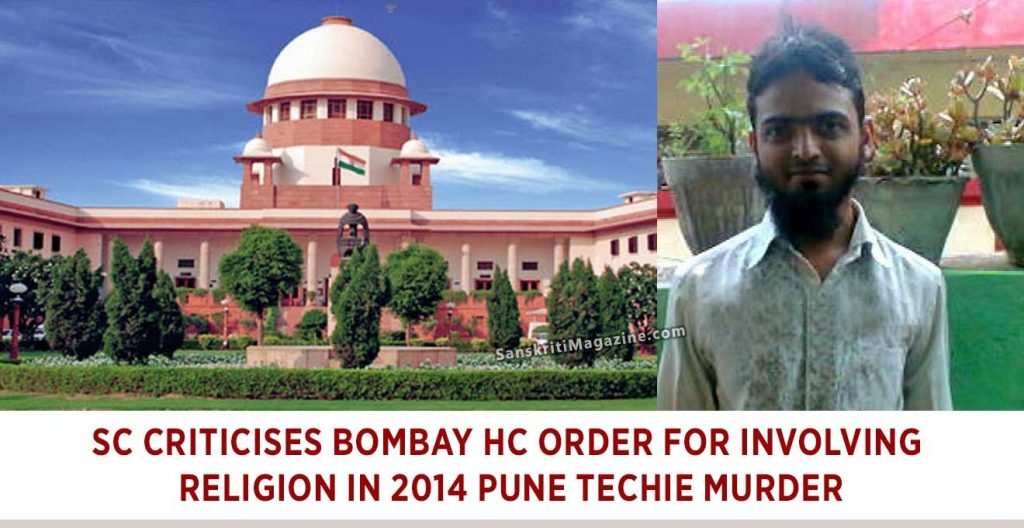
The Bombay high court granted bail to three accused, who are among the 21 activists of the Hindu Rashtra Sena booked in connection with the murder of a software engineer in Hadapsar on June 2, 2014.
The Supreme Court of India has criticised a Bombay High Court order that seemed to suggest, while granting bail to three accused in a murder case, that they had been provoked “in the name of religion”.
On 8 February, the Supreme Court set aside the Bombay High Court order that released on bail the three accused in the murder of Pune-based techie Mohsin Shaikh in 2014.
The three accused are part of right-wing organisation Hindu Rashtra Sena and had reportedly attended an inflammatory meeting just before they accosted and killed Shaikh. The meeting happened in the background of communal clashes in Pune.
While the Supreme Court’s decision to quash the Bombay High Court order was reported on 8 February itself, it is only now that the apex court’s order has been uploaded on its site – and it shows the top court’s displeasure.
Taking exception to the high court order, the Supreme Court bench of Justice SA Bobde and Justice L Nageswar Rao said that the high court judge should have refrained from recording reasons that appears to justify the murder of the victim in the name of religion.
The Supreme Court bench said, “We have no doubt that a Court fully conscious of the plural composition of the Country while called upon to deal with rights of various communities, cannot make such observations which may appear to be coloured with a bias for or against a community.”
The Supreme Court records in its order that it is at pains to understand “why it (high court) said that “the fault of the deceased were only that he belonged to another religion” and further why the judge said, “I consider this factor in favour of the applicants/accused.”
“We find that the aforesaid reason can, on a fair reading, be understood or misunderstood almost as a mitigating circumstance or a kind of a justification for the murder and it is obvious fact that the deceased belonged to a certain community cannot be a justification for any assault much less a murder,” the bench said, ordering the immediate arrest of the accused last week.
The three accused — Vijay Gambhire, Ganesh Yadav and Ajay Lalge — are among the 21 activists of the Hindu Rashtra Sena, including their leader Dhanajay Jayram Desai, who were booked in connection with the murder of the software engineer in Hadapsar on June 2, 2014.
Shaikh was attacked by a mob during violence that erupted over a social media post. Around half-an-hour before the attack, Desai was allegedly addressing a meeting that instigated the audience to violence.
In its controversial order last year, the Bombay High court said: “The fault of the deceased was that he belonged to another religion. I consider this factor in favour of the accused. Moreover, the accused do not have criminal record and it appears that in the name of the religion, they were provoked and have committed the murder.”
Not satisfied with the Bombay High Court’s bail order, the brother of the deceased, Mubain Sheikh approached the Supreme Court for cancellation of the bail.
The top court has not just cancelled the bail of the accused but remanded the case back to Bombay High Court for fresh consideration.